

You may be able to cancel your Momentum Solar contract without paying a penalty, but only if you’re still inside your cancellation window. A Momentum installation contract filed with New York regulators gives customers three business days to cancel. Your own rights depend on your agreement, your state, and how the sale happened.
Start by checking your signing date, your contract type, how far along the project is, and whether you also signed separate financing paperwork.
If your window has already closed, the question changes. Now you need to work out exactly what you signed, how far Momentum has gotten with the project, and whether your real problem is with Momentum Solar, a lender, or Momentum Solar Energy Services.
Which Momentum Agreement Did You Actually Sign
Momentum offers a few different ways to go solar. You can pay cash, take out a solar loan, sign a lease, or sign a power purchase agreement (PPA). These come with very different obligations.
Momentum’s own materials say loan payments go to a separate financing partner. Lease and PPA customers, meanwhile, generally don’t own the system at all.
That means your Momentum paperwork could actually involve more than one company.
| Agreement | Who’s responsible | What it usually covers | What to check |
| Momentum installation or purchase agreement | Momentum Solar LLC | Sale, design, installation, and project obligations | Cancellation clause and work already done |
| Solar loan | Third-party lender or finance company | Loan balance, payment terms, lender remedies | Your separate financing agreement |
| Momentum lease | Momentum Solar Energy Services | System ownership, lease payments, exit terms | Purchase, transfer, and termination rules |
| PPA | Whoever is named in the agreement | Electricity pricing and long-term obligations | Cancellation, transfer, and purchase terms in your PPA |
A Momentum installation agreement filed with the New York Department of Public Service clearly separates Momentum’s installation role from the financing supplied by a third-party company. The form states plainly that Momentum is not the lender or broker, and points customers to their separate financing agreement for repayment questions.
This matters a lot. Cancelling your installation agreement doesn’t automatically cancel a separate solar loan.
If you’re still trying to figure out exactly what you signed, SCC’s solar contract cancellation guide walks through the difference between installation, loan, lease, and PPA agreements.
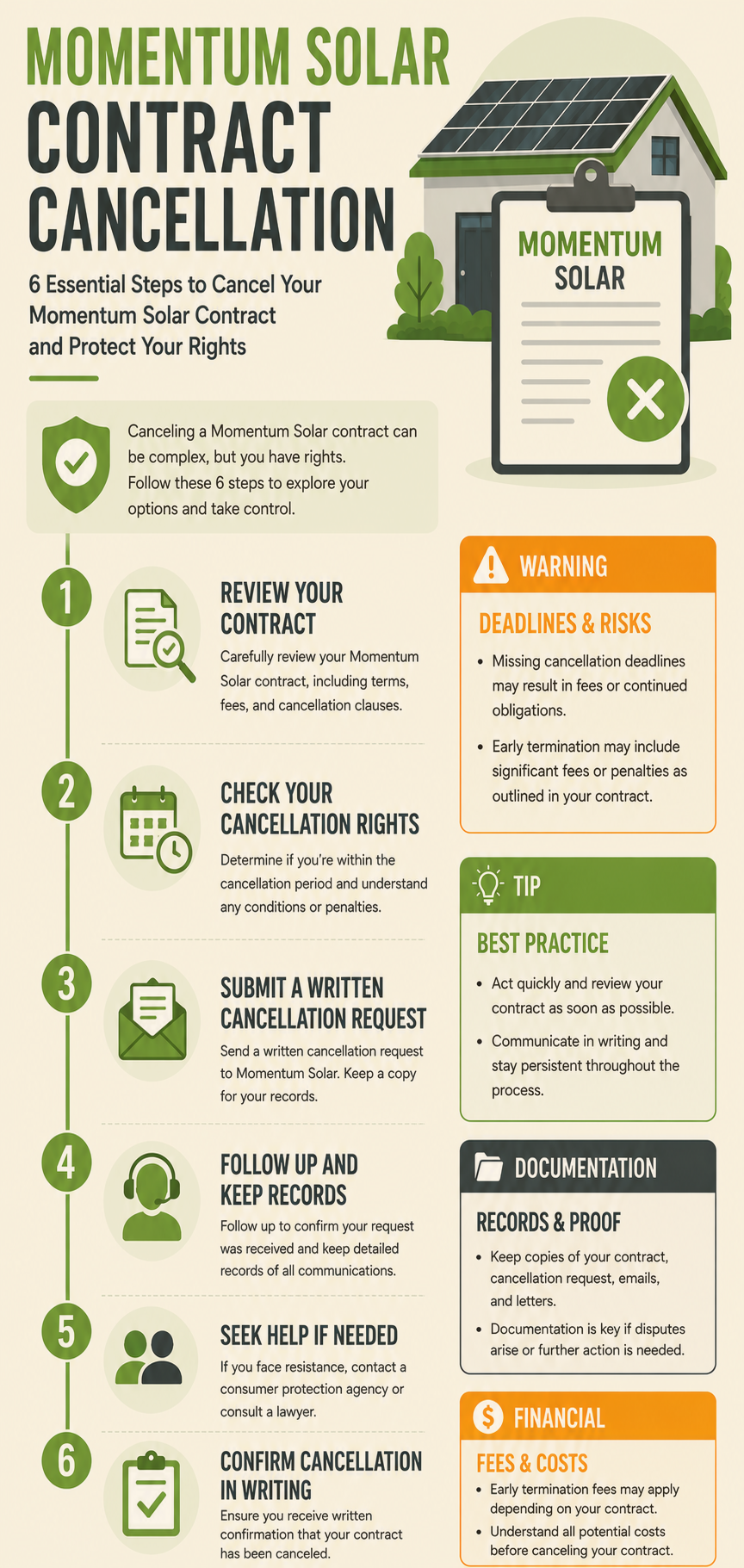
Are You Still Inside a No-Penalty Window
If you signed recently, check your paperwork right away.
A Momentum Solar installation contract filed with New York regulators says customers can cancel without penalty within three business days. The attached Notice of Cancellation uses the same deadline.
A separate 2026 Momentum Solar Energy Services lease disclosure, also filed with New York regulators, gives customers until midnight of the third business day after signing to cancel penalty-free.
These documents only tell you how those specific Momentum agreements work. They don’t prove every Momentum contract nationwide follows the same rules.
Your own signed agreement, and the law in your state, decide your actual deadline.
Your State May Give You More Protection
Momentum currently sells residential solar in Connecticut, Florida, Massachusetts, Nevada, New Jersey, New York, and Texas.
| State | Cancellation rule | Watch out for |
| Connecticut | Covered home-improvement customers usually have until midnight of the third business day. Saturday counts as a business day. | Coverage depends on the transaction and contract. |
| Florida | Qualifying home-solicitation sales usually carry a three-business-day written cancellation right. | Some statutory exceptions apply. |
| Massachusetts | Covered home-improvement contracts signed at home, or away from the contractor’s usual place of business, include a three-business-day right. | The state’s home-improvement rules must apply to your sale. |
| Nevada | Solar buyers, lessees, and PPA customers under 60 usually get three business days. Age 60 or older gets ten business days. | Nevada has extra solar-specific rules that depend on the facts. |
| New Jersey | Covered home-improvement customers usually have until midnight of the third business day after getting their contract copy. | Still depends on the agreement and transaction. |
| New York | Covered home-improvement contracts must disclose a three-business-day right. | Extra distributed-energy rules, and your own contract, may also apply. |
| Texas | Qualifying door-to-door sales usually carry a three-business-day right. | Chapter 601 has some exclusions. |
If you’re close to your deadline, go by the rule and instructions written into your own contract and state law.
How Do You Actually Send a Cancellation
Don’t rely on a phone call alone if your paperwork requires written notice. Momentum’s filed Notice of Cancellation says customers covered by that form can cancel by mailing or delivering a signed notice, sending another written notice, or emailing.
The filed form lists this address: CancelRequest@MomentumSolar.com
It also gives Momentum’s South Plainfield, New Jersey address.
Before you use either one, compare it against the Notice of Cancellation attached to your own agreement.
If it matches and your deadline hasn’t passed yet, here’s what to do.
- Confirm your transaction date and exact deadline on your notice.
- State clearly that you’re cancelling the agreement.
- Include your name, service address, and contract or account number.
- Use a delivery method your contract allows.
- Keep proof of when you sent the notice.
- Ask Momentum for written confirmation that the agreement is cancelled.
- If you signed separate financing paperwork, contact the lender too and confirm the loan status.
That last step really matters. Cancelling with Momentum doesn’t by itself prove your third-party finance account is cancelled.
What If Momentum Already Started Design, Permitting, or Installation
Once your no-penalty period has passed, the project’s stage becomes the key issue. The filed Momentum purchase agreement says a customer who cancels late, or who otherwise stops the project from finishing, may have to pay Momentum back for materials, labor, and services already used.
The filed agreement lists a few specific costs.
| Work listed in the filed contract | Amount stated in that form |
| Documentation | $250 |
| Engineering site visit | $325 |
| Design | $125 |
| Permitting | $250 |
| Permission to interconnect | $100 |
| Scheduling | $50 |
The contract also mentions installation materials, labor, and certain other out-of-pocket filing costs. These numbers are not a universal Momentum cancellation fee. They come from one filed agreement, and shouldn’t be assumed to apply to your contract too.
The real question to ask is simple.
What work has Momentum actually finished or paid for under my agreement?
Check whether the project has gone through site assessment, engineering, design, permit filing, interconnection paperwork, equipment ordering, installation, inspection, or utility activation.
If Momentum says you owe money after you cancel, ask exactly which contract clause applies, and ask for an itemized breakdown of the charge.
Does Cancelling Momentum Also Cancel Your Solar Loan
Not necessarily, and this is one of the biggest points of confusion for loan-financed projects. Momentum’s filed installation agreement says third-party financing is controlled entirely by the separate finance company and its own agreement.
The Consumer Financial Protection Bureau has also warned that solar deals can get confusing, since the installer and the lender often have completely separate legal and financial roles.
For a financed Momentum project, keep the parties separate in your head.
- Momentum Solar handles installation, design, and project work.
- Your lender handles the loan balance, repayment terms, and financing remedies.
- Your loan servicer is the company that manages your account and payments.
If you’re trying to cancel before installation finishes, ask your lender whether the account is active, whether funds have been sent out, and what happens under the loan agreement if the related installation gets cancelled.
Don’t assume that cancelling with Momentum automatically closes your loan account.
What If You Have a Momentum Solar Lease
A lease needs a different approach than a purchase agreement. A 2026 Momentum Solar Energy Services disclosure filed with New York regulators names Momentum Solar Energy Services, or MSES, as the system owner. Momentum Solar is named as the installer, handling installation, maintenance, and repairs.
That distinction matters.
- MSES owns the leased system and sets the lease terms.
- Momentum Solar does the installation and specified repair work.
The filed disclosure describes a 25-year initial lease term. It says the homeowner can buy the system after 66 months from the in-service date, at its fair market value at that time.
If you’ve had your lease installed, don’t assume you can buy out the system right away. That option only opens up later.
Ending Early Is Different From Using the Purchase Option
The same filed disclosure says ending the lease before the initial term is up counts as a default under the agreement.
It describes possible financial consequences, including future lease payments and/or the higher of the system’s purchase price or fair market value, repayment of any incentives claimed, and costs tied to removing or securing the system.
These consequences look very different from simply using the normal purchase option after month 66.
They also come from one specific New York lease disclosure. Check your own lease before assuming what an early exit would cost you. For a broader look at lease purchase, transfer, and exit options, see SCC’s solar lease exit guide.
What If Your System Is Already Up and Running
Once your system is installed and generating power, the original cancellation question usually isn’t the main issue anymore. What matters next depends on what’s actually gone wrong.
A filed Momentum purchase contract says Momentum doesn’t guarantee a minimum level of production or savings under that particular agreement.
The filed MSES lease disclosure works differently. It describes a guarantee of 95% of estimated output, measured over two-year stretches, subject to the lease’s conditions.
That means two Momentum customers with low production complaints might have completely different rights, simply because one bought the system and the other leased it.
If your system is running but something feels off, figure out whether the real problem is production, installation quality, equipment warranties, loan payments, sales promises, or a lease you want out of. Then compare that against the specific promise written into your own agreement.
What Happens If You Sell or Refinance Your Home
Selling a home with Momentum Solar attached isn’t a one-size-fits-all process. Momentum directs customers dealing with a sale, purchase, bankruptcy, death of a contract signer, or other ownership change to its Change of Ownership team. There’s a separate contact for refinancing.
What happens next depends on your contract type.
If You Purchased or Financed With a Loan
Momentum’s filed purchase contract says you may still owe money if you sell your home before the system is fully paid off.
If a third-party loan is involved, check the lender’s payoff and transfer terms separately, since they won’t be the same as Momentum’s.
If You Have a Momentum Lease
The 2026 MSES disclosure says a homeowner can assign the lease to a buyer with MSES’s consent, as long as the buyer meets creditworthiness and other requirements.
That’s more specific than assuming any buyer can simply take over your agreement.
UCC Filings
The same lease disclosure says MSES won’t file a lien against your property, though it may file a UCC-1 filing to protect its interest in the solar equipment itself.
The CFPB notes something similar, that solar financing companies sometimes use UCC filings against the equipment. A UCC filing isn’t automatically the same as a lien on your home, but it can still complicate a sale or refinance.
If you’re selling or refinancing, ask exactly which filing exists on your property and what release, transfer, or subordination steps your agreement requires.
What If Momentum Won’t Resolve the Problem
Start by figuring out which company actually controls the issue you’re having.
| Your problem | Where to start |
| Momentum installation or project cancellation | Momentum Solar |
| Third-party loan or servicing issue | Your lender or loan servicer |
| Momentum lease terms | Momentum Solar Energy Services |
| Contractor or workmanship issue | Momentum, and your state’s contractor regulator |
| Consumer-finance problem | Your lender or servicer, and the CFPB if needed |
| Deceptive sales concern | Your state Attorney General or consumer agency, or the FTC |
| New York distributed-energy dispute | Momentum first, then the New York DPS if unresolved |
| Formal contract dispute | Read the dispute-resolution section first |
The CFPB accepts complaints about covered financial products and can forward eligible complaints to the company for a response. Filing a complaint doesn’t automatically cancel or pause a solar loan.
The FTC accepts reports about fraud, scams, and unfair business practices too. Filing a report doesn’t cancel a Momentum agreement on its own.
New York customers with unresolved distributed-energy complaints can escalate to the New York Department of Public Service after going through Momentum first.
What to Have Ready Before Getting Help
The fastest way to make sense of a Momentum cancellation problem is to organize your documents by company and project stage.
Gather your signed Momentum agreement, Notice of Cancellation, financing documents, lease or PPA if you have one, your original proposal, sales communications, permit and interconnection records, installation status, lender statements, any cancellation attempts you’ve made, and any written denial you received.
Four facts matter more than anything else here.
What you signed. When you signed it. Which company holds each obligation. How far the project has actually progressed.
Those four answers usually reveal whether you’re dealing with a straightforward cancellation, a late-cancellation fee, a separate financing issue, a lease exit, a transfer problem, or a bigger contract dispute.
Need Help With a Momentum Solar Contract
Solar Cancellation Companies helps U.S. homeowners work through solar contract, financing, installer, cancellation, collection, and state-law problems.
If your cancellation window has already passed, the installer and lender are telling you different things, or you can’t tell which agreement controls your issue, SCC can help you map out the contract structure and figure out the next step.
Start by pulling together your signed Momentum agreement, financing documents, and current project status. That’s the groundwork for figuring out what to review next.
Frequently Asked Questions
Can I cancel a Momentum Solar contract after three business days?
Possibly, but the automatic no-penalty right likely no longer applies. A filed Momentum contract allows three business days to cancel. After that, your options depend on your signed agreement, how far the project has gone, your state’s laws, and whether Momentum has already spent money on design, permitting, materials, or installation.
What is the Momentum Solar cancellation email?
A Momentum Notice of Cancellation filed with New York regulators lists CancelRequest@MomentumSolar.com. Before using it, compare that address and the cancellation instructions against the notice attached to your own contract, since versions and state requirements can differ.
Does Momentum Solar charge a cancellation fee?
There’s no single, universal Momentum cancellation fee. One filed agreement lists specific costs for documentation, engineering, design, permitting, interconnection, scheduling, materials, and labor if you cancel after the no-penalty period. What applies to you depends on your actual contract and the work already done.
Can I cancel a Momentum Solar loan by cancelling the installation?
Not automatically. Momentum may handle your installation while a completely separate lender controls your loan. If you signed financing paperwork, contact the lender directly and ask what happens to your account if the installation agreement is cancelled.
This article is based on publicly available Momentum Solar documents and general consumer-protection rules. It isn’t legal, financial, or tax advice. Your signed agreement and the law in your state control your actual rights.