

Texas Solar Contract Cancellation starts with one simple step: find the date you signed your agreement. That date determines which cancellation rules may apply to you.
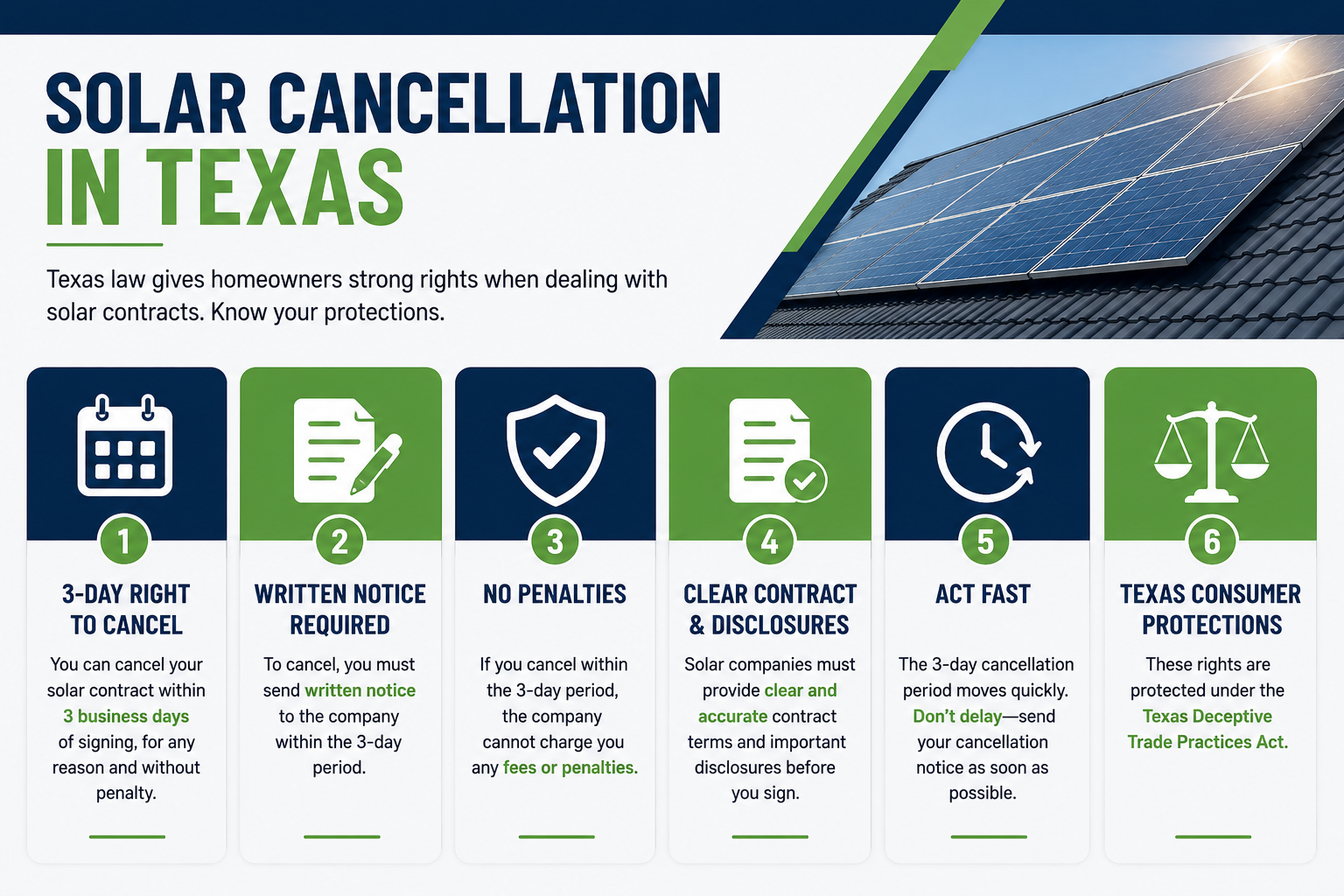
For residential solar agreements signed on or after September 1, 2025, Texas law generally gives you five business days to cancel in writing, with no penalty and no further obligation. Contracts signed before that date follow different rules. So before you do anything else, check your contract date, the cancellation instructions, your installer, and your financing agreement.
If the five day window has already closed, things get more complicated. You might still have a real problem with the contract, the salesperson, the installer, the lender, or how the system performs. But that’s a different situation from having an automatic right to walk away. If you need a broader overview of the process, SCC’s guide to canceling a solar contract explains the main contract and financing issues homeowners should review.
Can You Cancel a Solar Contract in Texas
Yes. Many Texas homeowners can cancel a solar contract without penalty, but only within a set window of time.
Under Texas Occupations Code Section 1806.156, a buyer or lessee can cancel by sending written notice on or before the fifth business day after signing. Weekends and legal holidays don’t count toward those five days.
Your contract should clearly state two things:
- the last date you’re allowed to cancel
- a mailing or email address for sending that notice
If your contract is missing that cancellation address, you can still send written notice through another reasonable method, as long as it’s within the five business day window.
What to Do If You’re Still Within Five Business Days
- Confirm the exact date you signed.
- Find the cancellation deadline in your contract.
- Locate the email or mailing address for cancellation notices.
- Send your written notice before the deadline.
- Keep a copy, along with proof of when you sent it.
- Check whether you also signed a separate solar loan.
Certified mail is a good way to prove delivery, but it isn’t the only option under Texas’s newer solar law. If your contract lists an email address for cancellations, you can use that instead.
Does the Five Day Rule Apply to Your Contract
This comes down to timing.
Texas’s Residential Solar Retailer Regulatory Act took effect on September 1, 2025. The Texas Department of Licensing and Regulation, or TDLR, now oversees covered residential solar sales and leases signed under this newer law, though some systems and properties are excluded.
| Your situation | What it means |
| Contract signed before September 1, 2025 | Don’t assume the five day rule applies to you |
| Contract signed on or after September 1, 2025 | Check your statutory right to cancel within five business days |
| Newer contract that includes installation | Review the installer, permit, and financing terms required by law |
| Sale made by a retailer after September 1, 2026 | TDLR registration rules may also apply |
There isn’t one single cancellation rule for every solar contract ever signed in Texas. The date you signed really does change your options.
If You Signed Before September 1, 2025
An older contract does not necessarily leave you without cancellation protections.
Certain qualifying sales made at a homeowner’s residence or somewhere away from the seller’s regular place of business may fall under separate state or federal cooling-off rules.
These rules have conditions and exclusions. Do not assume every door-to-door solar sale qualifies.
If the salesperson came to your home and that is where the transaction happened, SCC’s door-to-door solar sales complaints and cancellation guide explains the issues worth checking before assuming your cancellation period has expired.
What Should a Solid Texas Solar Contract Include
For newer covered contracts, the agreement itself should show whether the seller followed the rules.
Texas Occupations Code Section 1806.155 requires that any agreement involving installation at your home name a licensed electrical contractor, either directly or through an approved list. The contract also needs to spell out who is responsible for getting:
- required government permits
- utility interconnection approval
- approval from a co-op or municipal utility, if that applies
These details matter because the company that sold you the system and the company that installs it aren’t always the same business. Before signing anything, it helps to know who’s who.
Solar retailer sold or leased you the system. Salesperson made the pitch that convinced you to sign. Electrical contractor handled the actual installation. Lender provided the financing.
If a required piece is missing from your contract, that’s worth raising with a regulator or reviewing further. It doesn’t automatically mean the whole agreement is void, though.
What Happens to Your Loan If You Cancel
A common headache in Texas is signing an installation contract and a loan agreement in the same sitting. Don’t assume they’re one and the same document.
When a third party lender is affiliated with or referred by your solar retailer, Texas law requires the solar contract to include a clause forcing that lender to cancel the loan too, once you properly cancel within your five day window.
That protection is fairly narrow, though. It does not mean:
- every solar loan cancels automatically after a dispute with the installer
- an independent loan disappears just because your installation was delayed
- you should stop making payments simply because you’re unhappy with the installer
The better approach is to lay your solar agreement and your loan agreement side by side and compare:
- the lender’s name
- the amount financed versus the cash price of the system
- the cancellation language in each document
- your payment schedule and any required prepayment
- whether either document links cancellation of one to cancellation of the other
The Consumer Financial Protection Bureau has flagged concerns across the solar financing industry, including dealer fees, loan markups, and assumptions baked in about tax credits. These are broad industry findings, not proof that your particular lender did anything wrong. Still, they’re worth keeping in mind while you review your paperwork.
If an installer problem is making you think about withholding payments, first review SCC’s guide on what happens if you stop paying a solar loan or lease. A dispute with the installer does not automatically suspend a separate lender’s payment requirements.
What If the Five Day Window Has Already Passed
This is the situation most Texas homeowners actually find themselves in, since many people don’t spot a problem until installation starts, payments begin, or the first utility bill arrives.
Once your five business days are up, wanting to cancel isn’t enough on its own. You’ll need to figure out what the real problem is first.
The System Was Never Installed, or the Project Stalled
Look at what your contract says about installation, permits, utility approval, and what happens if the seller defaults. For newer contracts, check who the named electrical contractor is, since Texas law requires that information to be spelled out.
The System Doesn’t Match What You Were Promised
Pull together your signed proposal, equipment list, any written production guarantee, installation records, interconnection paperwork, and actual production data. Compare what you were told against what you actually got. Keep in mind that poor performance alone doesn’t automatically prove you have a right to cancel. What matters is what the contract actually promised, and why the system is underperforming.
The Salesperson Said Things That Weren’t True
Hang on to every text, email, proposal, and screenshot that shows what you were told about savings, equipment, or terms.
In 2026, the Texas Attorney General’s office investigated several solar sellers over complaints about misleading claims on savings, equipment, and terms. That investigation led to a lawsuit against CAM Solar, a San Antonio based company, over alleged deceptive sales practices. That case shows the kind of conduct regulators are watching for. It doesn’t mean the same thing happened in your situation, but it’s a useful reference point if something similar happened to you.
Your Issue Involves a Possible Violation of State Law
Under Texas Occupations Code Section 1806.207, TDLR can order a contract cancelled and a refund issued, but only after giving notice, holding a hearing, and finding an actual violation occurred. Filing a complaint doesn’t cancel your contract by itself. The agency has to go through its process first.
What If Your Installer Went Out of Business
If a company has closed down, figure out first whether you’re dealing with the retailer, the installer, the warranty provider, or the lender. These are often separate businesses, even if it felt like one transaction at the time.
For newer regulated transactions, Texas rules also address certain recordkeeping and continuing contractual responsibilities when a regulated solar retailer stops operating. That does not guarantee that a warranty will be fulfilled. It also does not automatically cancel an outstanding loan.
If your installer has closed while you still have an active loan, unfinished project, or warranty issue, SCC’s solar company bankruptcy and closure guide explains what homeowners should check next.
Where to File a Solar Complaint in Texas
The right place to file depends entirely on what went wrong.
| Your problem | Where to go |
| Covered contract signed on or after September 1, 2025 | Texas Department of Licensing and Regulation |
| Older contract, retailer conduct | Texas Attorney General, Consumer Protection Division |
| Electrical installation issue | TDLR |
| Deceptive sales practices | Texas Attorney General |
| Door to door cooling off issue | FTC and Texas law |
| Financing problem | CFPB, or your lender’s regulator |
| Federal tax credit question | IRS |
Filing a complaint helps document your case and can prompt an investigation. But it won’t, by itself, stop a loan, remove your panels, or end your contract. Those usually require a separate step.
What to Gather Before You Try to Get Out of a Solar Contract
Before you decide whether you’re dealing with a simple cancellation, a financing dispute, an installation problem, or a sales practices issue, pull together your paperwork. Start with:
- your signed solar agreement and any addenda
- the exact date you signed
- your cancellation deadline and notice instructions
- names of the retailer and salesperson
- the electrical contractor’s name and license number
- any separate loan or lease agreement
- the original proposal showing price and expected production
- any written savings or tax credit claims
- permit and utility interconnection paperwork
- warranty and service records
- production records, if performance is in dispute
- any notice that your installer stopped operating
For newer agreements, also check whether your retailer and salesperson were required to register with TDLR. That registration requirement took effect on September 1, 2026.
Getting these documents together helps answer the question that matters most. Is this a straightforward cancellation, or has it turned into something bigger involving your contract, your financing, your installer, or a regulator?
Solar Cancellation Companies helps homeowners review solar cancellation, financing, installer, company-closure, and related contract problems. Once the agreements and companies involved are clear, the next step can be based on the actual issue rather than an assumption that one Texas rule applies to every solar contract.
Frequently Asked Questions
Can I cancel a Texas solar contract by email?
Yes, if your contract provides an email address for cancellation and you send the notice within the applicable deadline. Keep a copy of the email, timestamp, and any delivery confirmation so you can prove when the cancellation was sent.
What happens if my Texas solar contract does not list a cancellation address?
For newer covered contracts, the agreement should provide a mailing or email address for cancellation notices. If it does not, Texas law may still allow you to send written cancellation through another reasonable method within the five-business-day window. Keep clear proof of what you sent and when.
Do weekends count toward the five-day solar cancellation period in Texas?
No. The Texas five-business-day cancellation period does not count weekends or legal holidays. Start counting from the date you signed the covered agreement and check the cancellation deadline printed in your contract.
Can I cancel a Texas solar contract because installation has not started yet?
Not automatically if your cancellation window has already expired. If installation has not started, review the contract for project deadlines, permits, contractor obligations, financing, and default terms. A stalled project may support a dispute, but the available remedy depends on your specific agreement and circumstances.