

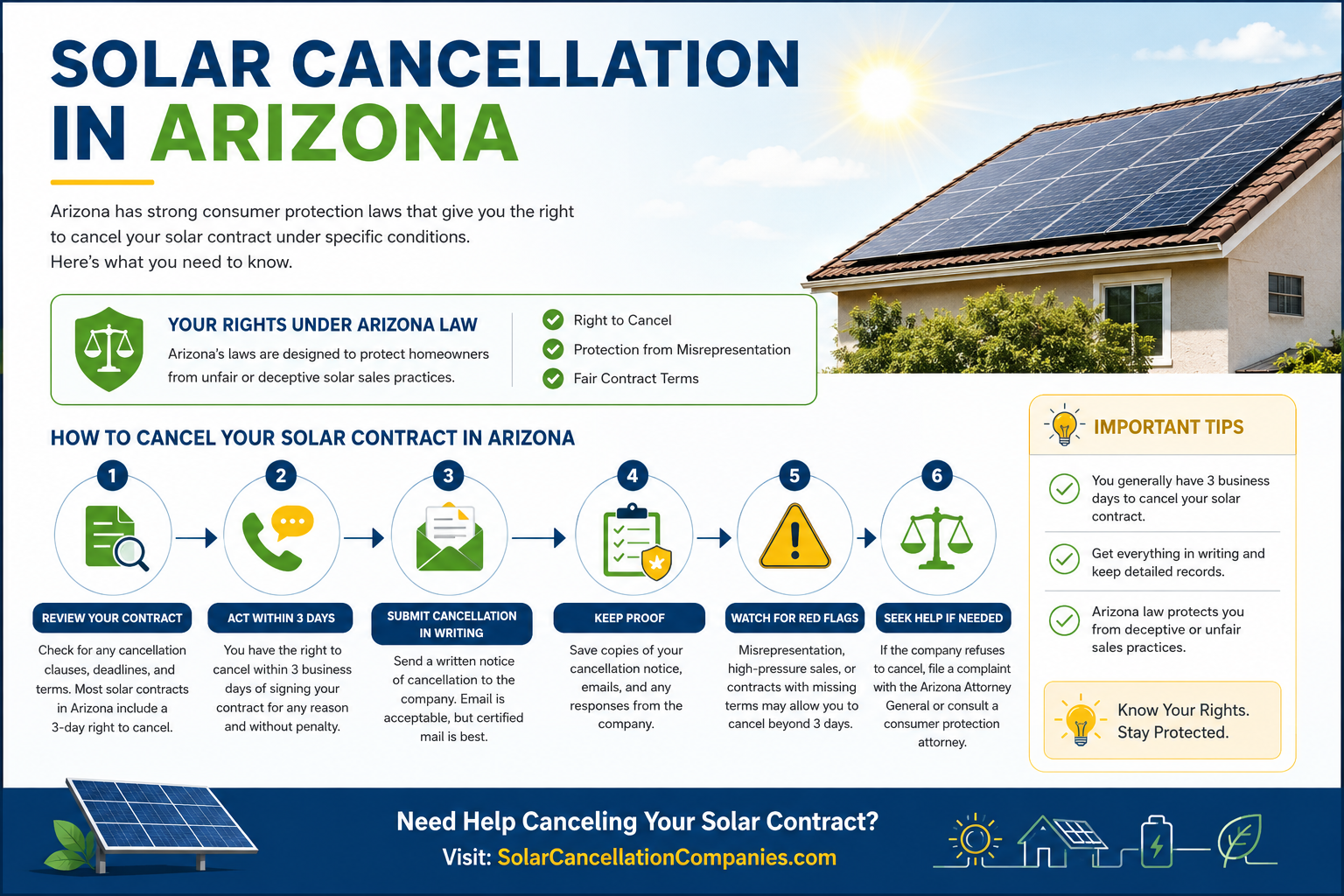
You can rescind a covered Arizona solar sale, lease, or financing agreement for at least three business days after signing, provided the system has not yet been installed. After installation, cancellation is not automatic. Your options depend on the contract date, required disclosures, sales promises, financing terms, roof damage, and installer performance.
First, check when you signed, whether the system is installed, and whether you have separate installer and financing agreements.
Can You Cancel an Arizona Solar Contract Within Three Business Days?
Arizona law requires covered solar agreements to give buyers and lessees at least three business days to rescind. The cancellation provision must appear in the agreement and be separately acknowledged. The statutory right applies after signing and before the distributed energy generation system is installed.
This is not a 72-hour deadline. Arizona law specifically says three business days.
If the deadline may still be open, find the cancellation instructions in every agreement you signed. Send written notice to the seller or installer using the stated address and delivery method. If you also signed a loan, lease, or PPA with another company, notify that company separately.
Keep the notice, delivery receipt, email confirmation, and any response. A call to the salesperson may not provide enough evidence that you cancelled properly.
Not sure which agreements you signed? SCC’s solar contract type guide explains the difference between an installation contract, loan, lease, and power purchase agreement.
When the Arizona Rule Does Not Apply
A.R.S. § 44-1763 does not apply when the solar agreement is entered as part of a transaction involving the sale or transfer of the property where the system is or will be installed. This exception may matter when someone buys a home with an existing solar agreement or accepts solar terms during the property transfer.
It does not mean the buyer has no contractual rights. It means this specific Arizona solar-agreement statute may not control the transaction.
Does the FTC Cooling-Off Rule Also Apply?
The federal Cooling-Off Rule may provide an overlapping cancellation right when the sale happened at your home, workplace, dormitory, or a temporary location such as a convention or hotel.
It does not cover every solar sale. Transactions completed entirely online, by telephone, through the mail, or after negotiations at the seller’s permanent business location are generally excluded.
For a qualifying sale, the deadline lasts until midnight on the third business day. Under the FTC rule, Saturday counts as a business day. Sundays and federal holidays do not.
The seller must give the consumer two cancellation forms and a dated contract or receipt explaining the cancellation right. If no form was provided, the consumer may send a cancellation letter. The FTC recommends certified mail because it creates evidence of mailing and delivery.
Arizona’s solar law and the FTC rule are separate protections. Eligibility under one does not prove eligibility under the other.
What Changes Under Arizona’s New 2026 Solar Law?
Arizona Senate Bill 1419 became Chapter 175 in June 2026 and is scheduled to take effect on September 12, 2026. The amendments strengthen requirements involving residential solar contracts, warranties, roof evaluations, savings estimates, and lease billing.
The contract date matters. Homeowners should not assume that every new requirement applies to an older agreement.
For covered agreements subject to the amended law, important costs and responsibilities must be presented clearly. These include the total agreement cost, interest and fees, payment schedule, major components, warranty periods, incentive conditions, transfer restrictions, maintenance duties, and estimated maintenance costs.
If the seller gave a savings estimate, the contract must briefly identify its basis. This includes relevant utility rates, assumed electricity-rate increases, estimated system production, and the status of utility compensation for exported electricity.
The agreement must also disclose whether warranties or maintenance duties can be transferred to another company. Before an existing warranty or maintenance obligation is transferred, the responsible company must identify the person or business assuming that duty.
These requirements give homeowners specific terms to inspect. A missing disclosure may support further review, but it does not guarantee that a court, regulator, lender, or solar company will cancel the agreement.
What If the Contract Had Blank Spaces?
Arizona provides a specific protection when material terms were missing at signing.
If a covered agreement contained blank spaces affecting its timing, value, or obligations, it may be voidable at the buyer’s or lessee’s option until the system is installed. Other blank spaces must be shown to the consumer and initialed when the agreement is signed.
This can matter if the company later added a different price, payment obligation, completion date, equipment model, or fee.
Compare your original copy with later versions stored in the installer or lender portal. Save the documents before asking for an explanation. The statute’s specific voidability protection ends when the system is installed, although altered documents may still remain relevant evidence in a later dispute.
Does the Installation Contract Meet Arizona Requirements?
The installation contract and financing agreement should be reviewed separately.
An Arizona contractor agreement worth more than $1,000 must generally identify the contractor, license number, property owner, jobsite, contract date, estimated completion date, work description, total price, deposit, and progress-payment schedule.
It must also display the homeowner’s right to file a written complaint with the Arizona Registrar of Contractors, along with the ROC’s contact information and applicable complaint deadline. The contractor must give the owner legible copies of signed documents and a signed receipt for cash payments.
However, A.R.S. § 32-1158 states that failing to include this information does not, by itself, prevent formation or enforcement of the contract. Missing terms can raise a compliance issue without automatically cancelling the agreement.
What Changes After the System Is Installed?
After installation, the homeowner must identify the actual problem instead of relying on the expired change-of-mind period.
An unfinished project may involve the completion date, permits, inspections, equipment delivery, or utility approval. An underperforming system requires a comparison between monitoring data and any written production guarantee. A financing dispute requires the loan agreement, payment schedule, amount financed, and lender records.
If the installed equipment differs from the proposal, compare model numbers, system size, battery specifications, change orders, and serial numbers. SCC’s solar production guarantee guide explains how a written output promise differs from an equipment or workmanship warranty.
Do not assume that a performance problem automatically voids the contract. The available response depends on what the company promised, what failed, and which party accepted responsibility.
Who Is Responsible for Roof Damage?
Arizona’s 2026 amendments directly address rooftop installations.
Before initial installation, a licensed solar contractor must evaluate the roof and roofing components. The contractor must also recommend that the customer obtain an inspection from a licensed roofing contractor.
Once the contractor installs the system, the contractor is treated as having accepted the roof surface for the initial installation. The contractor is responsible for repairing roof damage caused by that installation. This rule does not apply to structures used mainly for shade, such as certain vehicle or livestock structures.
The installer is not responsible for every later roof problem. Homeowners must distinguish installation damage from ordinary aging, storm damage, existing defects, or work performed by another contractor.
For new covered agreements, the contractor must obtain a written acknowledgment explaining that roof materials may require repair or replacement before the solar term ends. The disclosure must warn that the homeowner may be responsible for removal and reinstallation costs when the roof work is not required because of installation damage or another legal violation.
It must also explain that removing and reinstalling the system may affect installer or manufacturer warranties.
A useful roof claim should include dated photographs, the contractor’s roof evaluation, any independent inspection, the date the leak appeared, repair findings, and removal or reinstallation estimates.
Can a Solar Lessor Bill You Before Permission to Operate?
Under the amended Arizona law, recurring solar lease payments cannot begin until the local utility grants permission to operate and the lessor energizes and interconnects the system.
This rule applies specifically to recurring lease payments. It should not be treated as a universal payment rule for every solar loan, deposit, or PPA.
If you have a lease and billing began before operation, compare the first invoice with the utility’s PTO letter, interconnection approval, activation date, and system monitoring records. Send the lessor a written dispute identifying the exact charge and dates involved.
What If the Solar Loan Costs More Than Promised?
The installer and lender may be responsible for different parts of the transaction. The installer handles equipment and installation. The lender controls the loan terms. A separate servicer may collect payments.
The CFPB found that some solar-specific loans include dealer, platform, program, or finance fees that increase the loan principal above the project’s cash price. It also found loan structures where monthly payments rise unless the borrower makes an expected large prepayment.
Compare the quoted cash price with the financed price, amount financed, APR, finance charge, total of payments, initial payment, later payment, and any re-amortization date.
A difference between the cash and financed price does not automatically make the loan unlawful. The concern is whether the cost and payment structure were disclosed accurately and whether the sales explanation matched the documents.
SCC’s solar dealer fee guide explains which loan figures deserve closer review.
What If the Installer Closed or Abandoned the Project?
An installer’s closure does not automatically cancel a separate solar loan, lease, or PPA.
Determine when work stopped, whether the lender paid the installer, whether permits remain open, whether the system passed inspection, and whether the utility issued permission to operate. You should also identify who holds the equipment warranty and whether another company assumed maintenance duties.
If the problem involves a licensed residential contractor and a qualifying loss, an ROC complaint may be appropriate. Eligible owner-occupants may also qualify for Arizona’s Residential Contractors’ Recovery Fund after meeting its licensing, loss, deadline, and procedural requirements.
The fund may provide up to $30,000 for qualifying losses or corrective work. It is not an automatic refund and does not cancel financing.
SCC’s installer bankruptcy guide explains how to separate the unfinished work, warranty, and financing issues.
Do not stop loan payments solely because the installer closed. Missed payments may create collection and credit-reporting problems while the dispute remains unresolved.
Where Should You File an Arizona Solar Complaint?
The correct agency depends on the party responsible for the problem.
The Arizona Attorney General handles complaints involving deceptive or unfair sales conduct. Arizona’s Consumer Fraud Act addresses deception, false promises, misrepresentation, and concealment or omission of material facts connected with a sale or advertisement. The Attorney General can review or forward a complaint but does not represent the homeowner or guarantee a result.
The Arizona Registrar of Contractors is the relevant regulator for defective work, abandonment, roof damage, licensing problems, and installation-standard violations. For remodel or repair work, complaints against licensed contractors generally must be filed within two years after work was last performed. The deadline can depend on how the project is classified.
The Consumer Financial Protection Bureau accepts complaints involving lenders and loan servicers. These may concern unexplained balances, payment handling, collection activity, or credit reporting.
The FTC or FCC may be appropriate for qualifying Cooling-Off Rule, telemarketing, impersonation, or Do Not Call violations.
For permission to operate, interconnection, export credits, rate plans, or utility billing, contact the utility first. The Arizona Corporation Commission states that its Consumer Services staff cannot handle complaints against solar companies, although it may assist with qualifying disputes involving regulated utilities.
Do Sunrun Customers Have a Separate Arizona Process?
The Arizona Attorney General entered a court-approved consent agreement with Sunrun in May 2025. It gives eligible Sunrun consumers possible access to restitution, repairs, or service-contract modification.
Eligible consumers must submit their complaints through the Sunrun process identified by the Attorney General. Homeowners with new Sunrun or Vivint Solar issues should follow the separate documentation instructions on the AG’s page.
The settlement does not cover every Sunrun customer or every type of dispute. Eligibility and available relief depend on the consent agreement.
For broader company-specific options, review SCC’s Solar Exit Guides.
What Should You Do Next?
Your next step depends on the stage and type of problem.
A homeowner within the three-business-day period should send a documented cancellation immediately. Someone with a roof or installation problem should gather inspection records and contact the contractor in writing. A borrower with unexpected financing terms should compare the proposal with the loan documents and dispute the issue with the lender. An abandoned project may require both an ROC complaint and a separate lender dispute.
Keep the signed contracts, sales proposal, financing documents, utility records, warranties, photographs, payment history, and written communications together. These records show which company made each promise and which obligation remains unresolved.
If you need help separating the installer, lender, and contract issues, request a free SCC contract review. SCC provides educational information and connections to reviewed specialists. It does not provide legal or tax advice or guarantee cancellation.