

Thinking about cancelling a Sunnova solar contract? Start by figuring out two things: who manages your agreement now, and what type of agreement you actually signed.
Sunnova filed for Chapter 11 bankruptcy in June 2025. It has since stopped running as an independent company. A new firm called Solaris Assets bought most of Sunnova’s business, and SunStrong Management now handles the day to day servicing for most of those accounts.
Here’s the part that trips people up. Sunnova going bankrupt did not cancel anyone’s contract or wipe out payment obligations. If you owed money before, you likely still owe it now, just to a different company.
What you should do next depends on your exact situation. Do you have a lease, a PPA (power purchase agreement), a loan, an unfinished installation, a service complaint, or a home sale coming up? Each of these needs a different approach.
Who Handles My Sunnova Contract Now
Sunnova is no longer running its own show. During the bankruptcy, a group of buyers formed a company called Solaris Assets, backed by GoodFinch Management. Solaris bought nearly all of Sunnova’s assets and operations. SunStrong Management then took over the actual customer service work.
As of late 2025, SunStrong says it manages more than 500,000 former Sunnova and SunPower customers, representing about 4 gigawatts of solar and battery systems across the country.
SunStrong now handles billing, collections, account questions, and general servicing for the accounts under its control. But that doesn’t mean SunStrong is the right place to call for every problem.
| Your situation | Where to start |
| Active Sunnova lease or PPA | Confirm whether SunStrong manages your account |
| A loan that started with Sunnova | Check SunStrong’s Sunnova loan portal to find your current loan servicer |
| Billing or payment problem | Whoever currently services your account or payments |
| A defect from the original install | The original installer |
| System you paid for in cash or paid off | The installer, the equipment maker, or another service provider |
| Installation Sunnova never finished | Check whether it’s part of the GoodLeap completion process |
| Selling your home | Your current servicer, for transfer paperwork |
SunStrong keeps separate payment systems for old Sunnova lease and PPA accounts versus loan accounts. That’s why it matters to know exactly which product you originally signed up for.
For a fuller timeline of the bankruptcy, see SCC’s Sunnova Bankruptcy 2026 guide.
Are You Actually Trying to Cancel, or Is It Something Else
Not every Sunnova headache calls for the same fix.
Someone who signed a contract two days ago is in a totally different spot than someone who has a working Sunnova PPA and just wants to sell their house. Lumping every problem under the word “cancellation” can send you down the wrong path.
Your situation is probably one of these:
- Rescission. You signed recently and may have a legal right to back out.
- Pre-installation cancellation. You signed, but the project hasn’t gotten far yet.
- An unfinished project. Work started, but the system was never finished or turned on.
- Payoff or purchase. You want to buy out or settle the agreement using an option already in your contract.
- A sales or financing dispute. You think you were told something untrue about costs or terms.
- A service dispute. The system isn’t working well, or promised service isn’t happening.
- A home sale transfer. You need to sort out the agreement before you close on your house.
The first step is simple. Figure out your contract type and name your actual problem before you decide what to do about it.
Not sure if you have a lease, a PPA, or a loan? SCC’s Solar Lease vs PPA vs Loan guide breaks down the differences in plain terms.
Did You Sign Recently Enough to Cancel
Some Sunnova customers do have a short window to cancel. But there is no single, three day cancellation rule that applies to every solar contract in the country.
The FTC’s Cooling-Off Rule generally covers sales made at your home when the price is $25 or more. For sales made at certain other temporary locations, like a hotel conference room, the threshold is $130 or more.
If your sale is covered, you typically get three business days to cancel. But the rule has exceptions, so where and how you signed really matters.
What This Actually Means for You
The FTC rule might apply if a salesperson came to your house and the sale checks all the right boxes. It does not automatically apply to:
- an online purchase,
- a solar loan,
- a lease,
- a PPA, or
- a system that’s already installed and running.
Your state may offer its own cancellation rights for solar or home improvement sales, on top of the federal rule. Your Sunnova contract itself might include extra rights too.
If you signed fairly recently, check these six things:
- The date you signed.
- Where you signed (your home, a hotel, online).
- What your Sunnova agreement says.
- What any separate financing agreement says.
- Any cancellation notice you were given.
- Your state’s specific laws.
If your cancellation window is still open, follow the exact steps your contract or state law requires, and keep proof that you sent it.
For more on this, see SCC’s guide to door to door solar sales complaints and cancellation rights.
Could Your Financing Give You a Separate Right to Cancel
Maybe, but it depends on how your loan was set up.
Regulation Z gives you a right to cancel certain credit deals where the lender holds a security interest in your principal dwelling. Not every solar loan works this way.
The Consumer Financial Protection Bureau (CFPB) has pointed out that solar loans vary a lot. Some are unsecured. Others are backed by the solar equipment rather than your house.
If you financed your system, dig up these documents:
- the name of the original lender,
- your current loan servicer,
- your Truth in Lending disclosures,
- any notice about your right to cancel,
- the language about what’s used as collateral,
- the total amount financed,
- your payment schedule.
Just because one type of loan comes with a cancellation right doesn’t mean yours does too.
One more thing: don’t just stop paying because you think you have a right to cancel or dispute the loan. Figure out exactly what right applies to you, and what steps you need to follow, before you act.
What Does Your Actual Sunnova Contract Allow
Here’s something worth knowing. There is no single “Sunnova contract.” The company sold several different products, and the rules differ across each one.
Sunnova’s 2024 filing with the SEC lists several plans it offered, including:
- Easy Plan equipment leases
- Easy Plan PPAs
- Easy Own equipment purchase plans
- SunSafe solar plus battery packages
- Sunnova home improvement loans
- other repair and service add-ons
Terms varied a lot between these. Some leases and PPAs ran for 20 or 25 years. Easy Own purchase plans came in 10, 15, and 25 year terms.
This is why you shouldn’t trust a claim like “all Sunnova customers can buy out their system after year five.” That might be true for one contract type and false for yours.
Go through your own contract and check these points:
What type of agreement is it? Lease, PPA, Easy Own, loan, SunSafe, or something else.
Who services it today? Look at your most recent bill or payment record.
How much time is left? Check how far into the original term you are.
Is there a buyout or payoff option? Only if your specific agreement includes one.
What happens if you sell your home? Look for the transfer terms.
What happens if either side doesn’t hold up their end? Check the default and termination section.
Was a certain performance level promised? Some products included production guarantees, others didn’t.
One example that shouldn’t be assumed for other products: Sunnova’s SEC filing says customers under Easy Own purchase agreements could pay off some or all of what they owed early, with no penalty. That rule applied to Easy Own specifically, not to every Sunnova product.
What If Sunnova Never Finished Your Installation
An unfinished job needs a different plan than a system that’s already up and running.
After the sale, Sunnova said SunStrong was working with a company called GoodLeap to help finish certain projects that were left in progress. If your project qualifies, a dealer or someone from GoodLeap is supposed to reach out to you.
Not every stalled project is included in that process, though.
Before you decide whether you need a cancellation, a completion, or a financing dispute, figure out exactly where your project stalled. Ask yourself:
- Was equipment delivered to your house?
- Were the panels actually installed?
- Was the electrical work finished?
- Were permits approved?
- Did the system pass inspection?
- Did your utility company give permission to switch it on?
- Did the financing get funded?
- Who was your original dealer or installer?
- Did you get a notice about GoodLeap taking over?
Hold onto every relevant document: your contract, permit records, invoices, photos, inspection paperwork, lender letters, and messages with your installer.
SunStrong currently tells homeowners with installation problems to reach out to their original installer first.
If GoodLeap is now directly involved with your project or loan, SCC also has a separate guide on that. See GoodLeap Solar Contract Cancellation.
What If the System Is Installed but Not Working
Start by figuring out who’s actually responsible for the part that broke.
SunStrong runs the day to day operations for accounts it manages, but its own support page draws an important line. SunStrong says it does not handle maintenance for customers who financed and now own their system outright, like cash buyers or people who’ve paid off a lease or PPA. It also points installation problems back to the original installer.
That means different homeowners need to take different paths.
If You Have a Managed Lease or PPA
Look at the service and performance sections of your contract. Then report your specific, documented problem to your current servicer.
If You Financed and Own the System
Check:
- the installer’s workmanship coverage,
- the panel warranty,
- the inverter warranty,
- the battery warranty, if you have one,
- any separate service plan you bought.
Evidence Worth Saving
If you’re dealing with a system that isn’t performing, hold onto:
- your production history,
- monitoring records,
- utility bills,
- service tickets,
- technician reports,
- warranty paperwork,
- your permission to operate approval,
- anything in writing about expected production.
A system running poorly doesn’t automatically cancel your contract. What happens next depends on what your contract or warranty actually promised, and whether that promise was broken.
What If the Salesperson Misled You
Focus on three things: what you were told, what you signed, and what you can actually prove.
The CFPB has flagged real problems across the solar loan industry as a whole. These include hidden markups built into financing, confusing loan structures, misleading claims about tax credits, and overstated savings promises.
Those are industry wide findings. They don’t prove that your specific Sunnova salesperson or lender did anything wrong.
If you think you were misled, hang onto:
- the original proposal you were given,
- both the cash price and the financed price,
- your loan disclosures,
- emails and texts,
- sales presentation materials,
- any promises about utility savings,
- statements made about tax credits,
- your electronic signature records,
- production estimates you were shown.
Here’s the comparison that actually matters: what the salesperson told you, versus what your signed contract says, versus what actually happened.
Could the FTC Holder Rule Help You
For some financed deals, yes.
A rule called the FTC Holder Rule protects certain claims you might have, even after your loan gets sold or transferred to another company. In plain terms, selling your loan to someone else doesn’t automatically erase your right to raise a complaint about the original seller.
But this rule has limits. It doesn’t:
- cancel your debt automatically,
- apply to every single solar loan,
- create a valid claim out of thin air if you didn’t actually have one.
If you think you were misled on a financed Sunnova deal, check your financing paperwork for something called the FTC Holder Notice.
What About the 30% Tax Credit You Were Promised
The timing around this tax credit changed a lot after Sunnova stopped operating.
The federal Residential Clean Energy Credit gave eligible homeowners a credit equal to 30% of qualifying solar costs for property installed from 2022 through December 31, 2025.
The IRS now says this credit is not available for systems placed in service after December 31, 2025.
Here’s the tricky part. The IRS treats your spending as happening when your installation is actually finished, not when you paid. So paying before the deadline doesn’t help if your system wasn’t completed and working until 2026.
This matters a lot for former Sunnova customers whose installations got stuck during the bankruptcy and weren’t finished until sometime in 2026.
If your system was installed earlier, your eligibility still depended on IRS rules and your own tax situation. The credit was also nonrefundable, meaning it could only reduce taxes you actually owed, though unused amounts from qualifying 2025 claims could generally be carried forward.
A tax credit promise from a salesperson doesn’t by itself give you a right to cancel your contract. But if a specific tax claim was a big part of why you signed, and it turned out to be wrong, keep that evidence. It could matter if you end up disputing the contract or the financing.
Did Sunnova’s Bankruptcy Cancel Your Contract
No. The bankruptcy did not automatically cancel anyone’s agreement.
Sunnova filed for Chapter 11 in June 2025. Through the court supervised sale, Solaris Assets bought nearly all of its business, Sunnova stopped operating on its own, and SunStrong took over servicing for most active customer accounts.
SunStrong’s guidance for customers in transition is straightforward: keep making payments unless you’re told otherwise. Your existing terms don’t change just because SunStrong is now managing things, except for things your original contract already allowed, like scheduled rate increases or changes to sales tax.
So it helps to separate two different questions.
What happened to Sunnova the company? It went through bankruptcy, sold off its assets, and stopped running independently.
What happened to your contract? You need to find out who owns or services your specific account now, and what rights you still have under it.
Going bankrupt is not the same as giving customers permission to stop paying. If you think your agreement can be challenged or ended for a different reason, that’s a separate legal or financial question worth looking into on its own.
What If You’re Selling or Refinancing Your Home
Selling your home usually means you need a transfer or a payoff, not a cancellation.
SunStrong lists home sale transfers among the things it helps with for accounts it manages. If you’re selling, confirm your exact requirements directly with SunStrong or whoever currently services your contract.
Don’t assume a process that applies to a different legacy portfolio automatically applies to your Sunnova account. Ask specifically about the procedure for your agreement.
Before you close on your home sale, figure out:
- Whether SunStrong manages your account.
- Whether your contract allows a transfer at all.
- Whether a payoff or buyout option exists.
- What the buyer needs to complete on their end.
- What your title company or mortgage lender requires.
- Whether a solar related filing needs to be temporarily cleared.
What Does a Sunnova UCC-1 Filing Mean
Sunnova’s own transfer materials explain that a UCC-1 filing applies to the solar system rather than the home itself.
For leases and PPAs, this filing simply told the world that a third party owned the system on your roof. For financed systems, a lender could file one showing their interest in the equipment until the loan was fully paid off.
Sunnova also noted that this filing sometimes needs to be temporarily removed and refiled during a home sale or a second mortgage.
Since the whole portfolio has changed hands, don’t rely on Sunnova’s old process. Check directly with your current servicer, your lender, and your title company about how this works today.
Where Should You Take a Sunnova or SunStrong Complaint
Match your complaint to whoever is actually responsible for it.
| Problem | Where to start |
| SunStrong account or service issue | SunStrong customer support |
| Billing disagreement | Your current billing or account servicer |
| Problem from the original installation | Your installer or contractor |
| Dispute over a Sunnova originated loan | Your current lender or loan servicer |
| A broader consumer financing issue | The CFPB, or a consumer law attorney |
| Suspected deceptive sales tactics | Your state Attorney General or consumer protection office |
| Contractor licensing or workmanship issue | Your state’s contractor licensing board |
| A contract termination dispute | An attorney familiar with your contract and your state’s laws |
Where Things Stand With Regulators
In March 2026, Connecticut’s Attorney General opened an investigation into SunStrong Management. This followed roughly 65 complaints the state’s consumer protection office received about portfolios taken over from companies like Sunnova and SunPower.
Those complaints touched on warranty issues, slow or missing responses from the company, and unexpected monitoring fees.
An investigation is not proof that SunStrong broke any laws. It shouldn’t be treated as evidence in anyone else’s individual case.
What it does show is why it’s smart for former Sunnova customers to keep every notice, bill, and service request on file if they run into a servicing problem of their own.
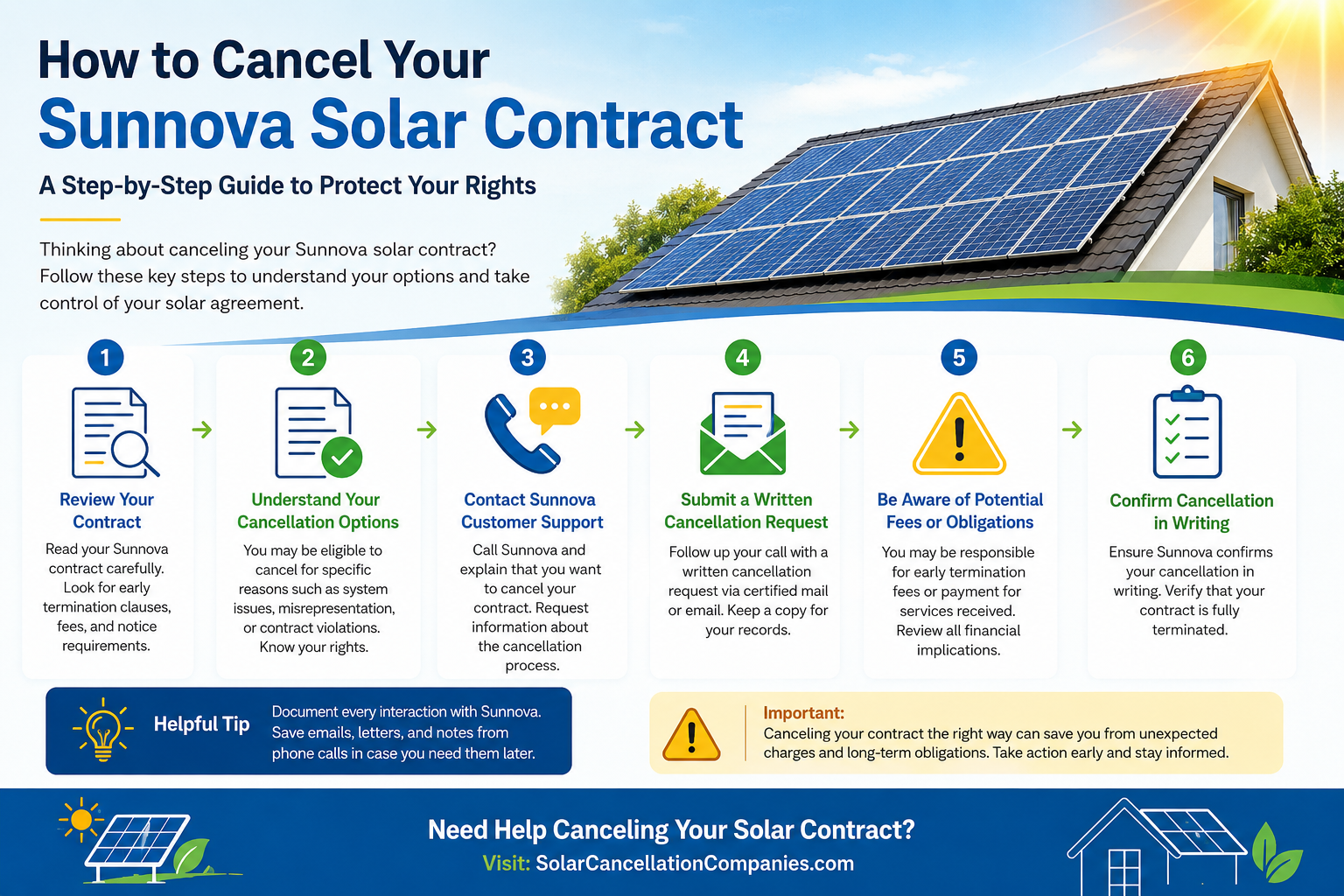
What to Do Before You Try to Exit a Sunnova Contract
Work through these steps in order.
- Find your signed Sunnova agreement. Figure out whether it’s an Easy Plan lease or PPA, an Easy Own agreement, a loan, a SunSafe product, or something else.
- Confirm who manages your account today. Check your recent bills and any messages from SunStrong.
- Check when and where you signed. This matters if you’re looking into a right to cancel.
- Read the cancellation, transfer, and payoff sections closely. Don’t assume your contract matches someone else’s.
- Identify your original dealer or installer. Sales and installation problems may be separate from anything SunStrong is responsible for.
- Check your project’s actual status. Confirm whether permits, inspection, installation, and permission to operate were all completed.
- Gather your evidence. Keep sales materials, financing paperwork, bills, production records, service requests, and any written messages.
- Pick the right path for your situation. Depending on what you find, that might mean rescission, straightforward cancellation, a payoff, a transfer, pushing for better service, resolving an unfinished job, or a financing dispute.
Frequently Asked Questions
Can SunStrong raise my old Sunnova payment or change my contract terms?
SunStrong says the transition alone doesn’t change your existing financing terms. Keep making your normal payments. That said, your amount can still change if your original contract already included a scheduled rate increase, or if local sales tax rules change. Check your original payment schedule before assuming any increase is unauthorized.
What if I never got a notice from SunStrong after Sunnova shut down?
Check a bill from after the transition and look for the name of the company now managing your account. SunStrong says customers who can’t confirm their new manager from emails or bills can contact its customer care team directly. Its website also has separate contact routes for old Sunnova lease and PPA accounts versus loan accounts.
Does SunStrong actually own my old Sunnova system?
Not necessarily. SunStrong describes itself as an operations and asset management company that works between the people who actually own these systems and the homeowners using them. Solaris Assets bought most of Sunnova’s business during the bankruptcy sale, while SunStrong took on the job of servicing those accounts. Check your paperwork to figure out who legally owns or holds the loan on your specific system.
What if my original installer has also gone out of business?
Don’t assume SunStrong automatically takes over every job your old installer used to do. Right now, SunStrong sends installation problems back to the original installer, and it limits maintenance help for some loan customers and people who own their systems outright. If your installer is gone for good, check your equipment warranties, find out what SunStrong will actually cover, and look into whether your state’s contractor licensing board offers any complaint process that could help.
SCC’s guide on when a solar installer goes bankrupt walks through this specific problem in more depth.
Where Solar Cancellation Companies Fits In
If you’re a former Sunnova customer, you might now be dealing with several different companies at once: SunStrong, your original installer, a lender or loan servicer, an equipment maker, or a company tied to an unfinished project.
Solar Cancellation Companies helps homeowners sort out who’s who before picking an exit strategy. That means figuring out who actually controls your agreement now, what your contract really says, where your specific problem started, and whether cancellation, a transfer, a payoff, pushing for service, or a formal dispute is the realistic way forward.
For former Sunnova customers, that distinction really matters. The bankruptcy changed who manages a lot of these accounts. It didn’t create one single cancellation rule that applies to everybody.
A quick note: This article gives general information for homeowners. It is not legal, tax, or financial advice. Your actual cancellation rights depend on your contract, your state’s laws, how your system was financed, and your personal situation.