

There is no single rule that lets every homeowner cancel a solar contract. Some in-home sales come with a federal three-day window to back out. Beyond that, your state’s laws and your own contract may give you extra protection.
The right first step is to look at the facts of your case. When did you sign? Where did you sign? What state are you in? How far along is the project? These answers decide whether you’re facing a simple cancellation, a financing problem, or a bigger dispute.
Why Homeowners Try to Cancel Solar Contracts
Many people sign solar deals with high hopes. Later, they realize the reality does not match the sales pitch. Here are the most common reasons for seeking a way to get out of a solar contract.
High Energy Bills Instead of Savings
Some homeowners end up paying two bills. They pay the solar company and the local utility company. Savings may fall short when system production, electricity use, financing costs, utility rates, or the assumptions used in the sales proposal do not match expectations.
Misleading Sales Tactics
Sales reps sometimes promise “free” solar or government checks. When these perks don’t appear, homeowners feel cheated. Misrepresentation is a major factor in solar contract termination options.
Poor Installation or System Issues
Leaky roofs or broken panels cause immediate regret. If the company fails to fix these issues, homeowners want out. A system that does not produce power is a liability, not an asset.
Long-Term Financial Burden
Solar contracts often last 20 to 25 years. Life changes like retirement or moving can make these payments difficult. Many people realize they cannot commit to such a long-term debt. Understanding which type of solar agreement you actually signed is often the first step toward figuring out what a long-term exit really costs.
Start By Figuring Out Where You Stand
Someone who signed a contract yesterday is in a very different spot than someone whose panels are already installed and waiting on the utility company. And if you took out a solar loan, you may owe something to both the installer and the lender, not just one or the other.
Here’s a quick way to match your situation to what you should check first.
| Your situation | What to check first |
| Signed within the last few days | Federal, state, and contract cancellation rights |
| No installation work started | The cancellation clause and any work already approved |
| Design or permitting started | Contract terms and project milestones |
| Loan approved | Whether the loan was only approved, or actually paid out |
| Panels installed | Inspection, financing, and contract status |
| Installed but no permission to operate | What the installer and utility still owe you |
| System up and running | Contract, financing, warranty, or sales issues |
| Installer went out of business | Financing, servicing, warranty, and project status |
| Collection notices arriving | The debt, the lender, the servicer, and the root problem |
Use the Right Word for Your Problem
It also helps to use the right term when you talk to a company or a regulator.
Rescission generally means unwinding a transaction under a legal right. Cancellation or termination ends an agreement according to the applicable law or contract, and may not erase obligations already incurred.
Payoff means paying off a debt you already owe.
Buyout usually means a purchase or exit option written into a lease or PPA.
Dispute means you’re challenging how a company performed, financed, billed, or represented something.
These words are not interchangeable, and using the wrong one can slow down your case.
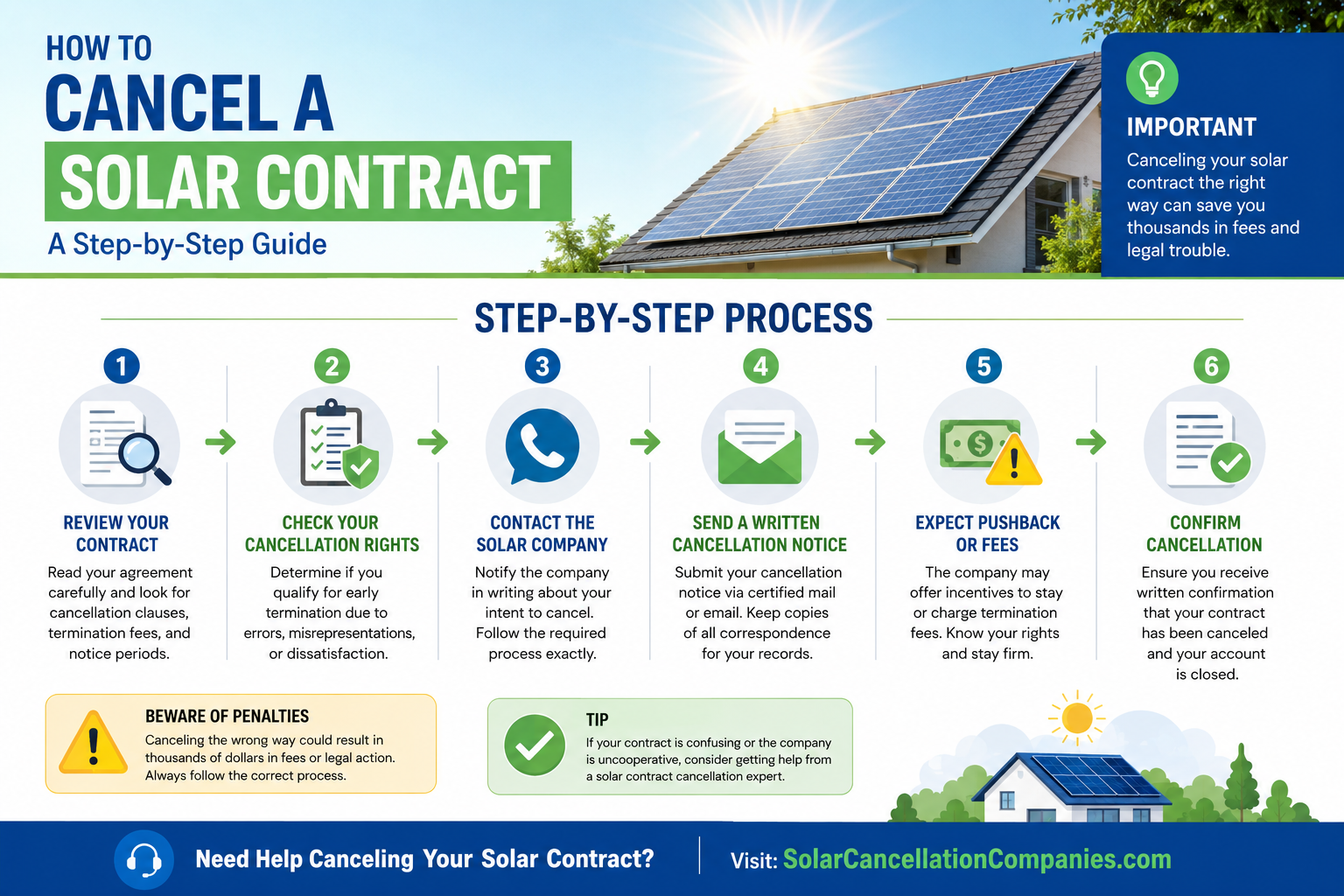
How to Cancel a Solar Contract
Once you know why you want out, here’s the actual process to follow.
- List every agreement you signed. That could be an installation contract, a loan, a lease, or a PPA, and you may have signed more than one.
- Check your timeline and location. Confirm your signing date, how the sale happened, your state, and the cancellation deadline written into your contract.
- Confirm your project’s current stage. Find out where the installation stands and whether financing has actually been disbursed, not just approved.
- Follow the exact cancellation instructions in your paperwork. Use the method, format, and address your contract or Notice of Cancellation specifies. Don’t improvise a different approach.
- Send your notice to the right party. That might be the seller, the installer, the lender, or the lease or PPA provider, depending on which agreement you’re cancelling.
- Keep proof of delivery and every written response. Certified mail receipts, email timestamps, and any reply you get all matter later if the company pushes back.
- Check your financing separately. Cancelling an installation contract does not automatically end a loan, lease, or PPA tied to it. Confirm each one on its own.
- If your cancellation is refused, or your deadline has passed, reclassify the problem. At that point you’re likely dealing with contract termination, a financing dispute, misrepresentation, installer failure, a warranty claim, or another type of dispute, and each one has a different next step.
Does the Federal Three Day Rule Apply to You?
The Federal Trade Commission’s Cooling-Off Rule gives buyers three business days to cancel certain sales made at home, at work, in a dorm, or at a seller’s temporary location. It can also apply if you invited a salesperson into your house for a pitch.
That makes the rule relevant to plenty of door to door solar sales. But it is not a blanket solar cancellation right, and several sales fall outside it.
When the rule usually applies
A covered sale is generally for personal or household use, and it happens somewhere the rule covers, like your home. If your sale qualifies, the seller has to tell you about your cancellation right and give you the paperwork to use it.
When the rule does not apply
The FTC excludes several kinds of sales, including deals made entirely online, by mail, or by phone. It also excludes sales finished after negotiating at the seller’s regular place of business, sales under $25 made at your home, and sales under $130 made at certain temporary locations.
So if you signed electronically, don’t assume that decides the outcome by itself. What matters more is how and where the sale was actually negotiated, along with any state law that applies.
How the three days are counted
Under FTC guidance, Saturday counts as a business day, but Sundays and federal holidays do not. Your cancellation window runs until midnight on the third business day.
If your paperwork includes a Notice of Cancellation, check the date you signed, the deadline it lists, where to send your notice, and how you’re allowed to send it. Keep proof that you sent it, no matter what.
Does Your State Give You Extra Protection?
Federal law is only part of the picture. Many states add their own cancellation windows, disclosure rules, or home improvement protections on top of it. You can check the current rules for your state before relying on the federal window alone.
Here are a few examples.
| State | What homeowners need to know |
| California | Covered solar customers generally have 3 business days to cancel, while homeowners 65 or older generally get 5 business days. The exact rule can depend on how and where the contract was signed. |
| Florida | Covered residential solar sale and lease agreements must provide at least a 3-business-day rescission period. Florida also requires important contract disclosures about financing, costs, warranties, and system terms. |
| Washington | Covered solar installation contracts include a 3-business-day written cancellation right. State law also requires the contract to spell out certain fees, financing details, and project information. |
| Texas | A 3-business-day cancellation right can apply to covered consumer transactions, including some in-home sales. However, Chapter 601 has exclusions, so not every solar contract qualifies. |
| New York | Covered home-improvement and distributed-energy agreements may provide a 3-business-day cancellation period. The applicable protection depends on the type of solar agreement involved. |
The key point: the deadline may look similar across states, but the type of contract, sales method, required disclosures, and exceptions are different. Homeowners should check the rule that actually applies to their transaction before relying on a three-day window.
Know Which Agreement You’re Actually Cancelling
A lot of confusion happens because homeowners lump every company together as “the solar company.” In reality, you may be dealing with several separate businesses, and the type of agreement you signed changes what you actually owe.
The seller is responsible for the sale and the representations it makes. The installation contractor handles the installation work and any permitting, inspection, or project duties assigned by the contract and applicable state law. Sometimes the same company performs both roles.
The lender is a separate company if you financed your system with a loan. Florida’s required disclosure spells this out clearly: it tells homeowners that solar disclosures don’t cover loan terms, and points them to the lender instead.
That means cancelling your installation contract does not automatically end a separate loan agreement. Your loan paperwork needs its own review.
The loan servicer might be a third company that just collects your payments. Check your latest statement for the name of the creditor, the servicer, the payment address, and any notice about your account being transferred.
The lease or PPA provider is different again. Don’t assume your lease or PPA automatically lets you buy the system early, remove it, transfer it when you sell your home, or end it on a specific formula. Those rights only exist if your actual contract spells them out.
Does Your Solar Loan Have Its Own Cancellation Right?
Maybe, but this is a separate question from the FTC’s Cooling Off Rule.
Regulation Z provides a right to rescind certain consumer credit transactions in which a security interest is taken in the consumer’s principal dwelling, subject to a set of exemptions. For loans that qualify, you generally have until midnight on the third business day after the key triggering event described in the rule.
Here’s the catch: not every solar loan is covered. Consumer finance regulators have flagged solar loans that are unsecured, or secured in ways that don’t trigger this particular right. Taking out a loan to pay for solar doesn’t automatically give you Regulation Z protection.
If you see a “right to rescind” notice in your loan papers, read it on its own terms. Don’t assume it lines up with your solar contract’s cancellation deadline.
Can Installer Problems Affect Your Loan?
Sometimes. The FTC’s Holder Rule protects certain claims and defenses you could raise against a seller, even after your loan is sold or transferred to another company. This can matter if your installer helped arrange your financing and you believe they misled you.
But this rule has limits. It doesn’t mean every dispute with your installer cancels your loan. It doesn’t cover every solar loan. Poor system performance on its own doesn’t create a valid claim. And it doesn’t mean you automatically owe nothing.
If your installer and lender are blaming each other, try mapping it out simply. What did the installer promise or actually do? What did the lender finance? Who is collecting your payments right now? And which company’s actions actually caused your problem? That map is more useful than sending the same angry letter to everyone involved.
What Changes as Your Project Moves Forward
Saying a project is “installed” or “not installed” doesn’t really capture where things stand. California’s own solar guidance breaks a project into stages: signing, site evaluation, permitting, installation, inspection, and utility connection. Your options depend on exactly which stage you’re in.
If you signed but nothing has started, check your cancellation rights right away. Also find out if financing already went through, if permits were filed, or if equipment was ordered. Don’t assume nothing has happened just because nothing is on your roof yet.
If design or permitting has started, look at your contract’s milestones and cancellation terms closely. A company might claim it already spent money on your project. Whether you actually owe that amount depends on your contract and your state’s law, not on a national average.
If your loan was approved, ask whether the money was only approved, or already sent out. Those are two very different things. Your lender or servicer can tell you which one happened.
If panels are already on your roof, the project still might not be finished. Check whether the required inspection happened, whether the utility approved the connection, whether you’ve received Permission to Operate, and whether the system is actually making electricity.
If you’re still waiting on Permission to Operate, you’re dealing with more of a project delay than a simple cancellation. This stage is common, and it’s worth reading up on interconnection delays specifically if this is where you’re stuck.
If your system is already running, your options usually shift toward your contract’s terms. Compare what’s actually happening against your written production promises, warranties, financing terms, and sales claims. Being disappointed with your system isn’t the same as having a legal claim, but real gaps between the promise and the paperwork are worth pursuing.
What If Your Installer Closed or Never Finished?
Don’t assume a company closing its doors cancels every agreement tied to your project. Solar lenders are often separate businesses that simply partner with installers to offer financing at the point of sale.
Start by sorting out who actually stopped operating. Was it the salesperson, the installation crew, the lender, the servicer, the lease provider, or the warranty company? These may be separate businesses, so identify each company’s role before deciding who to contact.
Then write down exactly where your project stands. Is it untouched, partly installed, fully installed, inspected, waiting on approval, or already running?
Next, confirm your financing status directly with the lender or servicer rather than guessing. Don’t assume the installer got paid in full just because a loan exists, and don’t assume the lender withheld payment just because the job wasn’t finished.
Finally, check each warranty separately. Installer closure can affect access to workmanship service, while manufacturer warranty coverage depends on the manufacturer’s warranty terms, product registration, and other applicable conditions.
The safest starting assumption is that an installer closing does not, by itself, cancel a separate loan. Whether you can challenge that loan depends on your agreement, the lender relationship, and the facts of your case. A vetted contract review specialist can help you sort out which agreements are actually still active.
Build Your File Before You Send Anything
A well organized folder of documents is worth far more than a long angry email. Try to gather your signed installation or purchase agreement, your Notice of Cancellation, your loan agreement, and your lease or PPA if you have one.
Add your financing disclosures, your original sales proposal, and a cash price quote if you have one. Keep your payment schedule, emails and texts with your salesperson, and any screenshots of savings claims or tax credit promises.
Round it out with permits, inspection records, interconnection paperwork, your Permission to Operate notice, and your system’s actual production data. Include utility bills, lender or servicer statements, warranty documents, and any collection letters you’ve received.
Keep your original files where you can. If someone made an important promise out loud, write down who said it, roughly when, and what they said, and don’t alter any of your existing records.
Who to Contact Based on Your Actual Problem
Different problems belong with different people.
| Your issue | Where to start |
| Still inside your cancellation window | Follow the exact notice method your contract or the rule requires |
| Installer workmanship or licensing | The installer and your state’s contractor regulator |
| Loan or servicing problems | Your lender or servicer, and the CFPB complaint process |
| Deceptive sales tactics | The seller, your state Attorney General, or the FTC |
| Utility connection delays | The installer, the utility, and your state’s utility regulator |
| Wanting out of a lease or PPA | The company that owns the contract |
| Debt collection calls | The collector or servicer, and a consumer finance regulator |
| Arbitration or a lawsuit | A qualified attorney who knows your contract and state law |
The Consumer Financial Protection Bureau accepts complaints about financial products and typically forwards them to the company for a response. That’s genuinely useful for building a paper trail, but filing a complaint is not the same as cancelling anything. Don’t assume a regulator complaint automatically pauses your contract or your debt.
What If Your Cancellation Window Already Passed?
Missing your cooling off deadline doesn’t leave every homeowner with the same next move. It depends on your contract and your specific problem.
You might find a contractual termination clause buried in your agreement that applies outside the original window. You and the company might reach a negotiated resolution, as long as it clearly spells out what happens to the equipment, the financing, the warranty, and any balance owed.
Paying off your loan simply settles the debt under its terms. It doesn’t undo the original sale. If you have a lease or PPA, check whether it includes a real buyout or purchase option, since not every contract offers a fair market value buyout, and terms vary by provider.
If you’re selling your home, check your contract’s transfer rules before you promise a buyer anything. And if your system is defective or underperforming, you may have a warranty or performance claim instead of a cancellation case, so compare what’s actually happening against the specific written guarantee you were given.
Figure Out Which Problem You Actually Have
Before you send another cancellation letter, nail down four things: which agreement you’re dealing with, what stage your project is at, what the real problem is, and which company is actually responsible for it.
If you’re still inside a valid cancellation window, use the exact method your contract or the law requires. If that window has closed, stop treating this as a generic “cancel my solar” problem. Figure out instead whether you’re facing a contract termination, a financing issue, a performance problem, an installer failure, a transfer question, a payoff, or a formal dispute.
That distinction is what actually decides your safest next move.
If your window has closed and you’re not sure what you’re actually dealing with, a free contract review can help identify which of these paths applies to your situation.
This article explains general consumer rights and contract structures. It isn’t legal advice. For a decision specific to your situation, consult an attorney or your state consumer protection office.
Frequently Asked Questions
What happens after a solar contract is successfully canceled?
What happens next depends on the agreement and project stage. The company may need to stop pending work, address equipment already delivered, and confirm the cancellation in writing. If separate financing exists, confirm its status independently rather than assuming it ended automatically.
What if the solar company ignores my cancellation notice?
Keep proof showing when and how you sent the notice. Follow up in writing and ask the company to confirm its position. If the cancellation was timely but remains disputed, the next step may involve the appropriate regulator, lender, dispute process, or legal review.
Does the solar company have to receive my cancellation before the deadline?
That depends on the cancellation rule and contract that apply to your transaction. Some rules focus on when a valid notice is sent, while others may contain specific delivery requirements. Follow the exact instructions in your cancellation notice and keep proof of sending.
What happens to solar equipment if I cancel after it has been delivered?
Delivery does not create one nationwide outcome. Check the contract for return, pickup, restocking, installation, or termination provisions. Do not remove, sell, or dispose of equipment until responsibility for it is confirmed in writing.