

Trying to exit a solar lease feels overwhelming. Whether you are selling your home or just want the panels gone, the costs can shock you. Two options appear in most leases: the solar lease fair market value buyout and the contract buyout. Both sound simple, but they are not.
Most homeowners discover these clauses only when it is too late. Suddenly a buyout quote arrives that feels far too high. The confusion is real, and the financial stakes are serious. Understanding your solar lease exit options before committing to anything can save you thousands. For free resources and access to reviewed specialists who handle solar lease buyout disputes, visit Solar Cancellation Companies.
This guide breaks down both paths clearly. You will learn how each buyout is priced, which usually costs less, and what traps to avoid when buying out a solar lease early.
Understanding Solar Lease Buyouts
What Is a Solar Lease Buyout?
A solar lease buyout means you pay a huge amount to end the lease agreement and take ownership of the panels. After the buyout, the solar company no longer has any claim on your roof or your electricity production.
Two main types exist: fair market value (FMV) buyouts and contract buyouts. Each is calculated differently and carries its own set of risks. Before deciding which path to pursue, it helps to understand which type of agreement you signed, our Solar Contract Type guide explains the key differences between a lease, PPA, and loan and what each means for buyout eligibility and pricing.
Why Homeowners Choose to Buy Out Solar Leases
- Selling a home where buyers refuse to take over the lease
- Wanting full ownership to maximize solar savings
- Avoiding escalating lease payments over time
- Refinancing complications caused by an active solar lease
- Removing a lien or encumbrance from the property title
When Solar Lease Buyout Options Become Available
Most leases allow buyouts at specific anniversary dates, typically every five years. Some contracts permit early buyouts anytime but charge steep fees. Read your contract carefully before assuming you can exit on your timeline.
What Is a Fair Market Value Solar Buyout?
How Fair Market Value Solar Buyouts Work
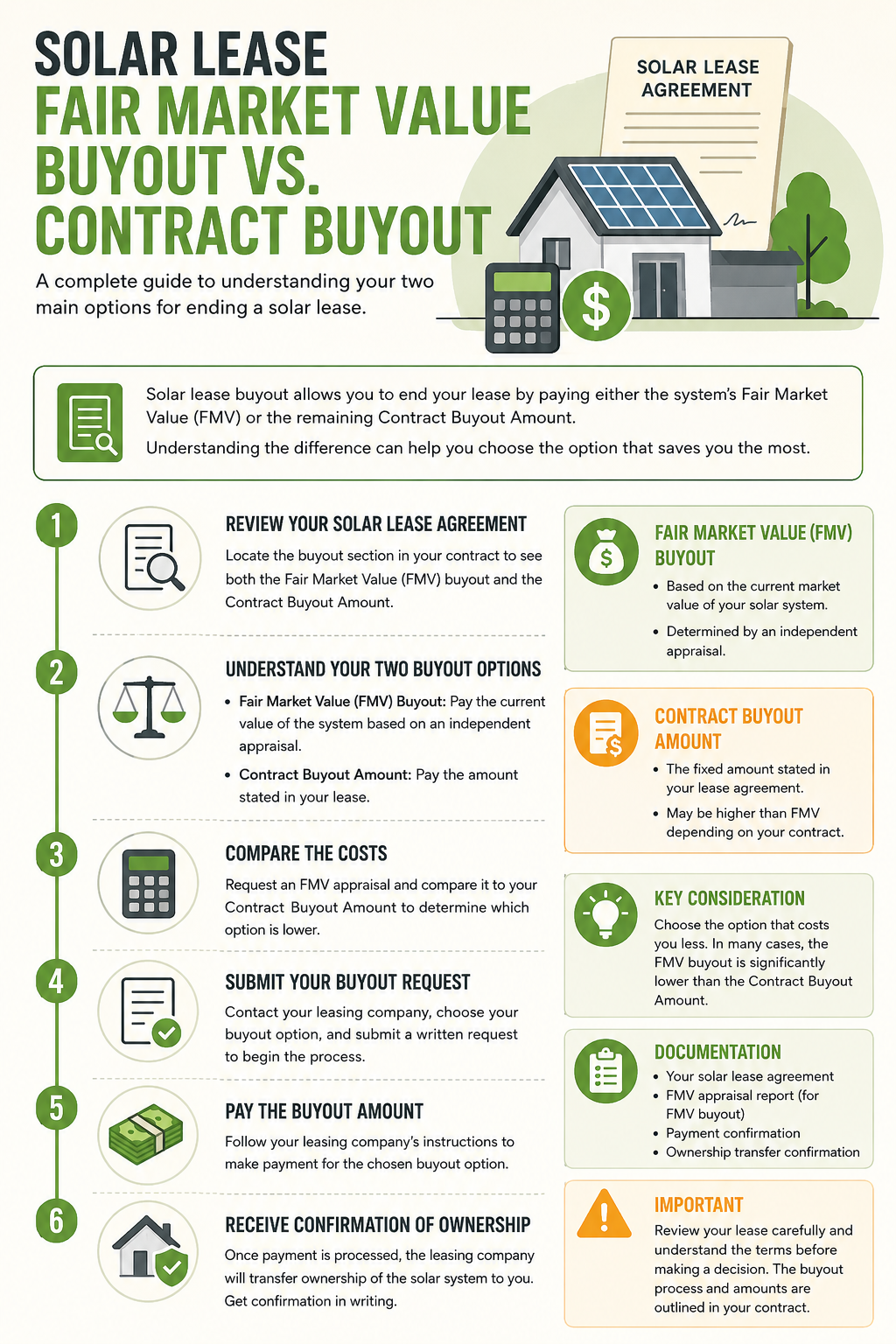
A solar lease fair market value buyout prices the panels based on what they are worth today in the open market. The solar company sends an appraiser or uses an internal formula to estimate the current value of the equipment.
You then pay that appraised amount to own the system outright. Simple in theory. Contentious in practice.
How Solar Lease Fair Market Value Buyouts Are Calculated
Providers factor in several variables when calculating FMV:
- Original equipment cost minus depreciation
- Current local solar market prices
- Panel age and expected remaining output
- Installation and labor cost estimates
- Local incentive and net metering values
The problem? The company doing the appraisal has a financial interest in a higher number. Independent verification is rarely offered upfront. The Consumer Financial Protection Bureau has documented how solar companies frequently use opaque valuation methods that inflate buyout costs and leave homeowners with little ability to verify the numbers independently.
Why Some Fair Market Value Buyout Quotes Feel Expensive
Solar companies sometimes use aggressive depreciation schedules or inflate replacement cost assumptions. A 10-year-old system might be quoted at near-original value when actual resale prices are far lower.
Homeowners in California, Texas, and Florida frequently report FMV quotes that exceed what comparable used systems sell for on the open market.
Pros and Cons of Fair Market Value Buyouts
| Pros | Cons |
| Can be cheaper later in the lease term | Provider controls the valuation method |
| Reflects actual equipment condition | Quotes can feel inflated or opaque |
| No fixed penalty tied to remaining payments | Harder to predict cost upfront |
| Negotiable in some cases | Requires independent appraisal to verify |
What Is a Contract Buyout for a Solar Lease?
How Contract Buyouts Work
A solar contract buyout calculates your exit cost based on what is left in the lease. You essentially prepay all remaining monthly amounts, often with a discount applied.
This method gives predictability. You can calculate it yourself using the lease document. No appraisal needed.
How Solar Contract Buyout Pricing Is Determined
The formula is usually: remaining monthly payments multiplied by months left, minus a discount percentage (often 10-20%). Some contracts also add an administrative fee on top.
Early in a lease, this number is almost always higher than FMV. Late in the lease, it may be lower.
Pros and Cons of Contract Buyouts
| Pros | Cons |
| Completely transparent calculation | Very expensive in early lease years |
| No appraisal disputes | Discount rates vary widely by contract |
| Predictable total cost | May include hidden administrative fees |
| Available at any time in most contracts | Does not reflect true equipment value |
Solar Lease Fair Market Value Buyout vs. Contract Buyout
Key Differences Between FMV and Contract Buyouts
The core difference is how the price is set. FMV ties the cost to the system’s current value. Contract buyouts tie the cost to the remaining lease obligation.
FMV favors buyers when the panels have depreciated significantly. Contract buyouts favor buyers only near the end of the lease term.
Comparison Table: Fair Market Value Buyout vs Contract Buyout
| Factor | FMV Buyout | Contract Buyout |
| Pricing basis | Current equipment value | Remaining lease payments |
| Transparency | Low (provider controls) | High (formula-based) |
| Best time to use | Mid-to-late lease term | Late lease or short remaining term |
| Negotiable? | Sometimes | Rarely |
| Risk of overpaying | High if unchallenged | High in early lease years |
| Typical cost range | $8,000 – $25,000 | $5,000 – $30,000+ |
Which Solar Buyout Option Is Usually Cheaper?
When a Fair Market Value Buyout Can Cost Less
If your panels are 8 or more years old, FMV tends to fall below contract buyout costs. Equipment depreciates. A 12-year-old system worth $6,000 on the market beats paying four years of remaining lease payments.
When a Contract Buyout May Save More Money
If you are 18-24 months from lease end, a contract buyout can be surprisingly cheap. You are only prepaying a small number of payments, often with a discount applied. That math works in your favor.
Real Cost Scenarios for Solar Lease Buyouts
| Scenario | FMV Quote | Contract Buyout | Cheaper Option |
| Year 5 of 20-year lease | $14,000 | $22,000 | FMV Buyout |
| Year 12 of 20-year lease | $8,500 | $10,200 | FMV Buyout |
| Year 18 of 20-year lease | $4,000 | $3,100 | Contract Buyout |
| Year 2 of 25-year lease | $18,000 | $28,500 | FMV Buyout |
Can Solar Companies Negotiate Buyout Prices?
Yes, some do. Especially FMV quotes. The valuation method is not set in stone, and providers would rather settle than fight an informed homeowner.
How Homeowners Challenge High Buyout Quotes
- Request a written breakdown of how FMV was calculated
- Get an independent appraisal from a certified solar assessor
- Compare your quote to current used panel prices in your area
- Document any panel degradation or equipment issues
- Present a counter-offer backed by your research
When Legal or Financial Guidance May Help
If the provider refuses to budge and the quote seems clearly inflated, consulting a solar contract specialist may be worth the investment. A single legal letter can shift the conversation quickly. You can find reviewed specialists who handle buyout disputes through the Solar Cancellation Companies directory.
Hidden Costs Homeowners Overlook During Solar Buyouts
Administrative and Early Termination Fees
Many contracts tack on fees of $500 to $2,000 on top of the stated buyout price. These are negotiable but only if you catch them early. Our Solar Dealer Fee Disclosure guide explains how to identify undisclosed fees in solar financing agreements and what your options are when they were not made clear at signing.
Solar Panel Removal and Roof Repair Costs
If you plan to remove the panels after buying out, expect $1,500 to $4,000 in removal and potential roof patching costs. This is rarely mentioned in buyout discussions.
Maintenance and Equipment Replacement Responsibilities
Once you own the system, repairs come out of your pocket. Inverters can cost $1,500 to $3,000 to replace. Budget for this before committing.
Warranty and Monitoring Service Changes
Leased panels often include monitoring and warranty coverage. After a buyout, those may lapse immediately. Confirm what transfers and what does not.
Selling a Home With a Solar Lease
How Solar Leases Affect Home Sales
An active solar lease appears as a lien on your property title in many states. Buyers must qualify to assume the lease or you must pay it off before closing. Many deals fall through because of this.
Should You Buy Out a Solar Lease Before Selling Your Home?
Not always. If the buyer is willing to assume the lease and qualifies, a transfer avoids the buyout cost entirely. However, if the lease has escalating payments or is unpopular with buyers, a buyout may help your sale move faster. Our Solar Exit Guides cover how lease transfer and buyout situations play out with major solar providers including Sunrun, Sunnova, SunStrong, and Spruce Power.
When a Solar Lease Transfer May Make More Sense
A lease transfer costs little to nothing in most contracts. If your system is performing well and payments are reasonable, many buyers will accept the transfer. This is often the cheapest exit option when selling.
Red Flags in Solar Lease Buyout Offers
- Vague FMV clauses: No formula or methodology explained
- Pressure to decide quickly: Legitimate buyout offers do not expire in 48 hours
- Missing line-item pricing: Lump sums with no breakdown are a warning sign
- Verbal promises: Always get terms in writing before agreeing to anything
- Buyout higher than new system cost: A serious red flag worth challenging
How to Determine if a Solar Buyout Offer Is Fair
Questions to Ask Before Accepting a Buyout Offer
- What methodology was used to determine FMV?
- What is the current replacement cost for this exact equipment?
- Are there additional fees beyond the stated buyout amount?
- What warranties or service agreements transfer to me after buyout?
- Is this price negotiable if I provide an independent appraisal?
Signs a Solar Buyout Quote May Be Overpriced
- Quote exceeds 80% of the original installation cost on older systems
- No depreciation applied to 10+ year old panels
- Quote is significantly above used market prices for comparable systems
- Provider refuses to share valuation details in writing
Best Solar Lease Exit Options Based on Your Situation
| Your Situation | Best Exit Option |
| Selling your home, buyer refuses lease transfer | Negotiate contract buyout or FMV buyout before closing |
| Long-term homeowner, 10+ years remaining on lease | Request FMV buyout and get independent appraisal |
| 2 years or less remaining on lease | Consider contract buyout for predictability |
| High FMV quote, panels are old | Challenge FMV with independent appraisal |
| Buyer willing to assume lease | Pursue lease transfer — no buyout needed |
Frequently Asked Questions
What is the difference between a fair market value and a contract buyout for solar leases?
An FMV buyout prices the panels based on current equipment value. A contract buyout calculates costs based on remaining lease payments. FMV is often cheaper mid-to-late lease. Contract buyouts offer more transparency.
Can you negotiate a solar lease buyout price with the provider?
Yes. FMV buyouts especially have room for negotiation. Getting an independent appraisal strengthens your position significantly.
Which solar buyout option is cheaper for homeowners long term?
FMV buyouts tend to be cheaper after year 7-8 of the lease when significant depreciation has occurred. Early in the lease, neither option is cheap.
What happens after buying out a solar lease agreement?
You own the panels outright. You are responsible for all maintenance and repairs. Monitoring services and warranties may or may not transfer depending on your original contract.
How do solar leases affect selling a house?
Active leases can appear as title encumbrances. Buyers must assume the lease or you must buy it out before closing. Many lenders and buyers object to active leases, which can slow or kill a sale.
Conclusion: Choose the Right Path and Avoid Overpaying
The solar lease buyout vs contract buyout decision comes down to timing and verification. FMV buyouts favor you when panels are older and market values have dropped. Contract buyouts make sense when very little lease time remains.
If your buyout quote feels inflated or the provider is unresponsive, you have options:
- Request a written FMV calculation methodology
- Commission an independent solar appraisal
- Consult a solar lease attorney in your state
- Compare your quote against current used panel market prices
You are not trapped. You have leverage. Use it. Contact Solar Cancellation Companies today for a free no-obligation review of your buyout offer. Our team can help you understand whether the quote is fair and what your next steps should be.