

An EverBright PPA or lease doesn’t come with one simple cancel button. What you can actually do depends mostly on where your project stands right now.
If your system hasn’t been installed yet, the big question is whether your cancellation window is still open. Once the system is up and running, your options usually shift toward prepaying, buying the system outright, transferring it to a new buyer, or working through a dispute that’s specific to your contract.
Find Your Agreement First
Open MyEverBright and look for these details before you do anything else.
- Whether you have a PPA or a lease
- Your signing date
- The stated cancellation period
- Whether equipment has been installed
- Whether the system has reached Permission to Operate (PTO)
- Prepayment terms
- Purchase terms
- Transfer terms
- Performance guarantee terms
These details will point you toward the right next step.
Which EverBright Agreement Do You Actually Have?
Don’t start by calling EverBright and asking for a generic “buyout.” First, figure out exactly what you signed.
With an EverBright power purchase agreement (PPA), EverBright owns the solar equipment and you pay for the power it produces. With a lease, you’re paying to use equipment that EverBright owns and maintains. EverBright says its PPA and lease agreements usually run for 25 years.
This is different from EverOwn, which is EverBright’s retail installment contract. With EverOwn, you own the system yourself and finance the purchase over time.
EverBright currently offers different PPA structures, with product availability depending on location. Your signed agreement, not the product name alone, is what actually determines your rights around cancelling, transferring, and paying.
If you’re not sure whether your issue is a cancellation problem or something else entirely, SCC’s solar contract cancellation guide walks through the difference in plain terms.
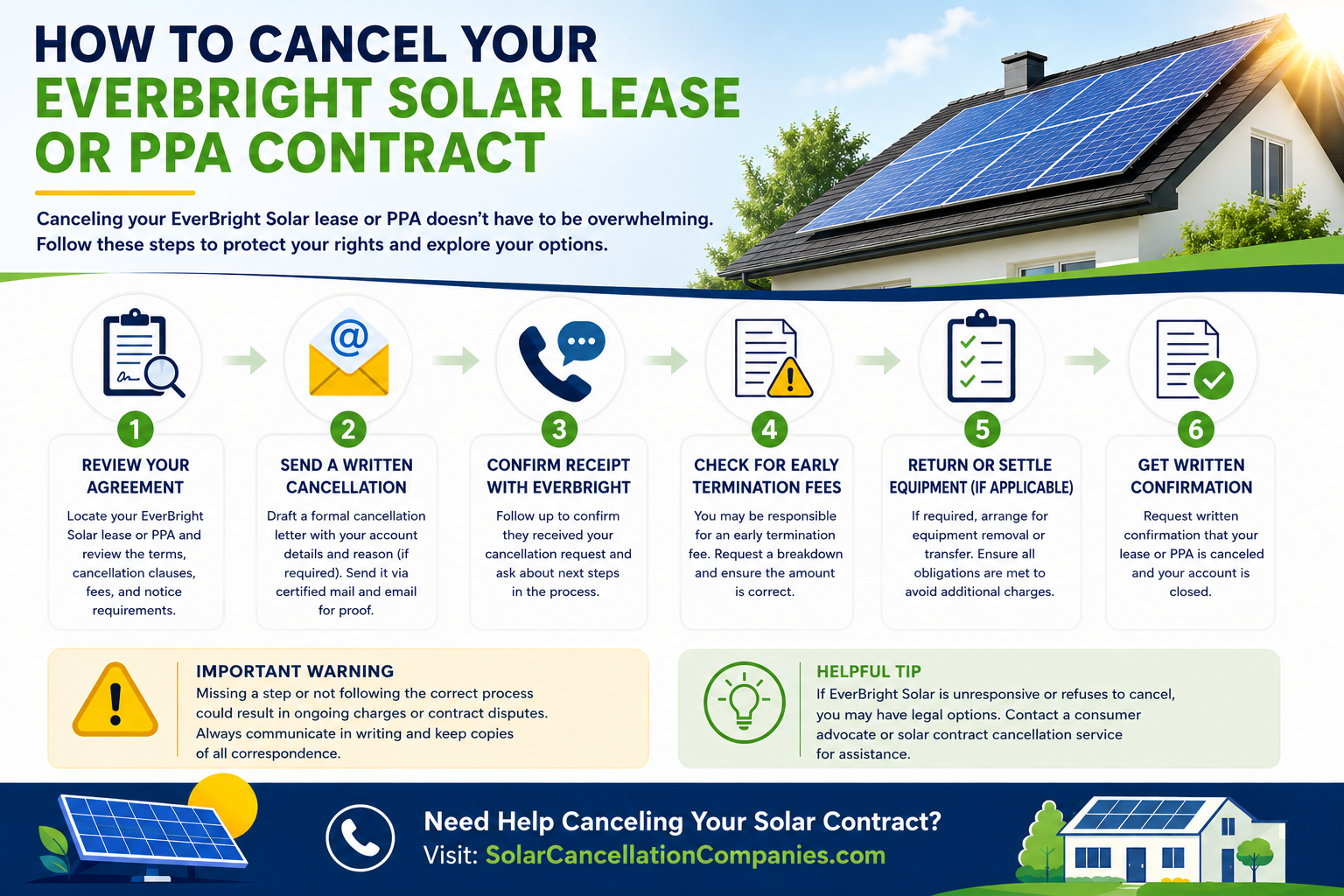
Are You Still Inside Your Cancellation Window?
If you signed recently, go find the Notice of Cancellation in your paperwork right now.
EverBright’s older cancellation guidance mentioned that the cancellation period can vary by state. That older material shouldn’t be used to figure out your deadline today. Use the deadline written in your own signed agreement instead.
A federal rule may also help you. The FTC Cooling-Off Rule gives qualifying consumers three business days to cancel certain sales made at their home or at certain other locations away from a seller’s regular place of business. This is not a blanket three-day rule for every solar contract everywhere.
Your state may add more protection. California’s Solar Consumer Protection Guide, for example, states that covered customers have at least three business days to cancel, or five business days if they are 65 or older. That rule is specific to California and doesn’t apply everywhere else.
If You’re Still Inside the Window
Cancel using the exact method your agreement describes. Don’t rely on a phone call alone.
Hold onto these records:
- The notice you sent
- Proof it was delivered
- Email timestamps
- Any replies from EverBright
- Messages with your installer
If your contract was signed during an in home sales visit, SCC’s door to door solar sales guide explains when extra federal or state rules might kick in.
What if the Deadline Passed and Nothing’s Been Installed?
Don’t assume the project is locked in just because your deadline has passed. This is one spot where EverBright works a little differently.
Older EverBright support documentation described a practice where the company accepted cancellation requests after the standard deadline, as long as nothing had been installed on the roof yet.
Because that document is outdated, it shouldn’t be treated as a guaranteed right today. Still, it’s worth trying.
If you missed your deadline but installation hasn’t started, here’s what to do:
- Send EverBright a written cancellation request right away.
- Clearly state that no equipment has been installed.
- Ask if the project can still be cancelled.
- Ask EverBright to confirm the current status of your project.
- Get any approval to cancel in writing.
- Check any separate agreement you signed with your installer before assuming everything is settled.
EverBright’s cancellation workflow documentation shows that a completed cancellation can trigger a cancellation notice to the homeowner. That’s exactly why written confirmation matters so much.
A salesperson or installer telling you the deal is off doesn’t mean your actual EverBright agreement has been cancelled. Get it in writing from EverBright itself.
What Changes Once Your System Is Installed?
Once your system is installed or turned on, the question shifts. It’s no longer about cancelling. It’s about figuring out what you actually need.
| Your problem | What to check with EverBright |
| You want to stop the monthly payments | PPA prepayment terms |
| You want to own the panels | System purchase eligibility |
| You’re selling your home | EverBright’s transfer process |
| Your system isn’t producing enough | Performance guarantee |
| Your installer stopped responding | EverBright’s service obligations |
| What you were told doesn’t match your contract | Contract or disclosure dispute |
For an active PPA or lease, one distinction matters more than any other: prepaying is not the same thing as buying the system.
Prepaying Is Not the Same as Buying the System
Paying off your EverBright PPA early doesn’t automatically make you the owner of the panels.
EverBright allows PPA customers to make full or partial payments at any point during the contract. A full prepayment wipes out your remaining monthly bill, but EverBright still owns the system and continues to handle maintenance and repairs.
EverBright’s home sale guidance also lists prepayment as an option for both PPA and lease customers who are selling. If you’re a lease customer looking to prepay outside of a home sale, confirm your exact rights in your signed agreement, since they can vary.
What Actually Happens if You Buy the System?
Buying the system is a completely different transaction.
According to EverBright’s current home transfer guidance, once an eligible PPA or lease system is purchased outright as part of a home sale:
- The new homeowner owns the system outright
- There’s no more EverBright agreement attached to it
- The new owner takes on responsibility for future repairs
Whether you’re even eligible to buy depends entirely on your agreement.
Does Hitting Year Six Actually Matter?
It can, but don’t treat it as a rule that applies to every contract ever signed.
EverBright currently says PPA and lease customers get an extra purchase option once they pass the sixth year, according to its home sale guidance. Its transfer page also tells homeowners to double check purchase availability based on when they first signed.
Here’s the simple version: check the purchase clause in your own agreement before assuming you can buy your system right now. EverBright doesn’t publish one fixed buyout price that applies across the board.
For more on getting out of a third party owned system, see SCC’s guide to getting out of a solar PPA.
Selling Your Home With an EverBright PPA or Lease
Selling your house does not automatically cancel your EverBright agreement. The contract follows the system, not you.
EverBright currently offers three paths for PPA and lease customers who are selling:
- Transfer the agreement to a buyer who qualifies.
- Prepay what’s left on the agreement.
- Purchase the system, if your contract allows it.
Transferring the Agreement
Your buyer needs to meet EverBright’s credit requirements and agree to take on the contract.
EverBright recommends reaching out to its billing services team at least 45 days before closing, so there’s enough time to handle paperwork, payments, and the transfer itself. That’s a recommended timeline from EverBright, not a legal requirement.
What if Your Buyer Doesn’t Pass the Credit Check?
A failed credit check doesn’t cancel your PPA or lease automatically.
In that case, EverBright says you can prepay what’s left on the agreement instead. Depending on when you signed, there may also be an exemption fee option available. Buying the system outright could be another route, if your agreement allows for it.
Check your signed agreement carefully before picking one of these paths.
What if Your System Isn’t Producing Enough Power?
Lower than expected production doesn’t automatically give you the right to walk away from your agreement.
EverBright backs its covered systems with a performance guarantee. Production gets reviewed every two years, and you receive bill credits if your system falls short of what your agreement promised. That said, your contract may include conditions or exclusions that affect this guarantee.
If production is your concern, look into:
- The production amount you were guaranteed
- Your actual production records
- The time period used to measure it
- Any exclusions in your agreement
- Your service history
- Any credits you’ve already received
Don’t confuse production with savings. A system can technically be producing plenty of electricity while your overall energy costs still don’t match what a salesperson originally estimated.
Start with the production promise that’s actually written into your agreement, not the pitch you remember hearing.
When the Sales Pitch Doesn’t Match Your Paperwork
Focus on the exact thing you were told that conflicts with what’s actually in your contract. A few common examples:
- You were told you’d own the panels, but your PPA shows EverBright as the owner.
- You were promised a fixed payment, but your agreement includes a yearly increase.
- You were told your utility bill would disappear completely, even though EverBright’s own materials explain that customers can still see utility charges.
- You were personally promised a tax credit, despite signing a PPA or lease owned by a third party. Check the IRS Residential Clean Energy Credit guidance for the tax year involved.
The FTC has warned consumers for years about solar sales pitches involving “free” systems, fake government or utility ties, disappearing electric bills, and inflated savings numbers. Those warnings don’t mean every disputed sales claim will automatically cancel your contract. But they’re worth knowing about.
If you’re dealing with a dispute, hold onto every piece of evidence you have:
- Your signed agreement
- The original proposal
- Any required disclosures
- Texts or emails from your salesperson
- Ads or presentations you were shown
- Your EverBright bills
- Your relevant utility bills
Then line up what you were told against what your signed EverBright contract actually says.
SCC’s solar contract misrepresentation guide covers how to build this kind of evidence and dispute case in more depth.
What if Your Installer Goes Silent?
An installer that stops answering your calls doesn’t mean your EverBright PPA or lease has ended.
EverBright still owns the equipment under its PPA and lease structures, and its current guidance says EverBright itself handles service and repairs, subject to the terms in your agreement.
One thing worth knowing: some agreements signed before March 2023 may not include live monitoring through MyEverBright.
If your installer has gone quiet, here’s what to do:
- Confirm your EverBright agreement is still active.
- Check MyEverBright for whatever system and production data is available.
- Ask EverBright directly about its service responsibilities under your contract.
- Separate a workmanship problem with the installer from a service or performance issue with EverBright itself.
- Review any separate agreement you signed with the installer.
If your installer has actually shut down or filed for bankruptcy, that’s a different problem. SCC’s solar installer bankruptcy guide covers what to do in that situation.
FAQs
Can I prepay an EverBright PPA without buying the panels?
Yes. Prepaying in full wipes out your remaining monthly payments, but EverBright still owns and maintains the system afterward. Prepayment and buying the system are two completely different transactions.
Can I buy my EverBright system before year six?
Don’t count on it. EverBright describes buying the system as an extra option that opens up after year six, but its own transfer guidance says eligibility also depends on when you signed. Check your specific purchase clause rather than assuming the six year mark applies to you.
What happens if my home buyer doesn’t qualify for the EverBright agreement?
You can prepay what’s left on the PPA or lease. Depending on your signing date, an exemption fee option might also be available. Buying the system outright could work too, if your contract permits it.
Can I cancel because my system isn’t producing enough?
Not automatically. Instead, EverBright offers a performance guarantee process for covered systems, which can include bill credits when production falls short. Check the guarantee terms and any exclusions in your agreement first.
Does EverBright charge a fee to transfer a PPA or lease?
It depends on the product. When your account is in good standing and your buyer meets EverBright’s credit requirements, the agreement can usually be transferred, though an administration fee may apply. Ask EverBright for the exact number before you get to closing.
Can I transfer my agreement if my account isn’t in good standing?
EverBright’s published transfer rules assume your account is current and your buyer passes its credit check. If your account is past due or under dispute, reach out to EverBright before you count on a transfer to close your sale.
Where can I find my agreement and contract ID?
Current customers can access their agreement through MyEverBright. For home transfers, your contract ID appears in the top right corner of every page of your signed agreement. You can also request a copy directly from EverBright’s billing or customer support team.
Do I need to contact EverBright again after my home closes?
Yes. EverBright asks sellers to confirm the closing within 48 hours of the title transfer. This is part of EverBright’s own transfer process, not a general legal requirement.
Match Your Next Step to Your Contract
The right move depends on your agreement and where your project stands, not on some generic solar cancellation checklist you found online.
If you’re still inside your cancellation window, act now, before it closes. If your deadline passed but nothing’s been installed, ask EverBright directly whether cancellation is still on the table. If your system is already active, figure out whether your real issue is prepayment, buying the system, transferring it during a home sale, performance, installer service, or a sales claim that doesn’t match your paperwork.
Solar Cancellation Companies helps homeowners sort through solar agreements, installer paperwork, project status, and dispute records to figure out exactly which issue applies and what to do next. If your EverBright paperwork is confusing, or the company and your installer are telling you two different things, SCC can help you get organized before you decide on a next step.
This article is for general information only, not legal or tax advice. Contract rights and state laws vary, and your own signed EverBright agreement controls most of what’s covered here.