
Your solar company closed. Nobody is picking up the phone. You still have panels on your roof, but nobody to call for help. This is called an orphaned solar system. And more U.S. homeowners are dealing with it right now than ever before.
The good news? You have rights. Knowing your orphaned solar system rights is the first step. This guide walks you through what to do next.
What Is an Orphaned Solar System?
An orphaned solar system is one that has no active company behind it. The panels are still on your roof. The system may still run. But the company that put it there is gone. No one is left to handle service, repairs, or warranty claims.
How Solar Systems Become Orphaned
Some installers close without warning. Others get bought out, and the new owner drops all old accounts. Some companies just stop picking up the phone after the sale is done. Others file for bankruptcy and leave customers with no point of contact at all.
Common Types of Orphaned Solar Installations
Here are the most common forms this problem takes:
- Fully built systems with no active service or support
- Jobs that stopped halfway through and were never finished
- Leased systems where the lessor no longer operates
- Power purchase agreements (PPAs) with a company that has shut down
- Financed systems where the lender is separate from the closed installer
Not sure which type of agreement you have? Our solar contract type guide explains the difference between loans, leases, PPAs, and cash purchases and what each means when a company closes.
Signs Your Solar Provider Has Abandoned Support
Watch for these warning signs:
- Phone lines are cut off or no one answers
- Your emails bounce back or get no reply
- The company website is down or shows a closure notice
- Your monitoring app has stopped working
- You reported a fault but never heard back
Why More Homeowners Are Facing Orphaned Solar Systems in 2026
Solar Company Bankruptcies and Market Changes
The solar industry grew fast. Too fast for many companies to keep up. Higher interest rates, fewer subsidies, and tighter loans have pushed many installers out of business. Some went into solar company bankruptcy. Others just quietly shut down.
Either way, your solar company bankruptcy rights do not kick in on their own. You have to act to protect them.
Installer Closures and Business Acquisitions
Not every closure is a formal bankruptcy. Some installers just stop trading one day. Others get bought by bigger companies that do not honor the old service agreements. The result is the same for you: no support, no warranty help, and no one to call.
Why Support Often Disappears After Installation
Most solar contracts included service terms that only worked if the company stayed open. When the company closes, those promises go with it. This is a real gap in US solar consumer protection laws. Many homeowners are left fully exposed.
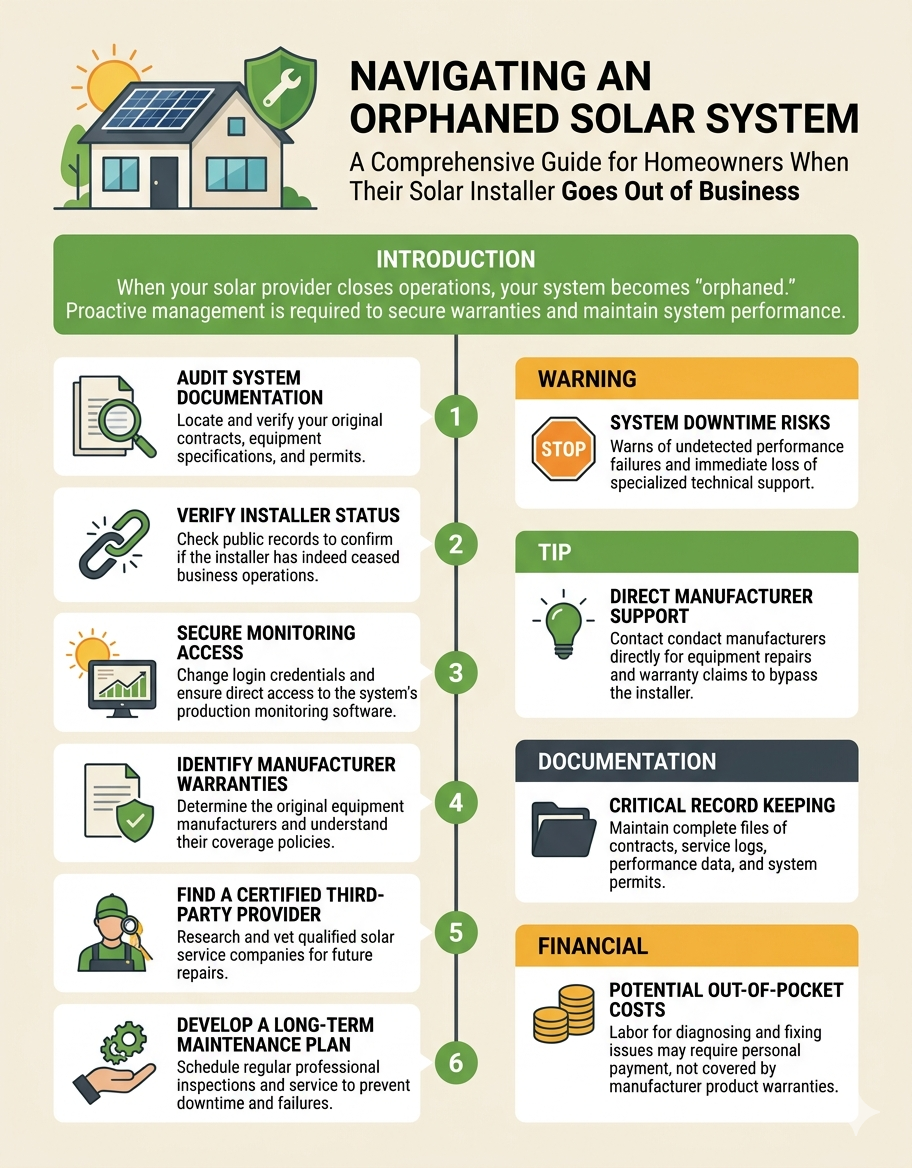
What Happens When Your Solar Company Goes Out of Business?
What Changes for Your Solar System
The physical system keeps running until something breaks. But solar system no support means you lose the safety net.
No one schedules annual checks. No one follows up on a drop in output. You become fully responsible for a system you may not fully know how to manage.
What Happens to Existing Service Agreements
Installer service contracts are tied to the company. When the company shuts down, those agreements usually stop being enforceable.
You may still have the right to chase damages in some cases. But active service stops right away. Solar maintenance responsibility falls to you from that point on.
What Happens to Incomplete Projects
An abandoned solar installation is a bigger problem than a finished orphaned system.
If work stopped before the system was inspected or turned on, it may not meet code. You may need to hire a licensed tech to finish or fix the work before the system can legally run.
What Happens to Monitoring and Customer Support
Most monitoring tools are set up by the installer or a third party. But solar monitoring after company closure can often be restored.
Contact the equipment maker directly. Register as the owner. Most brands let you do this yourself. It is one of the first steps you should take.
What Rights Do Homeowners Have?
Solar Contract Rights
Your solar contract rights do not vanish when a company closes.
You may still be able to file a breach of contract claim against the business, its owners, or a company that bought it. Check your original agreement. If the company was acquired, the new owner may have taken on those contract duties.
Warranty Rights
Equipment maker warranties often survive a company closure. Solar warranty rights in the United states depend on the exact warranty documents you received.
Panel and inverter makers often offer 10 to 25 year warranties. These are tied to the product, not the installer. They may still be valid even if your installer is gone.
Consumer Protection Rights
Several federal and state laws protect solar buyers. The FTC Act bans deceptive trade practices. Many states also have home improvement contractor laws that apply here. Check our solar state laws hub to find the consumer protection rules in your state. If you were misled during the sales process, you may have a claim under orphaned solar system legal rights including misrepresentation or unfair business practices.
Understanding Solar Warranties After Bankruptcy
Manufacturer Warranties vs Installer Warranties
There are two types of warranties in most solar installs. Maker warranties cover the equipment. Installer warranties cover the work done and any output promises.
When a company closes, installer warranties are usually gone. But solar warranty after bankruptcy can still apply if the equipment maker offers its own program. Contact them directly.
What Coverage May Still Remain
Check each piece of equipment on its own. Orphaned solar system warranty options vary by brand.
SolarEdge, Enphase, SunPower, and other big names have their own warranty programs. Some even have special plans for homeowners who have lost their installer.
How to File Warranty Claims
Call or email the maker directly. Give them proof of purchase, the date the system was installed, and each equipment serial number.
The documents needed for solar warranty claims usually include your original contract, permit records, and any warranty cards you got at install.
Records You Should Keep
Store these somewhere safe and easy to find:
- Original install contract
- Equipment serial numbers and model numbers
- Maker warranty papers
- Permit approvals and final inspection records
- Utility grid connection agreement
- Loan or lease agreement
Financial Risks Homeowners Should Understand
Solar Loans After Installer Closure
Yes. You still have to pay your solar loan even if the installer closed. Your loan is a separate deal with a lender. The installer going bankrupt does not cancel it. If the system was never built or never worked, you may be able to challenge the loan through your lender or under consumer protection law. The Consumer Financial Protection Bureau (CFPB) accepts complaints about solar financing when a lender is unresponsive or the loan was tied to an incomplete install. Contact your lender in writing right away if this is your situation. Do not wait.
Solar Leases and Power Purchase Agreements
If you signed a lease or PPA, the finance company may still own the panels on your roof.
Even if the original installer closed, the leasing firm may still have rights over the gear. Read your lease agreement to find out who owns the equipment and what happens if the installer shuts down.
Property Liens and UCC Filings
A solar lien after installer bankruptcy can cause problems with your property title.
Check your county property records for any UCC filings or liens tied to your solar loan. Solar equipment ownership verification matters most when you want to sell or refinance your home.
Potential Costs of Future Repairs
Without a service plan, all repair bills land on you. Orphaned solar system repair cost depends on the problem.
Swapping out an inverter usually costs between $1,000 and $3,000. Roof or panel repairs can run higher. Set aside a budget for maintenance now. It is much cheaper than a surprise repair later.
How to Protect and Maintain an Orphaned Solar System
Verify Equipment Ownership
Start by finding out who legally owns the panels. Look at your contract and any UCC-1 forms filed with your state.
If you bought the system outright, ownership is clear. If you financed or leased it, a third party may still own it. Sorting this out early protects everything else you do.
Restore Monitoring Access
Contact the inverter or panel maker to register the system under your name. Most brands, including Enphase and SolarEdge, let you take over the monitoring account directly.
Once you have access, you can track output and catch problems early. It is free in most cases and takes less than an hour.
Find a Qualified Service Provider
Look for a qualified solar service provider replacement in your area.
Search for NABCEP-certified techs or ask your equipment maker for a list of approved service providers. How to service an orphaned solar system starts with finding someone who knows your specific brand.
Schedule Preventive Maintenance
Have a qualified tech inspect the system at least once a year.
They should check the wiring, inverter output, panel health, and roof seals around the mount points. Catching small issues early keeps costs low.
Can You Sell a Home With an Orphaned Solar System?
Challenges Buyers May Raise
Yes, you can sell. But be ready for questions.
Buyers will want to know who owns the panels, whether the system is financed, and what warranties are still valid. A system with no paperwork makes buyers nervous. Good documentation keeps the deal moving.
Documents That Help During a Sale
Pull these together before you list your home:
- Original install contract with all equipment details
- Current maker warranty papers
- Proof that permits were pulled and the final check passed
- Recent monitoring reports showing system output
- Copy of your utility net metering agreement
Warranty and Ownership Verification
Make sure all liens or UCC filings tied to the solar system are resolved before you close. What happens to orphaned solar panels at sale time depends on whether ownership is clear and documented.
Title companies will flag any open filings. Get ahead of it before you list.
Preparing the System for Transfer
Have the system checked by a third-party tech before you list it. Transfer the monitoring account to the buyer at closing.
Give all documents in one folder for the buyer to review. A well-documented orphaned system adds value. It does not have to be a problem.
Orphaned Solar System Checklist
Documents to Gather
- Original install contract
- Permit records and final inspection certificate
- Utility grid connection and net metering agreement
- Any warranty documents signed at install
Warranty Information to Verify
- Panel maker and warranty length
- Inverter maker and warranty length
- Racking and mount system warranty
- Any remaining installer workmanship warranty
Financing Records to Review
- Loan agreement and current balance
- Lease or PPA contract and equipment ownership terms
- UCC-1 filings on your property title
- Any liens filed by the original installer
Equipment Details to Confirm
- Panel brand, model, and serial numbers
- Inverter brand, model, and serial numbers
- System size in kilowatts
- Install date and the date the system was turned on
Service Contacts to Secure
- Maker support numbers for each piece of equipment
- At least one NABCEP-certified local tech
- Your utility contact for grid connection issues
- A solar attorney if you need legal help with your contract
Frequently Asked Questions
What happens to orphaned solar panels?
They keep running until something fails. Without a service plan, all upkeep falls to you. Equipment maker warranties may still apply even after the installer has gone.
Who maintains orphaned solar panels?
The homeowner takes over once the installer closes. You can hire any licensed solar tech to service the system. Look for NABCEP-certified pros who know your equipment brand.
Do I still have to pay my solar loan?
Yes. Your loan is a deal with a lender, not the installer. The installer closing does not cancel your payments. If the system was never finished or never worked, talk to your lender and a lawyer right away.
Can another company service my system?
Yes. Any licensed solar tech can work on it. The original installer has no exclusive rights once they close. Ask your equipment maker for a list of approved service providers near you.
How much does orphaned solar system repair cost?
It depends on the problem. Small fixes may cost a few hundred dollars. Swapping an inverter usually runs between $1,000 and $3,000. If the original install was never finished or done wrong, costs can be much higher.
Can I sell a house with an orphaned solar system?
Yes, but prep is key. Gather all papers, clear any open liens, and have the system checked before you list. Buyers can feel good about a well-documented system even without the original installer.
What You Should Do Next
Your next move depends on where you stand right now. Here is a clear action plan for each situation.
If you think you were misled during the sale:
File a complaint with your state attorney general, the FTC, and the CFPB. Keep records of every promise that was made. Get legal advice about your orphaned solar system rights under your state’s consumer protection laws.
At Solar Cancellation Companies, we work with U.S. homeowners dealing with failed, abandoned, or incomplete solar installs. If you are not sure where to start, reach out for a case review at solarcancellationcompanies.com. You do not have to face this alone.