

Many American homeowners were sold solar with big promises. Guaranteed savings. Lower electric bills. Energy freedom. But for a lot of people, the reality looked very different.
If your bill is still high, your installer has gone quiet, or your contract had hidden terms, you may have legal options. A solar class action lawsuit lets homeowners with the same complaint take on a company together. This guide explains who qualifies, what evidence you need, and what to expect.
What Is a Solar Class Action Lawsuit?
How Class Action Lawsuits Work
A class action groups many people with the same complaint into one case. One legal team handles everything. If the case wins or settles, each member gets a share of the money.
For solar disputes, this usually means homeowners who dealt with the same company. They may have faced the same bad sales tactics or signed the same problem contract. You can look up your solar company in our directory to see if other homeowners have reported similar issues.
Types of Solar Disputes That Lead to Lawsuits
The most common issues include:
- Solar contract fraud lawsuits based on false contract terms
- Solar misrepresentation claims tied to inflated savings numbers
- Hidden fees in financing agreements
- Poor installation or long delays
- Wrong information about tax credits
- UCC-1 liens that block home sales
Why Homeowners Choose Class Actions Instead of Individual Cases
Taking a solar company to court alone costs a lot. It is slow and risky.
A class action shares the cost among all the plaintiffs. It also puts more pressure on the company. That often leads to faster settlements.
Why Solar Homeowners Take Legal Action
False Savings and Energy Production Promises
Many homeowners were shown reports with big savings numbers. When the bills stayed high, they found out the projections were not realistic. These situations often form the core of solar misrepresentation claims.
Keep your original savings estimate. Compare it to your actual utility bills. That gap is your evidence.
Misleading Sales Tactics and Contract Misrepresentation
Common examples of deceptive solar sales practices include:
- Calling solar ‘free’ because it replaces your utility bill
- Promising savings without actually checking your usage
- Making verbal promises that never showed up in the contract
- Hiding fee increases in the fine print of lease deals
Hidden Financing Costs and Dealer Fees
Solar loans often include dealer fees that raise the total cost of the system. These fees are not always explained clearly. Homeowners who find out after signing may have grounds for solar financing fraud claims.
Installation Defects, Delays, and Property Damage
Roof leaks, bad wiring, and systems that never hit their promised output are all valid reasons to sue a solar company. Take photos of every problem. Save every written complaint you have made.
Tax Credit and Incentive Misrepresentations
Some salespeople overstated the federal tax credit. Others implied that everyone would qualify. The federal Residential Clean Energy Credit requires you to owe federal taxes to benefit from it. If you took out a solar loan expecting a credit that never came through, that misrepresentation can support a legal claim.
Do You Qualify for a Solar Class Action Lawsuit?
Common Eligibility Requirements
To explore solar lawsuit eligibility, you generally need to show:
- You signed a solar contract or financing agreement
- The company made false or misleading statements
- You suffered real financial harm because of it
- Your situation is similar to other affected homeowners
Situations That May Support a Claim
You may qualify if your electric bill never dropped as promised. You may also qualify if your system was installed wrong, fees were added without notice, or the salesperson gave you wrong tax credit information.
Situations That May Not Qualify
If your system works as described in the written contract and your savings match the original written estimate, a case will be harder to build. Minor complaints that do not connect to actual financial harm are also difficult to pursue.
How Statutes of Limitations Can Affect Your Rights
Every state has a solar lawsuit statute of limitations. This is the legal deadline to file your claim. Miss it and your case may be over before it starts. In most states, the window is two to four years from when you first found out about the problem. Do not wait.
Evidence That Can Strengthen Your Claim
Contracts and Financing Agreements
Your original contract and loan documents are the most important items you have. They show what you were promised and what fees were shared with you up front.
Utility Bills and Savings Estimates
Pull 12 to 24 months of utility bills from before and after installation. Then compare them to the savings estimate you were shown during the sales process. That side-by-side comparison is often the core of the case.
Sales Communications and Marketing Materials
Texts, emails, brochures, and written proposals all count as evidence. If a salesperson made verbal promises, write them down now while the details are still fresh.
Inspection Reports and Repair Records
Any written inspection, repair estimate, or complaint letter adds weight to a solar installation defects lawsuit. Photos of damage or improper work are especially helpful.
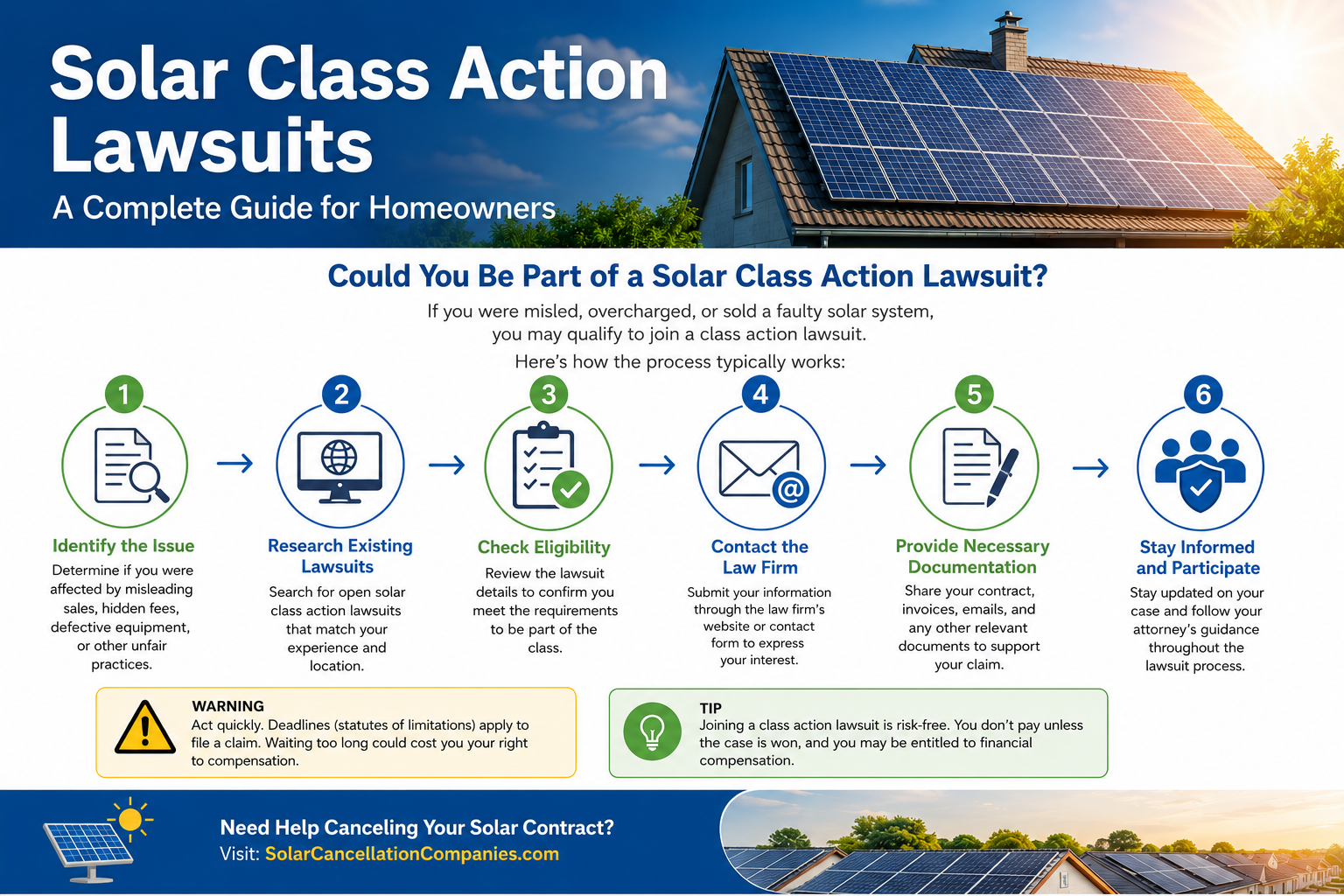
How to Join a Solar Class Action Lawsuit
Finding an Active Case
Search legal databases and consumer protection websites for active cases involving your solar company. The Federal Trade Commission and sites that track class action settlements often list open cases where you can join a solar lawsuit.
Verifying Your Eligibility
Once you find a relevant case, read the class definition carefully. You must match the criteria the court approved. An attorney can confirm whether your situation fits the case.
Submitting Supporting Documentation
You will need your contract, billing records, and a short summary of your complaint. The more organized your documents are, the stronger your position.
What Happens After You Join
Once you join, the legal team will keep you updated. You generally do not need to attend court hearings.
You are bound by the outcome of the case. That is one reason to review your options carefully before you sign on.
Understanding the Solar Lawsuit Timeline
Investigation and Case Filing
Attorneys review contracts and complaints from many homeowners. They look for a shared pattern. This phase can take several months before a case is formally filed.
Class Certification
The court decides whether the case can move forward as a class action. This step is critical.
The solar lawsuit filing timeline often gets longer at this stage, depending on how complex the case is.
Settlement Negotiations
Most cases settle before going to trial. Both sides work out terms, and the court must approve the final deal.
Negotiations can take one to two years in more complex cases.
Settlement Approval and Payouts
Once the court approves the settlement, class members are notified. They are given a deadline to submit their claims. The solar settlement payout timeline varies. Most payments arrive six to twelve months after final approval.
What Compensation Could Homeowners Receive?
Financial Losses and Overpayments
Homeowners may recover the gap between promised savings and actual costs. Undisclosed fees may also be recoverable. Solar company fraud compensation can include loan overpayments in some cases.
Installation and Repair Costs
If your system was installed incorrectly and you paid for repairs, those costs may be included in your claim.
Save all receipts and written estimates from any contractor you hired.
Property Damage Claims
Roof damage caused by poor installation can be part of a claim. You will need contractor assessments and photos to support it.
Settlement Awards and Other Remedies
Class action payouts vary a lot. Some settlements pay hundreds or thousands of dollars per household.
Others offer non-cash options like contract changes, lien removals, or warranty extensions. Set realistic expectations before you file.
Major Obstacles That Can Affect Your Case
Arbitration Clauses in Solar Contracts
Solar arbitration clause lawsuits are common because many contracts require disputes to go through private arbitration. This can stop you from joining a class action.
A lawyer can review whether the clause in your specific contract is enforceable.
Solar Loans and UCC-1 Liens
Many solar loans include a UCC-1 lien filed against your property. This can block a home sale or refinance until the loan is fully paid off or released. If this is your situation, a solar lien lawsuit may be the better path to take.
Installer Bankruptcy or Business Closure
If your installer went bankrupt, you may still have options. The lender who financed your loan may share legal responsibility.
Equipment makers may also have warranty duties. An attorney can help you figure out which parties are still liable.
Missing or Incomplete Documentation
A weak paper trail weakens your case. If you are missing your contract, contact the financing company or your state public utilities office. Lenders are often required to keep these records for several years.
Class Action vs Individual Solar Lawsuit
Key Differences
A class action is handled as a group. You share the attorney, the strategy, and the settlement payout.
An individual lawsuit is yours alone. You have full control, but you also carry all the cost.
Advantages of a Class Action
The main benefit is lower cost. Legal expenses are shared across many plaintiffs. It also lets you pursue a case that would be too small to fight on your own.
Most solar legal options for homeowners involve class actions for this reason.
When an Individual Lawsuit May Be Better
If your losses are much larger than those of other class members, a shared payout may not be enough.
In those cases, a separate individual suit may recover more. Speak with a solar class action attorney near me or in your state to compare what makes sense.
Other Legal Options Available to Homeowners
Contract Cancellation Rights
Solar contract cancellation rights vary by state. Some states allow a window to cancel after you sign. Some contracts also include buyout provisions.
If your installation was defective, the contract may be voidable under your state’s consumer law.
Consumer Protection Complaints
You can file a free complaint with your state consumer protection office. These records can support a future lawsuit. They also help flag companies that repeat the same bad practices.
State Attorney General Complaints
Several state attorneys general have taken action against solar companies for deceptive sales tactics. Filing a complaint does not start your own case. But it adds to a pattern that can trigger a larger investigation.
Frequently Asked Questions
Who qualifies for a solar lawsuit?
Homeowners who signed a solar contract, received false or misleading information, and suffered real financial harm may qualify. Solar lawsuit eligibility depends on the case details and your state’s rules.
Can I join a solar lawsuit after my system is already installed?
Yes. Most cases involve homeowners whose systems are already in place. The issue is not the installation itself. It is the sales practices or contract terms that followed.
What documents do I need for a solar lawsuit?
The documents needed for a solar lawsuit include your contract, loan agreement, original savings estimate, utility bills, and any emails or texts from the sales process.
What compensation might I receive?
Compensation varies. It may include partial refunds, overpayment recovery, repair costs, or property damage awards. Some settlements offer non-cash options like lien removal or contract changes.
What if my solar company went out of business?
You may still have options through the financing company, equipment maker, or warranty provider. An attorney can identify who is still liable and what claims you can still make.
Conclusion
If your electric bill never dropped as promised, gather your original savings estimate and your utility bills. That comparison is often the core of a misrepresentation claim. If a UCC-1 lien is blocking a home sale or refinance, talk to an attorney about lien removal before anything else.
Start by pulling together your contract, loan documents, utility bills, and any written communication from the sales process. Whether you pursue a solar class action lawsuit, an individual claim, or a consumer complaint, organized documents put you in a stronger position from day one.
Solar legal options for homeowners across the USA are real. Knowing what they are is the first step toward protecting your home and your finances. Visit solarcancellationcompanies.com for a free case review and to explore your next steps.