
If you still have a Solcius contract or a solar loan, the company’s bankruptcy does not wipe out what you owe. Solcius stopped operating and filed for Chapter 7 bankruptcy in February 2024. But many homeowners had separate financing deals that are still very much alive.
What you should do next depends on your project. Check whether Solcius finished the installation, who actually sold you the system, who financed it, whether your utility signed off on it, and what your paperwork says.
Is Cancellation Still Possible in 2026?
For most former Solcius customers, this isn’t a normal cancellation request anymore, because there’s no operating installer left to send it to.
Sunworks, the parent company, told the SEC that it and three related businesses shut down and filed Chapter 7 petitions on February 5, 2024. Solcius LLC’s case was filed in the U.S. Bankruptcy Court for the District of Delaware as case 24-10216-LSS.
Your issue probably falls into one of these buckets.
- An installation that never got started
- A job that was left half-finished
- Panels installed but never approved by the utility
- A solar loan you’re still paying off
- Sales promises that don’t match your contract
- A system that has broken down and needs repair
- A possible money claim tied to the bankruptcy itself
There’s no single rule that fixes all of these. The first step is simple. Separate your Solcius installation contract from your sales and financing paperwork. The company that put the panels on your roof may not be the one that sold you the system or lent you the money.
If you need the broader rules first, SCC’s solar contract cancellation guide explains how contract stage, financing, state law, and installation status can affect cancellation options.
Figure Out Which Problem You Actually Have
Your situation determines where to start looking.
| Your situation | What to check first |
| You signed, but work never started | Contract terms, whether the lender funded the loan, and who the seller was |
| Solcius started but never finished | What’s left to do, inspection status, and financing |
| Panels are up but there’s no utility approval | Utility and interconnection status |
| The system works, but you still want out | Your financing agreement and any separate sales dispute |
| The system has stopped working | Equipment warranty and who can service it now |
| Sales promises don’t match your paperwork | Who sold it to you, your written evidence, and financing terms |
| You think Solcius owed you money | Where the bankruptcy case stands and how to file a claim |
An unfinished project can support a dispute with the contractor or the lender, but it doesn’t automatically erase a separate loan you signed.
If your main problem is that the panels were installed but never cleared to operate, SCC’s solar interconnection and PTO delay guide explains what to check with the utility before treating it as a contract dispute.
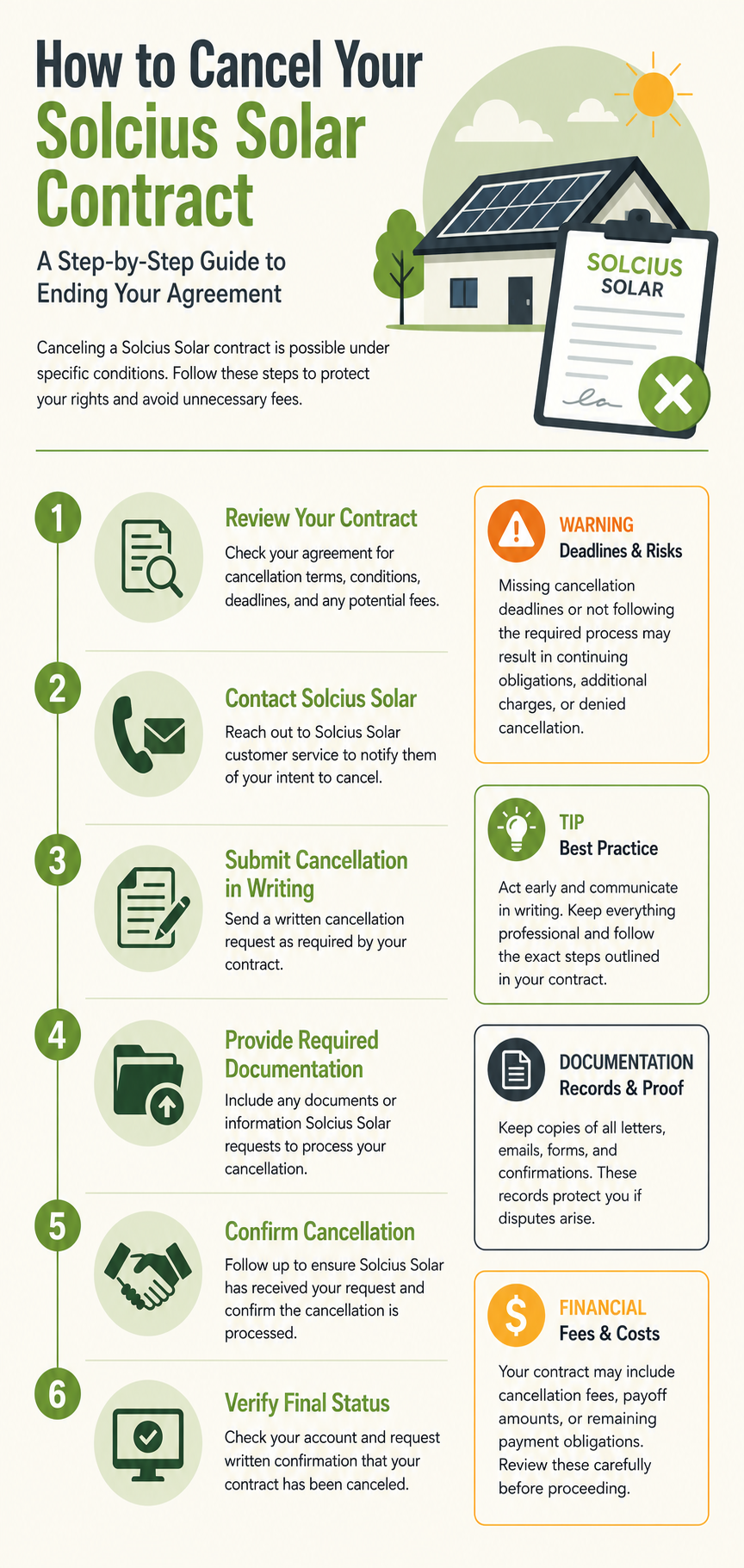
Who Actually Sold, Installed, and Financed Your System
This matters more with Solcius than the name on your roof might suggest.
Sunworks disclosed to the SEC that Solcius sold residential systems two ways, through its own sales team and through outside dealer partners. It also said three dealers brought in more than half of Solcius’s revenue in 2022, and that the company helped customers find financing through a network of lenders.
So a former Solcius customer may actually be dealing with four different companies.
- The sales company or dealer who pitched you the system
- Solcius, who was responsible for the actual installation
- A lender or servicer, who controls your loan and collects your payments
- The equipment maker, who controls any warranty on your panels, inverter, or battery
A filing Solcius made with the New York Department of Public Service shows how this played out in at least one state. Solcius said its New York systems were bought either directly by customers or through outside loan companies, and that Solcius itself was not the lessor on PPA arrangements there.
That’s specific to New York, though. Don’t assume every Solcius deal nationwide worked the same way.
Pull out your paperwork and check the legal names on each of these.
- Your installation contract
- Your original proposal
- Your financing agreement
- Your current loan statement
The company still taking your money each month may be a completely separate business from Solcius.
If Solcius Never Finished the Job
If your installation was left unfinished, start by writing down exactly where the work stopped.
Ask yourself these questions.
- Were the panels actually mounted?
- Was the electrical work completed?
- Did the project pass its local inspections?
- Did your utility give final approval to operate?
- Did you sign any kind of completion certificate?
- Did the lender release the loan funds?
- Is the system producing any power right now?
Your answers help point to whether the real problem is with the installation contract, the financing, the utility approval, or a mix of all three.
Don’t assume an unfinished job automatically cancels your loan. The Consumer Financial Protection Bureau’s solar financing research explains that solar loans often involve lenders working with separate installers or dealers. That means your loan obligation can sit with a company that had nothing to do with the actual installation work.
If a lender is still billing you, ask for your loan records and find out exactly when the money was released. Then compare that against the real status of your project.
For homeowners dealing specifically with an installer that shut down, SCC also has a solar installer bankruptcy guide covering contracts, payments, warranties, and unfinished work.
Still Paying a Loan After Solcius Shut Down?
Solcius closing its doors doesn’t cancel a loan held by someone else.
If bills are still showing up, track down these details.
- Who the original creditor was
- Who services the loan now
- What you still owe
- When the lender actually released the funds
- Any completion or installation certificate on file
- What your contract says about seller disputes
The CFPB has found that solar loans often involve separate lenders, dealer commissions, and fee structures layered on top of each other. That’s exactly why your financing agreement needs its own careful read, apart from the Solcius installation contract.
Don’t stop paying just because Solcius went under. Missing payments can create a brand new problem for you, depending on your agreement and your lender. If you’re thinking about stopping payments, or you already have, read SCC’s guide on what happens if you stop paying a solar loan or lease before deciding what to do next.
Can the FTC Holder Rule Help?
Maybe, but only in certain kinds of deals.
The FTC Holder Rule preserves certain claims and defenses a consumer has against a seller when a covered consumer credit contract is later held by another creditor.
For a Solcius customer, this could come into play when three things are all true:
- You have a real, legally valid claim against the seller
- Your financing deal is the kind the Holder Rule actually covers
- Your loan contract includes the required Holder Rule notice
This rule doesn’t mean every Solcius loan can be cancelled, and the bankruptcy by itself doesn’t give a lender a free pass either. Check your financing agreement for the Holder Rule notice. If your complaint is about work that was never finished, or something you were promised that didn’t happen, hold onto every piece of supporting evidence before you raise it with the lender.
Were You Sold Through a Separate Dealer?
The person who sold you the system might not have worked for Solcius at all.
Sunworks disclosed that Solcius used its own direct sales team plus a network of outside dealers and sales partners. That makes it important to know exactly who sold you the system, especially if your complaint is about something that happened before installation ever began.
Hold onto everything you can find.
- The salesperson’s name
- The name of the dealer or sales company
- Every email and text message
- Your original proposal
- Any savings estimates you were given
- Financing paperwork and presentations
- Advertisements you saw
- Any statements about the tax credit
- Every document you signed, including electronic ones
The CFPB’s residential solar financing report has flagged industry-wide risks involving dealer fees, tax-credit representations, and financing structures where the loan amount can exceed the system’s cash price.
These are industry-wide findings, not proof that Solcius or your specific salesperson did anything wrong. Your own documents are what determine whether a sales claim matters to your dispute.
Does an Old Cancellation Notice Still Matter?
It can help show whether the original sale followed the rules, but it won’t hand you a brand new cancellation window in 2026.
The FTC’s Cooling-Off Rule gives buyers a three business day window to cancel certain sales made at home or at another non-permanent business location. It doesn’t apply to every solar sale, though.
There’s also Solcius-specific proof from New York. A cancellation notice Solcius filed with the New York Department of Public Service stated buyers could cancel that particular sale, penalty free, within three business days. That doesn’t mean every Solcius customer nationwide got the same terms.
State law can add different protections. The California Public Utilities Commission’s Solar Consumer Protection Guide states that consumers generally have at least three business days to cancel, while customers age 65 or older generally have five business days. Different rules may apply in certain circumstances.
For an older contract, check these four things.
- Which state you signed in
- Where and how the sale actually happened
- The cancellation notice you were actually given
- The law that was in effect on the day you signed
Most former Solcius customers are now well past any three or five day window. If you never got the notice you were supposed to get, what happens next depends on your contract and your state’s law.
What Happened to Warranty and Repair Support
Solcius is no longer around to service the systems it installed.
EnergyAid’s Solcius service page says the company provides repair and service work for systems originally installed by Solcius.
That could matter if your system has:
- Low or no power output
- Equipment that’s stopped working
- Monitoring app or dashboard issues
- A need for a fresh inspection or repair
Keep in mind, offering repairs isn’t the same as taking on every legal obligation Solcius once had. EnergyAid’s service page doesn’t mean it inherited Solcius’s debts, its old contracts, or its workmanship warranty.
You should also check your equipment warranty separately from any of this. Track down the manufacturer name and serial number for your panels, inverter, any microinverters or optimizers, and your battery if you have one. Then look up that manufacturer’s current warranty terms directly. Don’t assume a repair is covered just because your system still looks like it should be within the advertised warranty window.
What the Bankruptcy Actually Means Now
Solcius’s bankruptcy is a Chapter 7 liquidation, which means the company isn’t reorganizing. It’s being wound down for good.
The case is number 24-10216-LSS in the U.S. Bankruptcy Court for the District of Delaware. Sunworks told investors that a court-appointed trustee took control of the company’s remaining assets and liabilities to sell them off under bankruptcy law.
If you believe Solcius owed you money before it closed, don’t assume you can simply file a claim today. Federal Bankruptcy Rule 3002 sets out the deadlines and narrow exceptions for filing a proof of claim in a Chapter 7 case, and the current version of that rule took effect on December 1, 2024.
Since the Solcius case began back in 2024, anyone thinking about a claim in 2026 should check four things first.
- The current court docket
- Whether a claim was already filed on your behalf
- What bankruptcy notices you actually received
- Whether any exception still allows a late filing
Don’t rely on an old article, or a rough guess, to decide whether filing is still possible. And remember, a bankruptcy claim against Solcius itself is a completely separate matter from a dispute with a third party lender.
Documents to Gather Before You Dispute Anything
A solid file should show what you were sold, what you signed, what was financed, and what actually got built.
- Installation agreement. Look for the scope of work, cancellation terms, warranty language, and dispute clauses.
- Dealer or sales agreement. This identifies any separate company involved in selling you the system.
- Financing agreement. Confirm your lender, the amount financed, payment terms, and dispute language.
- Holder Rule notice. Check whether your loan paperwork includes this FTC-required notice.
- Notice of Cancellation. Use the one you were actually handed, not a nationwide assumption.
- Proposals and sales messages. Save estimates, emails, texts, ads, and anything about the tax credit.
- Completion and inspection records. These show exactly how far the job got.
- Utility approval record. Confirm whether your system was ever cleared to operate.
- Loan statements and funding records. Line these up against your project’s real timeline.
- Equipment records. Save model and serial numbers for any warranty or repair claims.
- Production records. Keep any monitoring or utility usage data if performance is part of your complaint.
Together, these help you tell apart a Solcius problem from a dealer problem, a lender problem, or an equipment problem.
What Should You Do Next
For a former Solcius customer, the real question isn’t “how do I cancel” anymore. It’s “which part of this deal is actually still causing me a problem.”
If your project was left unfinished, write down exactly where it stands and check on the lender’s funding. If financing is the sticking point, review that agreement on its own, separate from the Solcius contract. If you were misled during the sale, track down the dealer and hold onto your evidence. If the system’s broken, check the manufacturer’s coverage and find someone who can service it today.
Solar Cancellation Companies helps homeowners sort through this kind of paperwork and figure out whether the real issue is the original Solcius contract, the financing, an outside dealer, an unfinished job, or some other party still in the picture. Getting clear on that comes before any decision to dispute, cancel, stop paying, or pursue anything else.
This article is for general information only. It isn’t legal, financial, bankruptcy, or tax advice. Your actual rights and options depend on your state, how your deal was structured, your financing agreement, your project’s status, and your own circumstances.
Frequently Asked Questions About Solcius Solar Contracts
Can I dispute my Solcius solar loan if the installation was never completed?
Possibly. An unfinished installation may support a dispute, but it does not automatically cancel a separate solar loan. Check when the lender released the funds, whether a completion certificate exists, and what your financing agreement says about disputes involving the seller or installer.
How do I find out who currently owns or services my Solcius solar loan?
Start with your latest loan statement and original financing agreement. Look for the original creditor, current loan servicer, account details, and payment instructions. The company collecting your monthly payments may be completely separate from Solcius and may still enforce the financing agreement.
Do I have to file a bankruptcy claim to dispute my Solcius financing?
Not necessarily. A bankruptcy claim against Solcius and a dispute with a third-party lender are separate matters. If your problem involves financing, review the loan agreement and lender records first. A bankruptcy claim may only be relevant if you believe Solcius itself owed you money.
What should I do if I cannot find my original Solcius contract?
Gather whatever records you still have, including loan statements, proposals, emails, text messages, utility records, inspection documents, and equipment information. You should also identify the dealer, lender, and current loan servicer. These records can help reconstruct how your solar transaction was structured.