
Your solar panels are installed. Your loan is active. But your electric bill looks the same as before. Or maybe you just found a $30,000 loan on your credit report. One the salesperson never clearly explained.
Situations like these are happening all across North Carolina. The FTC received over 7,000 solar fraud complaints in 2025 alone. That number keeps rising in 2026. For free resources and access to reviewed specialists serving North Carolina homeowners, visit Solar Cancellation Companies.
This guide will walk you through your North Carolina solar contract cancellation rights. You will learn what the North Carolina UDTPA means for your case. You will also learn how to file a North Carolina Utilities Commission complaint and what to do next.
Understanding Solar Contracts Before You Try to Cancel
The Four Most Common Solar Agreements
Before you do anything, you need to know what you signed. Most NC homeowners are dealing with one of these four types:
- Solar Purchase Agreement – You buy the system. Either upfront or through a loan.
- Solar Loan Agreement – A lender pays the installer. You pay the lender back each month.
- Solar Lease Agreement – You rent the equipment. You pay a monthly fee to use it.
- Power Purchase Agreement (PPA) – You pay for the power the panels make, not the panels themselves.
Each type has different solar contract cancellation requirements. Loans and leases behave very differently in a dispute. Know which one you have before you act. Our Solar Contract Type guide explains each structure clearly and what it means for your exit options. Know which one you have before you act.
Key Contract Terms That Affect Cancellation
Before you contact anyone, look for these terms in your contract:
- Cancellation windows and deadlines
- Liquidated damages clauses
- Early exit fees
- Dispute or arbitration clauses
- Performance guarantees, or whether they exist at all
Here is something most homeowners miss in 2026. The NC Supreme Court ruled in Warren v. Cielo Ventures (March 2026) that companies can shorten the standard four-year UDTPA filing window to just one year. This shortened period is valid if it appears in your contract.
Check your contract today. Do not wait.
Why Homeowners Cancel Solar Contracts in North Carolina
Misleading Savings and Utility Bill Claims
This is the number one complaint. The salesperson says your bill will drop to nearly zero. Then the panels go live and the bill barely moves.
That gap between what was promised and what happened is the core of most solar contract misrepresentation in NC cases.
Unexpected Loan Terms and Monthly Payments
Many homeowners did not even know they were signing a solar loan. Others were told the monthly loan payment would be less than their current electric bill. Then both bills arrive at once. The total is much higher than expected. That is a serious problem.
Installation Delays and Project Problems
You signed the contract months ago. Permits are stuck. No crew has shown up. The company has stopped returning calls. Delays like this are not just frustrating. They can support a breach of contract claim under NC law.
Systems That Do Not Perform as Promised
A system producing 60 percent of what was promised is a real issue. Especially when you are paying a full loan on it every single month.
High-Pressure Sales Tactics
These are the specific claims that can support a solar sales fraud North Carolina case:
- “Free solar” or “government program” claims with no clear explanation of real costs
- Guaranteed savings quoted as a fixed dollar amount
- Guaranteed tax credits without checking your eligibility first
- “Sign today” pressure tied to disappearing discounts
In November 2025, the NC Justice Center published a guide on exactly these tactics. It directs homeowners to the NC Attorney General’s Office and the FTC for help.
Can You Cancel a Solar Contract in North Carolina?
The Three-Day Cancellation Rule
North Carolina’s Door-to-Door Sales Act gives you three business days to cancel any contract signed at your home.
The seller must tell you about this right at the time of signing. If they did not, your cancellation window may be longer than three days. You can review how solar state laws handle cooling-off periods across different states to understand how NC compares.
What Happens After the Cancellation Window Ends?
Missing the three-day window does not end your options. It means you need a different legal reason to cancel. That is where UDTPA rights and contract law become important. Keep reading.
Cancellation Before Installation vs After Installation
Before installation: You are in a stronger spot. The company has not done any work yet. Damages are limited.
After installation: It gets more complex. The loan, the equipment, and any liens on your home all become part of the picture.
But solar cancellation after installation is still possible. It depends on the facts of your situation.
Situations That May Still Allow Cancellation
- Misrepresentation – The salesperson made false claims during the sale
- Fraud – Intentional lies about costs, savings, or program eligibility
- Breach of contract – The company failed to install on time or deliver what was promised
- Failure to perform – The system consistently underperforms what the contract states
North Carolina UDTPA Rights for Solar Customers
What Is the UDTPA?
The North Carolina Unfair and Deceptive Trade Practices Act protects consumers from dishonest business practices.
If a solar company used false or misleading claims to get you to sign, that may qualify as a UDTPA violation. This applies even if the misrepresentation was verbal.
How Solar Companies Can Violate Consumer Protection Laws
A successful UDTPA claim against a solar company in NC can result in:
- Triple damages, known as treble damages
- Recovery of your attorney fees
- Cancellation of the contract
A Critical 2026 Warning
Because of the March 2026 NC Supreme Court ruling, your contract may contain a one-year window to file a UDTPA claim instead of the standard four years.
If your contract was signed more than six months ago, check it now. Your window may be shorter than you think.
Solar Loans: The Most Overlooked Part of Contract Cancellation
Why the Loan and Installation Contract Are Separate Agreements
Your solar loan cancellation process is completely separate from canceling the installation contract. The lender is a different company. Canceling the install does not cancel the loan. You have to address each one on its own.
What Happens to Financing When a Project Is Canceled?
If the installation is disputed or canceled, the loan usually stays active. It keeps running until you address it directly. You may need to dispute the loan with the lender, file a CFPB complaint, or take legal action to deal with it properly.
Common Solar Financing Problems
- Dealer fees added to the loan total without clear disclosure
- Loan balance higher than the actual cost of the system
- Autopay starting before the system was inspected or switched on
When Financing Disputes Become Part of the Case
If the lender knew about the contractor’s false claims, that opens more legal options. This is where working with a North Carolina solar cancellation lawyer makes a real difference.
What Evidence Can Strengthen Your Solar Dispute?
Solar Contract Cancellation Checklist
Gather these documents right away:
- Signed contract and all addenda
- Loan agreement and lender disclosure forms
- All emails and texts with the salesperson
- Written savings estimates or utility projections shown during the sale
- Permit applications and approval records
- Installation completion certificates, or proof they were never issued
- Utility bills from 12 months before and after installation
- System monitoring data if you have access to it
- Photos of the installation with timestamps
- Voicemails or any verbal promises later confirmed in writing
Evidence That Often Supports Misrepresentation Claims
- Sales quotes showing savings that never materialized
- Any document describing your loan as a grant, rebate, or government program
- Salesperson messages about guaranteed tax credits
Where to File a Solar Complaint in North Carolina
| Agency | Best For | What It Can Do |
| NC Attorney General | Deceptive sales, fraud patterns | Investigate and take legal action against companies |
| NC Utilities Commission | Utility billing, grid connection issues | Regulate utility practices and mediate disputes |
| CFPB | Solar loan or financing problems | Regulate lenders and look into bad financing deals |
| FTC | Door-to-door fraud, cooling-off rule violations | Build enforcement records and pursue national cases |
What Happens to Deposits, Fees, and Existing Payments?
Can You Recover Your Deposit?
Within the three-day window: yes, in most cases. After that, recovery depends on your contract’s cancellation terms and whether you can prove misrepresentation or breach of contract.
Understanding Liquidated Damages Clauses
Many contracts say you owe a fixed amount if you cancel after a certain point. These clauses are common. But they are not always enforceable. Especially if the cancellation happened because the company misled you or failed to deliver what was promised.
What Happens to Payments Already Made?
In misrepresentation or fraud cases, getting those payments back may be part of a legal remedy. Track every payment you have made, including monthly loan payments to the financing company.
Special Situations That Complicate Solar Contract Cancellation
The Solar Company Goes Out of Business
This happened with Pink Energy in North Carolina. The company closed after a wave of homeowner complaints.
When a company shuts down, your best options shift to the lender, warranty providers, and state consumer protection programs. Act fast. Do not wait to see what happens.
Permits Already Approved or Equipment Delivered
These situations do not block cancellation. But they do add complexity. Removal costs and permit reversal fees become part of the negotiation. Get these terms in writing before agreeing to anything.
Installation Is Already Complete
Even a fully installed system can be disputed if the sale involved misrepresentation. The equipment being on your roof does not make the contract unbreakable. The facts of the sale still matter.
The Homeowner Wants to Sell or Refinance
Solar loans and leases can create issues when you try to sell or refinance your home. They attach to the property and can slow down or block a clean title transfer. Resolve the dispute before listing your home.
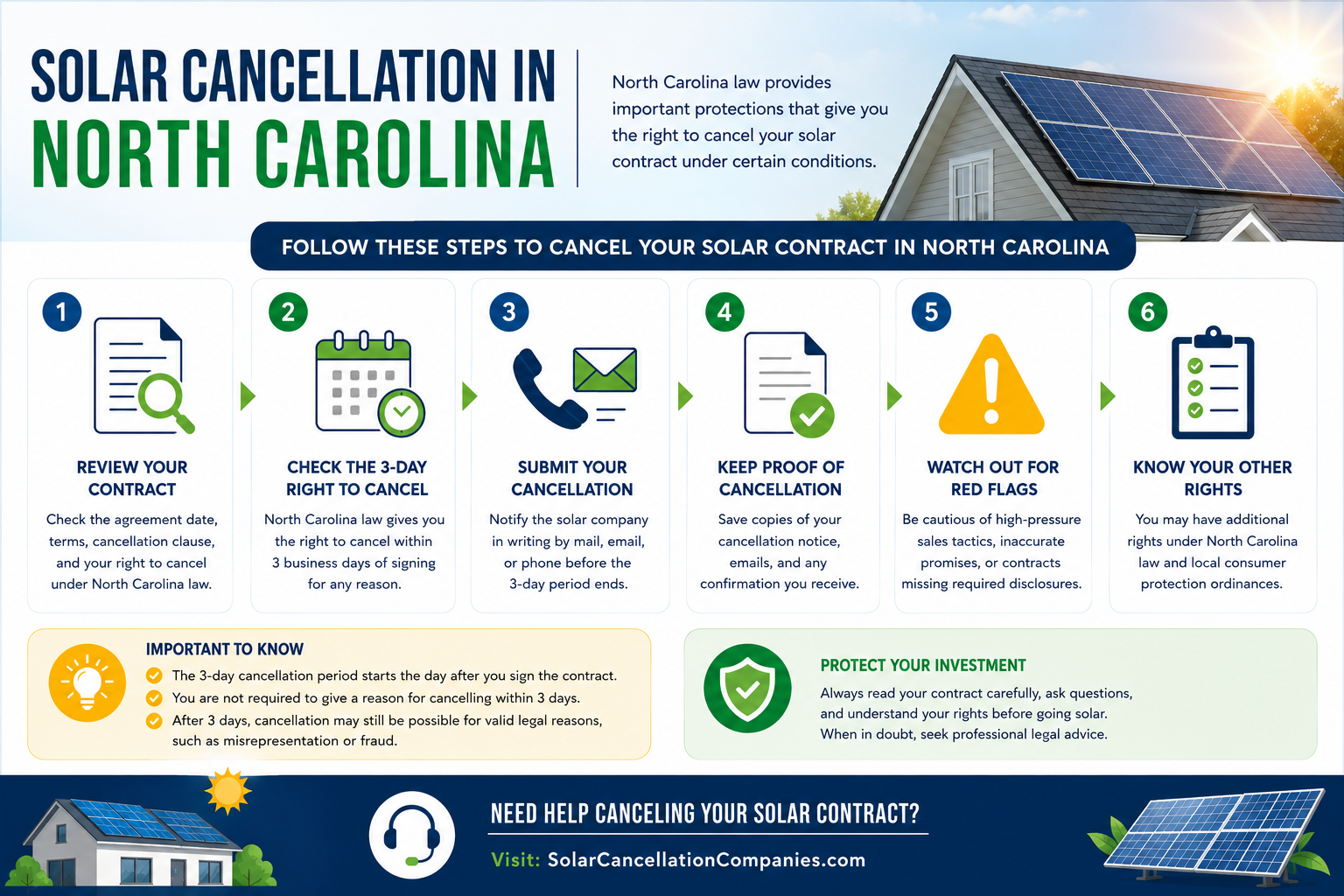
North Carolina Solar Contract Cancellation Action Plan
Step 1: Review the Contract
Read every page. Look for the cancellation clause, any shortened dispute window, and exact language around savings or system performance.
Step 2: Preserve All Evidence
Screenshot text messages now. Save all emails. Print copies of your utility bills.
Keep anything that shows what you were promised versus what you actually received.
Step 3: Review Your Financing Obligations
Call your solar lender. Find out your current balance, payment status, and any clauses about canceling the financed project.
Step 4: Identify Potential Misrepresentations
Compare what the salesperson said to what the contract actually promises.
Write down every claim you remember. If you have written evidence of those claims, that is very useful.
Step 5: Determine the Right Complaint Path
Use the table above. For most Raleigh solar contract cancellation or Charlotte solar cancellation cases, starting with both the NC Attorney General and CFPB at the same time is the most effective approach.
Frequently Asked Questions
Can I cancel a solar contract in North Carolina after the three-day window?
Yes. If the company made false claims about savings, tax credits, or loan terms, you may still have options. UDTPA claims, breach of contract claims, and fraud-based remedies can all apply after the three-day window closes.
What if the solar company went out of business?
Contact your lender right away. File complaints with the NC Attorney General, CFPB, and FTC. Document every attempt you made to reach the company. Warranty coverage from the equipment maker may still be active.
How long do I have to file a UDTPA claim in North Carolina?
The standard window is four years. But a March 2026 NC Supreme Court ruling confirmed that contracts can shorten this to one year. Check your contract right now for any shortened limitation clause. Time may already be running.
Which agency handles solar complaints in North Carolina?
The NC Attorney General’s Consumer Protection Division handles deceptive sales complaints. The North Carolina Utilities Commission handles billing and grid issues. The CFPB handles loan disputes. You can file with more than one agency at the same time.
Conclusion: What to Do Right Now
Solar contract disputes can be stressful, especially when unexpected loan obligations, installation issues, or misleading sales claims are involved. The good news is that North Carolina homeowners may have more options than they realize, depending on the facts of their situation.
At Solar Cancellation Companies, we regularly educate homeowners about solar contract concerns, financing disputes, cancellation challenges, and consumer rights. Understanding your contract, preserving key documents, and evaluating your options early can make a significant difference.
If you need additional guidance, our trusted partner, Solar Equity Solutions, can also review your contract, assess your documentation, identify potential concerns, and help you better understand the options available based on your situation.