

Ohio solar complaints are growing fast. In January 2026, the Ohio Attorney General sued G3 Solar. The case claims the company used high-pressure sales tactics. Many Ohio homeowners ended up paying more each month, not less.
That case was filed under Ohio’s Consumer Sales Practices Act. It is one of many in recent years.
If you signed a solar contract in Ohio and feel misled, you are not alone. This guide tells you what your rights are, what options you have, and what to expect at each stage.
Can You Cancel a Solar Contract in Ohio?
When Cancellation May Be Possible
Yes, in some cases you can cancel. But it depends on three things: timing, your contract terms, and the facts of your case.
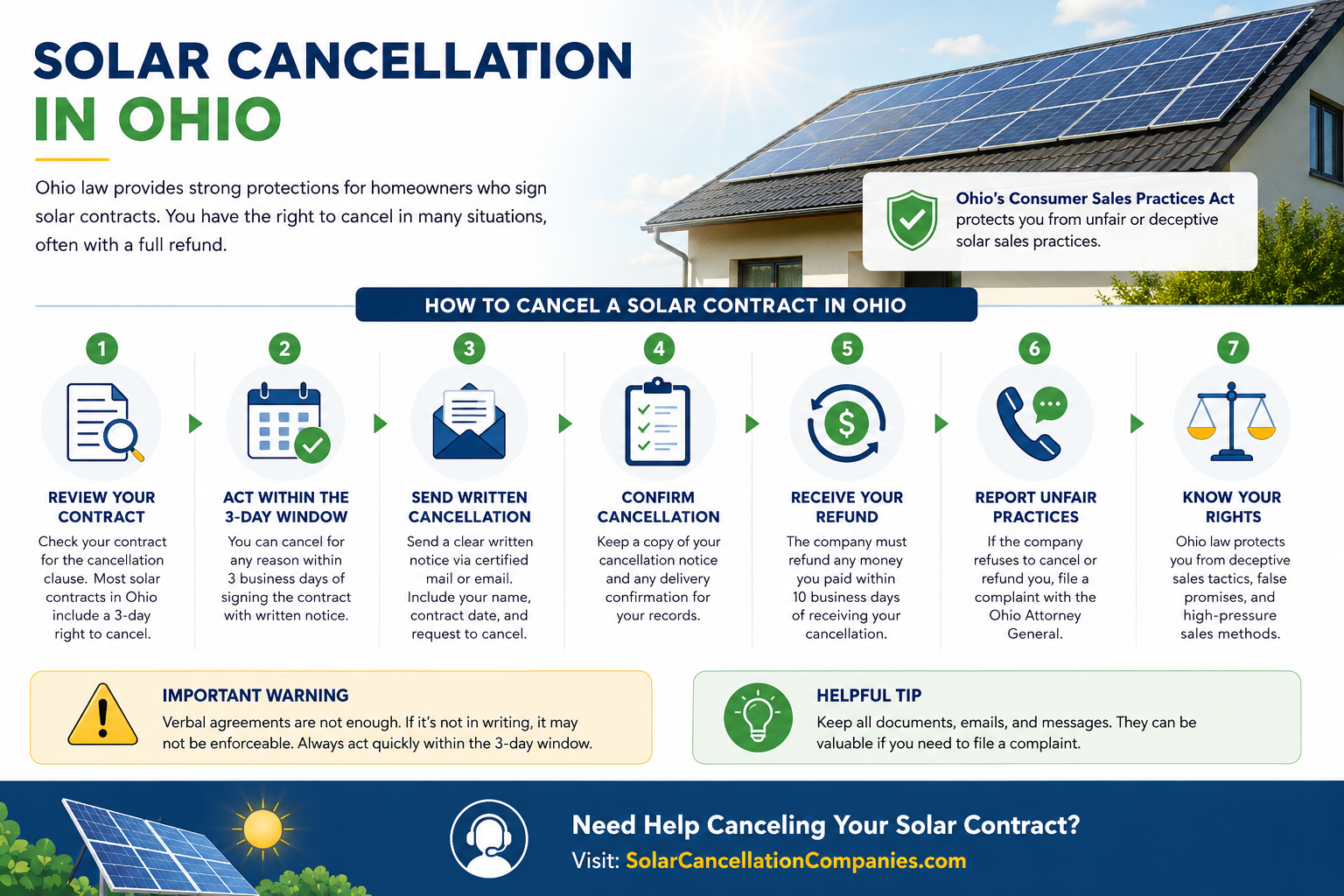
Ohio’s Home Sales Act gives you three days to cancel a contract signed at your home. This is part of your Ohio solar cancellation rights under state law. It applies when a sales rep came to your door and you sign at home.
There is one key point. If the company never gave you that right to cancel in writing, your three-day window may not have started. That can work in your favor.
Situations That Often Lead to Solar Disputes
Most homeowners who want out share the same story.
- Bills did not drop as promised
- Loan terms were not explained before signing
- The system puts out far less power than the estimate said
- The company went silent after the job was done
- The homeowner wants to sell the house and the loan is now a problem
Why Your Contract Details Matter
Not every solar deal is set up the same way. Some are purchase deals. Some are loans. Some are power buy deals. Your solar contract cancellation timeline and your options depend on which type you signed.
Our solar contract type guide breaks down each agreement type and what it means for your rights. Look at the first page of your documents. Do that before you take any action.
Understanding the Solar Agreement You Signed
What Is Included in a Typical Ohio Solar Contract?
A typical solar contract covers the equipment, install dates, warranty terms, power output estimates, and payment details. It may also include a clause that limits how disputes are handled.
Solar Contract vs Solar Loan: What’s the Difference?
This is where many homeowners get confused. Your install contract and your loan are two separate legal documents.
One is with the solar company. The other is with a lender like Mosaic, GreenSky, or Sunlight Financial. Canceling the install contract does not cancel the loan. That is one of the most important facts to know before you act.
Why Many Homeowners Don’t Realize They Signed Multiple Agreements
Sales visits move fast. Docs are shown one page at a time on a tablet. Many homeowners sign a loan form thinking it is just a step in the process.
One Ohio homeowner was told the panels were free. Later they found out they had a $52,000 loan with monthly payments. The loan details were never clearly explained.
Ohio Consumer Protection Rights for Solar Customers
What Is the Ohio Consumer Sales Practices Act (CSPA)?
The Ohio Consumer Sales Practices Act solar protection falls under Ohio law ORC 1345.01. It bans unfair and deceptive acts in consumer deals. This covers false claims, hidden fees, and failure to share key contract terms.
Under the CSPA, you may claim actual damages. In some cases, you can also seek up to $5,000 in non-economic damages through a civil case.
Common Solar Sales Practices That Raise Red Flags
These are the most common red flags in solar company misrepresentation Ohio cases.
- Guaranteed savings claims that promise set dollar amounts without disclosing all the variables
- “Free solar” promises where the loan is buried in the paperwork
- False tax credit claims. The federal Section 25D credit expired on December 31, 2025. Some reps still claim it applies to new deals
- Hidden fees or rate increases added after a verbal deal was made
- Inflated power output estimates used to make the monthly loan payment seem fair
Signs You May Have Been Misled by a Solar Company
Your bill is the same or higher than before solar. The system puts out far less than the written estimate. Your loan balance was not explained before you signed.
The rep used urgent lines like “this offer ends today.” These patterns show up in Ohio CSPA cases, including the G3 Solar lawsuit filed in 2026. You can check whether G3 Solar or your installer has a complaint history through our solar company lookup tool.
The Most Common Reasons Ohio Homeowners Seek Cancellation
The Savings Promised Never Materialized
False savings claims are the top complaint. If a rep promised a 60 percent bill drop and your bill stayed the same, that claim may support a CSPA complaint or a legal challenge.
Unexpected Loan or Financing Terms
Some homeowners find out later that their loan has a dealer fee, a yearly rate increase, or an early payoff penalty. These terms are binding once signed, even if the rep never brought them up during the visit.
Installation Delays and Project Abandonment
Some companies take a deposit, pull permits, and then go quiet. If your installer has stopped all contact and the project has stalled for months, that may break the terms of your contract. Check what your deal says about timelines. Our solar exit guides cover what to do when an installer goes silent or abandons a project.
System Performance Falls Short of Expectations
Output estimates in solar deals are projections, not promises. But if the written estimate was used to justify your monthly payment and actual output is far lower, that gap may support a dispute.
Contract Terms Were Not Fully Explained
Under Ohio’s Home Sales Act, companies must give you a written copy of the agreement and a written notice of your right to cancel. If you never got those documents, your cancellation window may still be open.
The Homeowner Wants to Sell the Property
A personal solar loan stays with you as the borrower. A PACE loan may attach to the property title. Either way, buyers often raise concerns during a sale.
Share the loan details early and speak with a real estate lawyer. That step can stop a deal from falling apart at the last minute.
Does the Installation Stage Affect Your Options?
Before Installation Starts
This is your easiest window. Send a written notice to the company before any work begins. That is the cleanest path. Check your contract for a cancellation clause and follow it step by step.
After Permits Are Approved
Approved permits mean the company has spent time and money. Canceling at this stage may trigger fees. Review your contract to see what those costs are before you act.
After Equipment Delivery
Equipment at your property adds more problems. You may owe return or delivery costs. Do not agree to anything by phone. Get every response in writing.
After Installation Is Complete
The ability to cancel solar contracts after installation is much harder. Your best arguments at this point are false claims, CSPA violations, or a clear breach of the contract. Start keeping records of everything now.
After the System Is Operating
Once the system is live and running, you need legal grounds to cancel. Regret alone is not enough. If you believe you were deceived, that changes things in a big way.
What Happens to the Solar Loan If You Cancel?
Why Canceling the Contract May Not Cancel the Loan
This is one of the most misunderstood parts of solar disputes. The how to cancel solar loan question has a short answer.
Canceling the install contract does not cancel your loan. Your lender may still hold you to the deal unless you can show false claims, deception, or a legal flaw in the transaction.
Solar Loan Risks Homeowners Often Overlook
- Some loans include a Notice to Proceed that the installer sends on your behalf, often before any work begins
- Loan funds may have already been sent to the installer, sometimes before the job is finished
- Early payoff penalties can make it much more costly than expected
Can You Challenge Both Agreements at the Same Time?
Yes, but it takes careful planning. If you believe the loan was obtained through false claims, you may be able to challenge it through the lender’s dispute process, the CFPB, or legal action.
Some attorney general cases have produced real refunds for consumers when fraud was found across both the contract and the loan.
Should You Continue Making Payments During a Dispute?
Stopping payments will hurt your credit score. Keeping up with payments may weaken your argument that you were harmed. There is no single right answer here.
Talk to a consumer lawyer who can look at your specific case and give you clear guidance.
How to Cancel a Solar Contract in Ohio
Review the Contract and Financing Documents
Read every page, including the back. Look for cancellation clauses, dispute clauses, and notice rules. The solar contract cancellation requirement process almost always starts with the steps written in your own contract.
Gather Evidence Supporting Your Position
Pull together all your records before reaching out to the company. The stronger your paper trail, the better your position in any dispute.
Submit a Written Cancellation or Dispute Notice
Send a written notice by certified mail or email with a read receipt. State clearly what you are disputing and what outcome you want. Keep every copy.
Escalate the Matter Through Available Channels
If the company does not respond or refuses to fix the issue, you have clear paths forward. These include the Ohio Attorney General, PUCO, and, if the loan is involved, the Consumer Financial Protection Bureau.
Filing a PUCO Complaint
When a PUCO Complaint Makes Sense
The puco solar complaint process works best when your solar system is tied to the grid and your dispute involves billing, net metering, or changes to your utility account.
PUCO is a regulator. It does not enforce solar contracts. For contract and false claims disputes, the Ohio AG’s office is often the stronger path.
Information You Should Prepare Before Filing
- Your utility account number and service address
- The solar company name and installer details
- A clear description of the issue with key dates
- Copies of all relevant emails, contracts, or messages
The PUCO Complaint Process Step by Step
- Go to puco.ohio.gov and find the File a Complaint section
- Fill out the online form or call 1-800-686-7826, Monday to Friday, 8am to 5pm
- PUCO contacts the company and asks for a response
- PUCO acts as a go-between. They do not take sides or speak for either party
- If the informal process fails, you can move to a formal complaint hearing
What Outcomes Can Homeowners Realistically Expect?
PUCO aims to make first contact within three to five business days. Full resolution depends on how complex the dispute is. Formal hearings can take several months.
A complaint can lead to a resolution. But it does not guarantee one. Set realistic goals going in.
Other Options Beyond PUCO
Filing a Complaint With the Ohio Attorney General
The Ohio solar fraud complaint path through the AG’s office is a strong option. The AG has already sued both Pink Energy and G3 Solar under the CSPA.
You can file a puco complaint in Ohio and also report to the AG at OhioProtects.org or by calling 800-282-0515. When enough complaints build up about one company, the AG is more likely to take action.
Arbitration and Contract Dispute Clauses
Many solar contracts include a binding dispute clause. If yours does, going to court may not be your first option. Read the clause carefully. This process works outside the court system but can still lead to a fair result.
When Legal Assistance May Be Appropriate
If your dispute involves a large loan, suspected fraud, or a company that has gone silent, talking to an Ohio solar contract lawyer is a smart move.
Many consumer lawyers offer free first meetings. The CSPA allows winning consumers to recover legal fees in some cases. That makes legal action more reachable than many homeowners think.
Ohio Solar Contract Cancellation Checklist
Gather these documents before filing any complaint or cancellation notice. Having them ready will speed up every step of the Ohio solar dispute resolution process.
- Solar contract (the install or purchase agreement)
- Loan agreement (this is separate from the install contract)
- Sales proposal (the document shown to you before you signed)
- Utility bills from before and after the install
- Emails between you and the company
- Text messages with the sales rep or project contact
- Marketing materials including any printed savings estimates or brochures
- Installation records and inspection certificates
- Production estimates from the proposal vs your actual monitoring data
Frequently Asked Questions
Can I Cancel a Solar Contract After Signing?
If a rep came to your home and you signed there, Ohio law gives you three business days to cancel in writing. If you were never given a written notice of that right, the window may still be open. Check your contract first.
How Long Does the PUCO Complaint Process Take?
First contact usually happens within three to five business days. Full resolution depends on how complex the dispute is. Formal hearings can take several months.
Will Canceling Affect My Credit?
Stopping loan payments will hurt your credit. Canceling an install contract without stopping payments may not. The impact depends on your specific loan terms and the steps you take. Get legal advice before stopping any payments.
What If the Solar Company Stops Responding?
Write down every attempt you make to reach them. Send a written notice by certified mail. File complaints with the Ohio AG and the Better Business Bureau. If a loan is involved, tell the lender too. A pattern of no response strengthens your case.
Can a Solar Contract Affect Selling My Home?
A personal solar loan stays with you as the borrower. A PACE loan may attach to the property title and pass to the new owner. That can cause problems in a sale. Share the loan details early and speak with a real estate lawyer.
Do I Need a Lawyer to File a Complaint?
No. You can file with PUCO and the Ohio AG on your own. But if you have a large loan, active fraud, or a company that has closed or gone silent, getting legal help is a smart move. Many consumer lawyers handle CSPA cases on a no-win-no-fee basis.
What Ohio Homeowners Should Do Next
If something felt off about your solar sale, trust that feeling. Start pulling your documents together today. Your Ohio solar contract cancellation checklist is the base of every option open to you. That includes PUCO complaints, AG reports, dispute hearings, and legal action.
The FTC received over 7,000 solar fraud complaints in 2025. Ohio is one of the most active states for enforcement. You are not the first person in this position.
Start with what you signed. Then look at what you were told before you signed. If those two things do not match, that gap is where your dispute lives.
For more guidance on solar contract rescission Ohio, real homeowner cases, and state-by-state resources, visit Solar Cancellation Companies at solarcancellationcompanies.com. They help Ohio homeowners understand their options and find the right support for their situation.