

You signed a solar deal. The salesperson said your bills would drop. Now the loan is bigger than you were told. The panels barely work. Or the company is gone. You want to know: can I fight this?
The short answer is yes. The Truth in Lending Act (TILA) gives you the right to cancel a home loan if the lender hid fees or skipped key disclosures. In 2026, this matters more than ever. Solar loan complaints have surged. The federal solar tax credit expired. And many lenders are still burying fees in loan balances. Here is how to protect yourself. For free resources and access to reviewed specialists who handle solar financing disputes, visit Solar Cancellation Companies.
Understanding TILA Rescission Rights for Solar Financing
What Is the Truth in Lending Act (TILA)?
TILA is a federal law that protects borrowers. It forces lenders to show you the full cost of a loan before you sign. It covers your APR, total fees, and your right to cancel.
When a lender skips those steps, TILA gives you legal tools to undo the deal. The CFPB’s official TILA and Regulation Z compliance resource explains exactly what lenders must disclose and what happens when they fail to do so.
How TILA Applies to Solar Loans
If your solar financing agreement is secured by your home, TILA almost certainly applies. This includes home equity loans, HELOCs, or any loan tied to your property.
The CFPB’s August 2024 report on solar financing found that lender disclosures are often incomplete, wrong, or missing. That is the heart of most TILA rescission solar disputes. Not sure what type of solar financing you have? The Solar Contract Type guide explains the difference between loans, leases, and PPAs and which ones fall under TILA protections.
When Homeowners May Have Rescission Rights
You may have the right to cancel your loan when:
- The lender gave you wrong or missing TILA disclosures at closing
- You never got a signed right to cancel notice
- The APR or finance charges were wrong because of hidden dealer fees
- The loan was funded before your panels were installed
TILA Rescission vs Solar Contract Cancellation
TILA rescission and regular contract cancellation are two different things. TILA rescission is a federal right. When it works, the lender’s claim on your home becomes void. They must return all fees within 20 days. You return the loan amount.
A standard cancellation only works if your contract allows it. TILA works regardless of what your contract says.
Common Reasons Homeowners Dispute Solar Financing Charges
Hidden Dealer Fees and Loan Markups
This is the biggest problem in 2026. The CFPB found that solar lenders add hidden dealer fees of 10% to 30% above the cash price without putting them in the APR. One borrower told the CFPB their lender added a 26% upfront fee that was never explained.
A 2026 lender review found the average solar loan now includes a 22% dealer fee. On a typical system, that adds over $5,700 to your balance. If the fee was not shown in your loan cost, that may be a TILA violation.
Misleading Sales Representations
Sales reps promised your bill would hit zero. Or they said a 30% federal tax credit would cover part of the cost. That credit expired December 31, 2025. If a salesperson used it to close your deal in 2026, that is a false claim and may support a legal case.
Incorrect APR or Finance Charge Disclosures
If the dealer fee was left out of the finance charge, then the APR shown on your paperwork is wrong. A wrong APR is a TILA error. It can extend your window to cancel the loan.
Missing Right to Cancel Notices
At closing, TILA requires the lender to give you two copies of the right to cancel form. If you never got them, your three day rescission window may not have started. That means you might still be within your legal window today.
Forged Signatures or Inaccurate Application Information
Some solar sales reps inflate income on loan forms without telling the homeowner. Others have forged signatures on loan documents. These are federal crimes. They give you strong grounds to challenge the solar finance agreement.
Incomplete or Defective Solar Installations
If your system was installed but never turned on, or it fails to produce power, you may have both a contract claim and a TILA violation claim against the lender. This is especially true if the loan was paid out before the install was checked or finished.
Can You Cancel a Solar Loan Under TILA?
The Three Day Right of Rescission
Under 15 U.S.C. § 1635, you have three business days after signing to cancel a home loan for any reason. For solar loans tied to your home, the clock starts when you get all required TILA paperwork, not just when you sign.
When the Rescission Period May Be Extended
If the lender gave you wrong disclosures or skipped the right to cancel form, your solar financing dispute deadline can stretch to three years from the date of the transaction. Most homeowners never know this option exists.
What Can Trigger a TILA Violation
- Dealer fees left out of the disclosed finance charge
- APR that was set without adding all required fees
- A missing or unsigned Notice of Right to Cancel
- Loan amount higher than the cash price with no explanation
- Loan funded before the three day window closed
Limits of TILA Rescission Rights
TILA rescission applies to home secured credit. It generally does not cover unsecured solar loans. The three year window is a hard deadline. Once it passes, you lose the federal right to rescind. Other legal paths may still exist, but TILA rescission is gone.
Can You Rescind Solar Financing After Installation?
Does Installation End Your TILA Rights?
No. This is one of the biggest myths in solar disputes. Having panels on your roof does not end your TILA rights. If the lender never gave you proper disclosures, you can still rescind solar financing after installation for up to three years.
Other Legal Options Past the Rescission Window
Even after three years, you may still have options:
- State consumer protection laws
- FTC Holder Rule claims against the lender
- Breach of warranty or contract claims
- Fraud or misrepresentation lawsuits
Your state’s specific protections matter significantly here. Our Solar State Laws directory breaks down consumer protection rules by state, including which states allow the strongest post-window claims.
System Performance Issues and Financing Disputes
If your system produces far less than the installer promised in writing, that gap may prove a breach of contract. In 2026, legal teams use performance audits to compare actual output against the numbers in your contract.
Loans Funded Before Project Completion
If your lender paid the installer before your system was up and running, that is a red flag. It can strengthen both a TILA violation claim and an FTC Holder Rule case against the lender. Our Sunnova solar contract cancellation guide shows how early loan funding became a key dispute factor after the company’s bankruptcy, a pattern repeated across multiple lenders.
How to Spot a TILA Violation in Your Solar Contract
Missing Required Disclosures
Your closing packet must include a Truth in Lending Disclosure Statement. It should show your APR, finance charge, amount financed, total payments, and payment schedule. If any of those are blank or missing, that may be your case right there.
Errors in Finance Charges or APR
Compare the cash price you were quoted to the total amount in your loan. A gap of $5,000 to $15,000 with no explanation is almost always an undisclosed dealer fee. It should have been included in the finance charge and APR.
No Right to Cancel Form
You should have received two signed copies of the right to cancel form at closing. If you did not, or if the dates were left blank, your rescission window may still be open.
Undisclosed Fees
The CFPB confirmed that solar dealer fees are often left out of the APR entirely. This raises your cost without telling you. It is a core issue in most solar financing disputes today. For more on how specific lenders handle dealer fees and what disputes look like in practice, see our Solar Exit Guides covering major solar finance companies.
Documents You Need for a TILA Solar Dispute
Getting the right paperwork together is the first real step. Here is what you need for a TILA solar dispute:
- Solar financing agreement: the loan contract with your total balance, rate, and term
- Truth in Lending Disclosure: shows APR, finance charge, and payment breakdown
- Notice of Right to Cancel: both copies should be signed and dated
- Installation and sales contracts: proof of what was promised, including system size and output estimates
- All communications: emails, texts, voicemails, and any sales presentation slides
- Utility bills and system data: before and after bills, plus app monitoring records if available
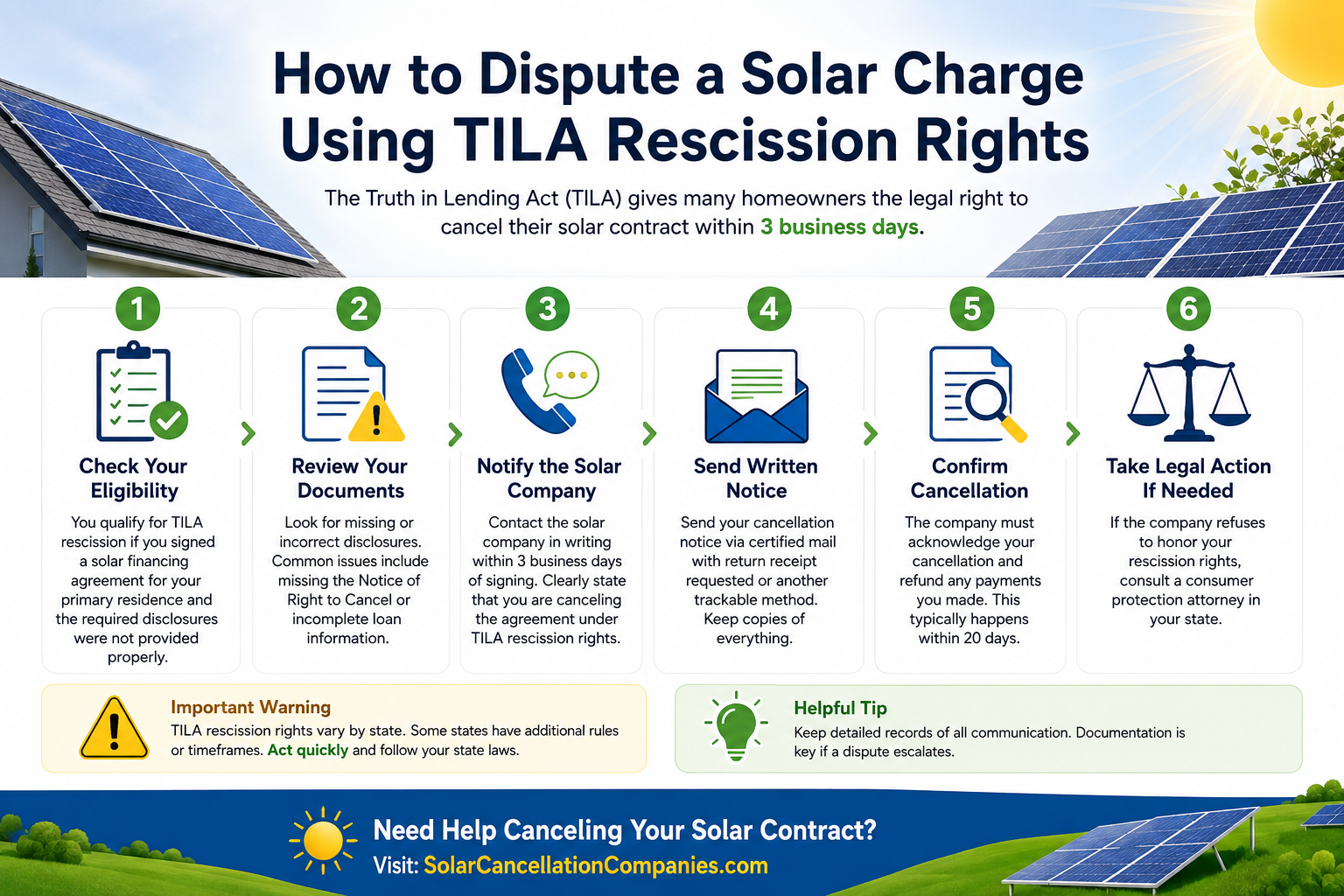
Step by Step Guide to Disputing a Solar Charge Using TILA
Step 1: Review Your Financing Documents
Pull everything from your closing. Look for the TILA disclosure, the right to cancel form, and the actual loan agreement.
Step 2: Spot the Violation
Compare the total amount financed to the cash price of your system. Check that the APR matches what you were told. Confirm you have two signed, dated right to cancel forms.
Step 3: Gather Your Evidence
Collect utility bills, system performance data, all sales communications, and any written savings estimates the salesperson gave you.
Step 4: Write a Rescission Notice
Your TILA rescission notice must be in writing. Include your name, address, loan number, loan date, and a clear statement that you are using your right to rescind under 15 U.S.C. § 1635. If you have grounds for the extended three year window, say so.
Step 5: Send It to the Right Party
Send the notice to the lender, not the solar installer. If your loan was sold, send it to the current servicer. Check your state’s solar cancellation laws for any additional state-level notice requirements before you mail anything.
Step 6: Keep Every Record
Document everything from this point. Once you send the notice, the lender has 20 days to respond. Your paper trail is your protection.
Quick Dispute Checklist:
- Collect your loan agreement, TILA disclosure, and cancel notice
- Compare the amount financed to the installer’s cash price
- Check whether APR includes dealer fees
- Confirm you got two signed, dated right to cancel forms
- Gather sales emails, utility bills, and system records
- Draft a written rescission notice under 15 U.S.C. § 1635
- Send via certified mail with return receipt
- File copies of everything
TILA Rescission Notice Requirements
What to Include
Your TILA rescission notice should have: your full name and address, your loan account number, the loan date, and a clear statement that you are canceling under TILA. If you believe the three year window applies, briefly state the reason.
Where to Send It
Send it to the lender or current loan servicer. Not the solar company. If the loan changed hands, call the servicer to confirm the right address before you mail anything.
Why Certified Mail Matters
Send via certified mail with a return receipt. This gives you a timestamp showing exactly when you exercised your right. In a dispute over deadlines, that date can be the deciding factor.
Solar Charge Dispute Timeline: What to Expect
| Phase | Action | Timeframe |
| 1. Document Review | Gather financing docs and spot violations | 1 to 2 weeks |
| 2. Legal Review | Attorney or specialist checks your case | 1 to 2 weeks |
| 3. Notice Sent | Written rescission notice mailed to lender | Day 1 |
| 4. Lender Response | Lender has 20 days to respond under TILA | Up to 20 days |
| 5. Escalation | CFPB complaint filed if lender goes quiet | As needed |
| 6. Resolution | Settlement, loan cancel, or litigation | 30 to 180 days or more |
What Happens After You Send a TILA Rescission Request?
Lender Review
After you send a valid rescission notice, the lender must respond within 20 days. They review the notice and your loan file during that time.
Common Lender Responses
The lender may accept the rescission, reject it, ask for more documents, or offer a partial deal. A denial does not end your case. It may mean a CFPB complaint or legal action is next.
What Resolution Can Look Like
In some cases, lenders cut the loan balance, drop fees, or change the loan terms. In stronger cases involving fraud, full loan cancellation is possible.
Risks of Solar Loan Rescission
Lenders Will Push Back
Lenders often argue their disclosures were fine. To win, you need to show exactly how they failed to meet TILA rules. Your documents are what make that case.
Credit Score Concerns
Stopping payments during a solar financing dispute can hurt your credit. Talk to a solar attorney before you change your payment plan. Some lawyers advise paying under protest while the dispute moves forward.
These Cases Take Time
Complex TILA cases can take six months to over a year. Starting your document file on day one is the best way to speed things up.
You Must Prove the Violation
Being unhappy with your loan is not enough. You need to show the lender broke TILA rules. That takes clear records and a focused argument. Proving a TILA violation depends on having the right paperwork.
Filing a CFPB Complaint for a Solar Financing Dispute
When to File
If your lender ignores your rescission notice, keeps collecting, or reports negative credit data during an open dispute, it is time to file a CFPB solar financing complaint.
How to File
Submit a CFPB complaint or call (855) 411-CFPB. For solar loans, pick ‘Payday loan, title loan, personal loan or advance loan,’ then choose ‘Installment loan.’ The CFPB sends your complaint to the lender and requires a reply within 15 days.
What to Expect
A CFPB complaint often gets faster results from lenders who want to avoid scrutiny. It also creates a formal record that supports any future legal action.
Special Situations That Can Strengthen Your Dispute
The Solar Company Lied About Savings
If the salesperson gave you written projections showing exact dollar savings and your bills did not drop, you may have a misrepresentation claim. Keep those written projections.
The System Was Never Installed or Finished
If your solar loan was funded before the work was done, or the install was left incomplete, that is a serious problem. Under the FTC Holder Rule, lenders can be held responsible for installer problems when loans and sales contracts are bundled together.
The Solar Company Went Out of Business
Solar Mosaic filed for bankruptcy in June 2025. SunPower went to Chapter 7 in 2024. Freedom Forever filed Chapter 11 in April 2026. If your solar company went out of business, your claim shifts to the lender. The FTC Holder Rule is your main tool here.
The Loan Was Transferred to Another Lender
A loan transfer does not erase your TILA rights. The new servicer inherits the original lender’s obligations. You can send your rescission notice to them.
Elderly or Vulnerable Consumers Were Targeted
The CFPB found solar sales reps pitching in a homeowner’s native language but handing them contracts in English only. Elderly homeowners who faced high pressure door to door sales may have extra state level protections on top of TILA.
When to Call a Solar Contract Attorney
Signs You Need Legal Help
- Your lender denied your rescission notice
- Your loan balance is far higher than the cash price
- You think your signature was forged on loan forms
- Your system was never installed or has never worked
- Your solar company has gone bankrupt
High Dollar Solar Disputes
Most solar loans range from $25,000 to $60,000. At that level, getting legal help usually makes sense. Many solar contract lawyers take these cases on contingency. That means you pay nothing unless they win for you.
Mistakes to Avoid During a Solar Financing Dispute
- Missing the solar financing dispute deadline: three days normally, three years if disclosures were wrong
- Deleting texts, emails, or sales materials from the salesperson
- Trusting verbal promises with no written backup
- Ignoring lender letters during the dispute
- Assuming installation ends your rights. It does not.
Frequently Asked Questions About TILA Solar Disputes
What is a TILA rescission solar dispute?
It is when a homeowner uses their rights under the Truth in Lending Act to cancel a home secured solar loan because the lender skipped or got wrong the required cost disclosures.
Can I cancel a solar loan under TILA?
Yes, if the loan is tied to your home and disclosures were missing or wrong. You have three business days normally, or up to three years if the lender broke TILA rules.
Does TILA apply after installation?
Yes. Having panels on your roof does not end your TILA rights. If the disclosure problem existed at closing, the extended window still applies.
What documents do I need?
Your solar financing agreement, the TILA disclosure statement, the right to cancel form, the install contract, all sales communications, and your utility or performance records.
How do I send a rescission notice?
Write a signed letter that names your loan and states you are canceling under 15 U.S.C. § 1635. Send it by certified mail to the lender or current servicer.
What to Do Right Now
If your solar loan balance is higher than the cash price you were quoted, look at your TILA disclosure today. If you never got a right to cancel the form, your window to rescind may still be open, even if years have passed.
If your system was funded before install was done, if you were told about tax credits that no longer exist, or if your installer went bankrupt, the FTC Holder Rule and state laws may give you more leverage than you know.
The most important step right now is to gather your documents and talk to someone who knows solar financing law.
Solar Cancellation Companies help homeowners just like you. We review your loan documents, flag possible TILA violations, and connect you with qualified legal help. If you had hidden fees, false promises, or missing disclosures in your solar deal, Contact Us today to get a free review.