
Many homeowners sign a solar loan and then spot a problem. The loan balance is far higher than the system price they agreed to pay. A solar dealer fee is the most common cause.
The CFPB flagged this in its August 2024 Solar Financing report. It found that dealer fees can raise loan balances by 30% or more above the cash price. On a $30,000 system, that is up to $9,000 added to your debt before you make a single payment.
Most homeowners never hear the words “dealer fee” during the sales visit. That gap between what was said and what was signed is exactly what this guide covers. For free resources and professional help reviewing your solar loan documents, visit Solar Cancellation Companies.
What Is a Solar Dealer Fee?
A solar dealer fee is a charge a solar installer pays a lender to offer financing to buyers. The lender sets this fee as its cost for working with that installer.
Dealers pass the fee to buyers. They do this by adding it to the loan amount. So instead of borrowing $30,000 for your panels, you may borrow $36,000 or more. The extra money covers the dealer fee. Most buyers never know this happened. Understanding what type of contract you signed a loan, lease, or PPA is the starting point for any dealer fee dispute. Our Solar Contract Type guide explains the differences and what each means for your options.
Why Solar Lenders Charge Dealer Fees
Lenders use dealer fees to fund the low rates they put in their ads. A rate of 0.99% sounds great. To offer that rate, the lender collects an upfront fee from the dealer. The dealer adds that cost to your loan. You still pay it. It just hides inside your monthly bill.
This model is called “buying down” the rate. The dealer fee buys a lower APR for the buyer. But the cost does not go away. It sits in your loan balance from day one.
Who Gets the Dealer Fee?
The lender keeps the dealer fee. It is not a fee the installer earns. Think of it as the installer’s entry ticket to offer financing. Buyers fund that ticket without knowing it exists.
Dealer Fee vs. Interest Rate
Dealer fee vs interest rate: these are two very different things. Interest builds up over time on what you owe. A dealer fee is a flat charge added to your loan balance on day one. Both raise your total cost. But a dealer fee hits you upfront, and you also pay interest on top of it for the life of the loan.
How Much Does a Solar Dealer Fee Cost?
The CFPB’s August 2024 report found that solar dealer fees range from 10% to 30% of the cash price. Some go even higher.
On a $30,000 system, that is $3,000 to $9,000 added to your loan. You also pay interest on that added amount for up to 25 years. The total extra cost grows well beyond the fee itself.
| Cash System Price | Dealer Fee (15%) | Dealer Fee (25%) | Actual Loan Amount |
| $20,000 | $3,000 | $5,000 | $23,000 to $25,000 |
| $30,000 | $4,500 | $7,500 | $34,500 to $37,500 |
| $40,000 | $6,000 | $10,000 | $46,000 to $50,000 |
| $50,000 | $7,500 | $12,500 | $57,500 to $62,500 |
A sales rep who quoted you $189 a month likely used a loan amount that included a dealer fee. The payment feels low. But your total debt is thousands more than you thought.
Why Most Homeowners Never Spot a Dealer Fee
Solar sales pitches focus on monthly savings and low rates. Few reps walk through the full loan amount, the fee, and the total you will repay. Many are not allowed to.
The CFPB found that some lenders ban dealers from explaining fees during the sales call. That is a built-in blind spot. Buyers sign without knowing what they agreed to pay.
Red Flags That Suggest the Fee Was Not Explained
- The rep showed only a monthly payment, not a total loan amount
- Low APR was the main selling point, not total loan cost
- Your loan balance is higher than the quoted system price
- The tax credit was shown as a sure offset to your loan amount
- You signed on a tablet with no time to read the full terms
- No one used the words dealer fee, program fee, or platform fee
- The cash price and the financed price were never compared side by side
Was Your Solar Dealer Fee Disclosed?
This is the core solar dealer fee disclosure question. The issue is not always that a fee was charged. The issue is whether you were told about it clearly enough to make a fair choice.
Homeowner Self-Check List
- Did anyone explain the dealer fee before you signed?
- Does your loan paperwork list the dealer fee on its own line?
- Does your Truth in Lending form show a loan amount higher than the system price?
- Did you have time to ask questions before signing?
- Can you find the words dealer fee or program fee anywhere in your papers?
- Were you shown the cash price and the loan amount at the same time?
If you answered no to most of these, the fee may not have been properly disclosed. That matters both for your rights and your legal options.
Solar Loan Disclosure Rules Under Federal Law
The solar loan Truth in Lending Act (TILA) is the main federal law on loan disclosures. It requires lenders to give clear details about loan terms before you sign. This includes the APR, the total finance charge, and the total amount you borrow.
Here is the catch. Lenders have treated dealer fees as “seller’s points.” Under TILA’s Regulation Z, seller’s points can stay out of the APR math. So the dealer fee may not show up in your APR, even though it raises your true cost of borrowing.
The CFPB raised this concern in its 2024 report. Leaving dealer fees out of the APR makes it hard for buyers to compare loan costs. One homeowner told the CFPB that a lender claimed an APR of 1.99% on a loan with a 26% upfront fee. Those two numbers cannot both be true at the same time. For a full breakdown of how TILA applies to solar loans and what a TILA violation means for your rights, see our TILA Rescission Solar Dispute guide.
Solar loan disclosure requirements under TILA still require lenders to show the total amount you borrow and the total of all payments. If a dealer fee raised your loan balance, that higher number must appear in your loan papers, even if the APR did not include it.
How to Find Dealer Fees in Your Loan Papers
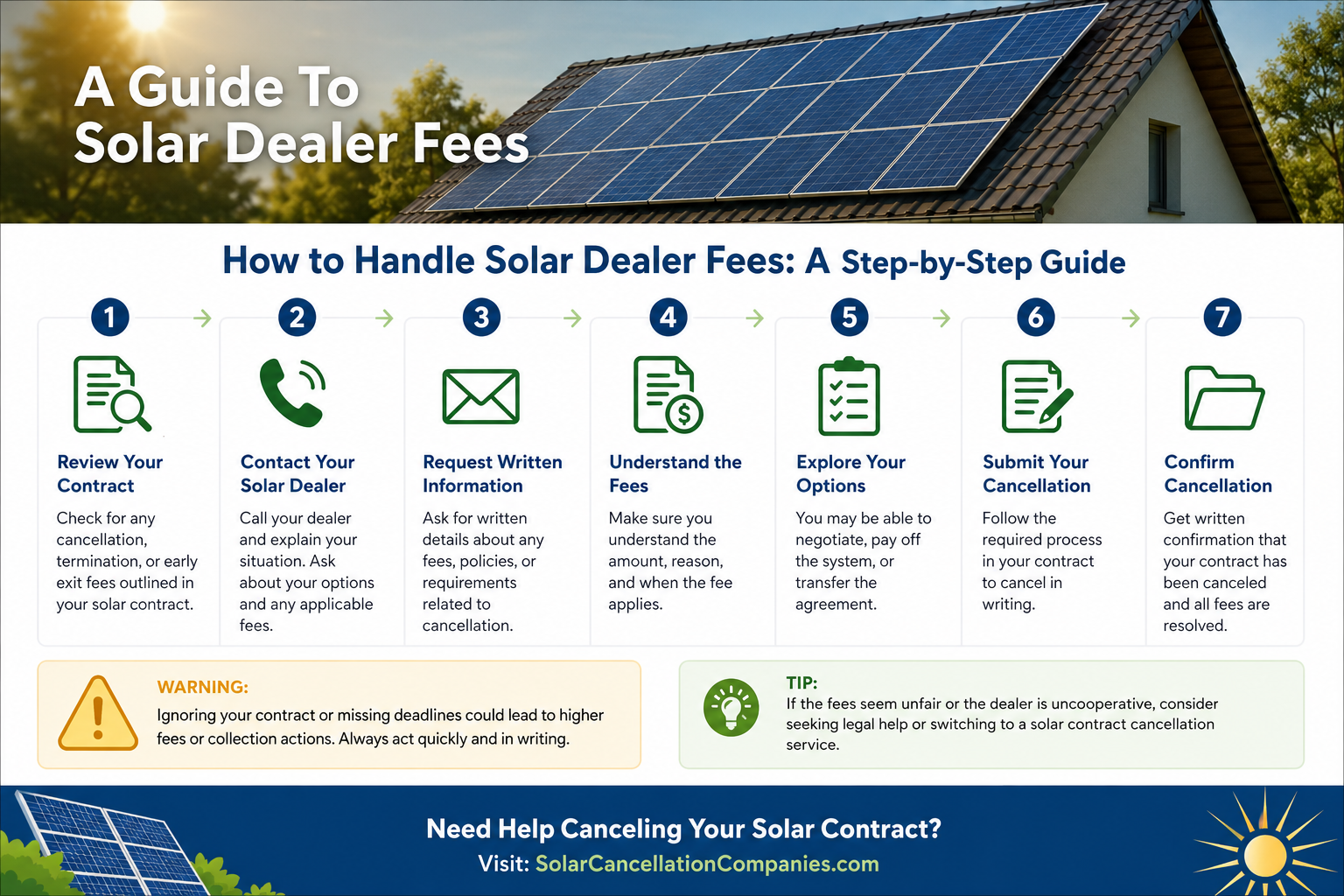
Step by Step
Step 1: Get your full loan agreement and Truth in Lending form if you do not have them yet.
Step 2: Find the Amount Financed line. Compare it to the system price in your sales quote.
Step 3: Look for any page labeled dealer fee, program fee, or platform fee.
Step 4: Ask for the cash price of the system. Compare it to your loan balance.
Step 5: If there is a gap you cannot explain, ask the lender for a written fee breakdown.
Documents to request: the original sales quote, the signed loan contract, the Truth in Lending form, any fee schedules, and all texts or emails from the sales rep.
Dealer Fee vs. Interest Rate: Which Costs More?
A 0% rate sounds perfect. But a 25% dealer fee on a $30,000 system can cost more than a standard loan with no fee at all.
| Loan Type | System Cash Price | Dealer Fee | Loan Amount | APR | Est. Total (25 yr) |
| Low-APR with dealer fee | $30,000 | 25% ($7,500) | $37,500 | 0.99% | ~$41,500 |
| Standard loan, no fee | $30,000 | None | $30,000 | 6.99% | ~$40,200 |
| Mid-range, no fee | $30,000 | None | $30,000 | 4.99% | ~$35,900 |
A low rate does not mean a low cost loan. Ask for the total amount you will repay over the full term. That number tells you the real story.
What to Do If Your Fee Was Not Disclosed
First, stay calm. A disclosure problem does not void your contract on its own. But it may give you real options.
- Gather your loan papers and all sales materials
- Mark every place where the dealer fee is mentioned or should be
- Ask your lender for a written list of all charges
- Save every message, email, and text with the solar company
- Check your state’s solar rules. Many states have added new protections
In March 2024, Minnesota’s Attorney General sued four major solar lenders. The suit claimed hidden dealer fees broke the state Consumer Fraud Act. In October 2024, Connecticut’s AG settled a solar case for $5 million over misleading marketing and undisclosed costs.
California’s SB 784 would require lenders to give both oral and written solar dealer fee disclosure before any loan is signed. Washington State’s Solar Consumer Protection Act has required these disclosures since June 2024. Rhode Island’s Residential Solar Energy Disclosure Act took effect in March 2025. You can check what protections are available in your state through our Solar State Laws directory.
Can You Cancel a Solar Loan Over an Undisclosed Dealer Fee?
You may be able to cancel. But timing is key. Under the FTC Cooling-Off Rule, you have three business days to cancel a contract you signed at home. Past that window, cancellation gets harder.
A material non-disclosure may still give you grounds to challenge the contract later. The right path depends on your state’s laws, the stage of your installation, and what you can prove was or was not told to you.
A solar contract attorney can review the facts of your case. Do not assume you are stuck before getting a professional read on your options.
Are Solar Dealer Fees Refundable?
Dealer fees are not auto-refunded once a loan closes. But that does not shut the door.
You may have grounds to pursue a refund if you can show the fee was not disclosed, that you were misled about total loan costs, or that the company broke state consumer laws. Good records strengthen your claim.
Save every document you have. Proposals, contracts, texts, and emails all matter. The stronger your paper trail, the better your position in any dispute.
State Laws That May Apply to Your Case
US solar dealer fee laws vary by state. Here is a quick look at key states:
- California: SB 784 would require oral and written dealer fee disclosure before signing, effective January 1, 2026
- Washington: Solar Consumer Protection Act (June 2024) requires written dealer fee disclosure in all contracts
- Rhode Island: Residential Solar Energy Disclosure Act (March 2025) requires specific disclosures and a 7-day cancel right
- Nevada: Senate Bill 379 adds new solar buyer protections, effective October 2025
- Minnesota: AG sued four major solar lenders in 2024 for hidden dealer fees, cases are ongoing
- Connecticut: $5M AG settlement in October 2024 for misleading marketing and hidden financing costs
Even if your state is not on this list, federal consumer rules still apply. A local consumer law attorney can tell you what protections cover your case.
Solar Loan Paperwork Check List
Before You Sign
- Ask: what is the cash price of this system?
- Ask: what is the full loan amount, including all fees?
- Ask: is there a dealer fee, program fee, or platform fee on this loan?
- Ask: what is the total amount I will repay over the life of the loan?
- Compare the cash price to the loan balance. Ask about any gap you see.
- Read every line of the Truth in Lending form before signing
After You Have Signed
- Find the Amount Financed line in your loan contract
- Compare it to the system price in your sales proposal
- Search all papers for the words dealer fee, program fee, or platform fee
- If you find a gap, ask the lender for a written fee list right away
- Contact a solar contract attorney if you think the fee was not disclosed
Frequently Asked Questions
How much is a typical solar dealer fee?
The CFPB’s 2024 report found fees range from 10% to 30% of the system cash price. On a $30,000 system, that adds $3,000 to $9,000 to your loan.
Is a dealer fee the same as interest?
No. Interest builds over time on your loan balance. A dealer fee is a flat charge added to your loan on day one. You pay interest on the fee for the full loan term, so the real cost is even higher.
Was my dealer fee required to be disclosed?
Under TILA, lenders must show the total amount you borrow. But dealer fees have often been kept out of the APR as “seller’s points.” Many regulators say this creates hidden solar loan fees that conflict with the goal of fair disclosure.
How do I find a dealer fee in my loan papers?
Compare the Amount Financed in your Truth in Lending form to the system price in your sales quote. If your loan balance is higher, a dealer fee is likely the cause. Look for terms like program fee, platform fee, or finance fee.
Can I cancel my solar loan if the fee was not disclosed?
You may be able to. Your timing, your state’s laws, and your specific contract all play a role. A solar contract attorney can tell you whether a non-disclosure gives you grounds to cancel or dispute.
Do state laws protect me from undisclosed solar fees?
More states do so each year. Washington, Rhode Island, and soon California and Nevada all have or are adding solar disclosure laws. Federal consumer rules also apply in every state.
What You Should Do Next
Have not signed yet? Slow down. Ask the rep for the total loan amount and whether a dealer fee exists. Get those answers in writing before you sign.
Signed recently? Check your three-day window. Under the FTC Cooling-Off Rule, you can cancel within three business days with no penalty. If that window is closed, ask your lender for a full written fee list right away.
Already found a high loan balance? Gather your papers now. Pull every proposal, contract, text, and email. Compare your loan amount to the quoted system price. The gap is likely a dealer fee.
Thinking about cancellation? Get legal advice first. Your options depend on your state’s laws, the stage of your install, and what was disclosed. Know the risks before you act.
Think you were misled? A contract review is your best next move. The CFPB, state attorneys general in Minnesota and Connecticut, and new state laws in Washington and Rhode Island all show that regulators take undisclosed dealer fees seriously. You are not alone, and you may have more options than you think.
Our team at Solar Cancellation Companies reviews solar contracts and helps homeowners understand their rights. If your loan balance does not match what you expected to pay, Contact us today for a free review. It could save you thousands.