

You signed your solar contract because the numbers worked. The 30% tax credit cut thousands off the price. The math made sense at the time.
Then something changed. Maybe your install slipped into 2026. Maybe a tax preparer said the credit is gone. Maybe your loan payment jumped because the “credit payment” never showed up.
Here’s the quick answer. The federal solar tax credit, called Section 25D, ended for any system installed after December 31, 2025. That’s federal law, not a sales rumor. A new law cut it off in July 2025, with no phase-down period. If your system went live after that date, no federal credit applies. It doesn’t matter when you signed. If you think you were misled about this credit, Solar Cancellation Companies can help you understand your options.
That doesn’t mean you’re stuck. You need to answer two things fast. Did your installer misrepresent the credit? Does that give you a way out of your contract?
What Changed With the Solar Tax Credit
For almost 20 years, homeowners could claim 30% of solar costs back. A new law ended that early. The cutoff depends on your installation date, not your contract date.
If your panels were running by December 31, 2025, you can still claim the full credit on your 2025 return. Unused credit even rolls forward to future years. If your system went live in 2026, the credit is gone.
So this isn’t always a fraud case. Sometimes it’s a timing problem nobody explains. Solar tax credit fraud in 2026 isn’t about the law changing. It’s about whether your salesperson promised something the law never guaranteed.
Were You Misled, or Caught by Timing?
There’s a real gap between a company that explained the credit honestly and one that used it to close a sale. Ask yourself:
- Did the rep call the credit “guaranteed” or say “everyone qualifies”?
- Was your price already reduced by the credit, before you’d even filed taxes?
- Did anyone mention the credit is nonrefundable, meaning it only offsets taxes you owe?
- Were you told your install was safely inside the deadline?
A tax credit isn’t a check or a rebate. It only reduces taxes you owe that year. If your liability is lower than the credit, the rest carries forward. You never get it as cash. Promised 30 percent ITC language that treats this like a guaranteed discount is a clear sign of a solar sales tax credit scam.
Common Ways Homeowners Get Misled
A few patterns repeat in solar tax credit misrepresentation complaints.
The guaranteed-credit pitch. A rep promises 30% back, no matter your tax situation or install date.
The rebate confusion. The credit gets called a government check, not a tax cut.
The financing trap. Your loan assumes a lump “tax credit payment” partway through. If the credit never comes, your real cost goes up.
The delayed install. You signed in 2025 expecting that year’s credit, but installation slipped into 2026 and missed the cutoff.
If this sounds familiar, you’re not imagining it. Solar tax credit no longer applies complaints like these are climbing fast this year. You can browse real homeowner situations in our Solar Exit Guides to see how others handled it.
How This Hits Your Loan Payment
Many solar loans assume one large “tax credit payment” within the first 12 to 18 months, paid from your tax savings.
If you never got the credit, owed too little tax to use it, or your install missed the cutoff, that payment still comes due. Miss it, and many loans re-amortize. That spreads the balance over your remaining term at a higher rate. This is usually when homeowners first sense something went wrong.
Can You Cancel Your Solar Contract?
Cancel solar contract tax credit disputes are strongest when:
- You’re still inside your state’s rescission window, often three business days
- You have written or recorded proof of specific promises
- Installation hasn’t started or isn’t finished
- Your sales materials built savings entirely around the credit
Your options narrow once the system is running, but they don’t disappear. Misrepresentation claims can still apply after the work is done. Cancellation rights vary by location, so check our Solar State Laws guide for the rules where you live.
Steps to Take Right Now
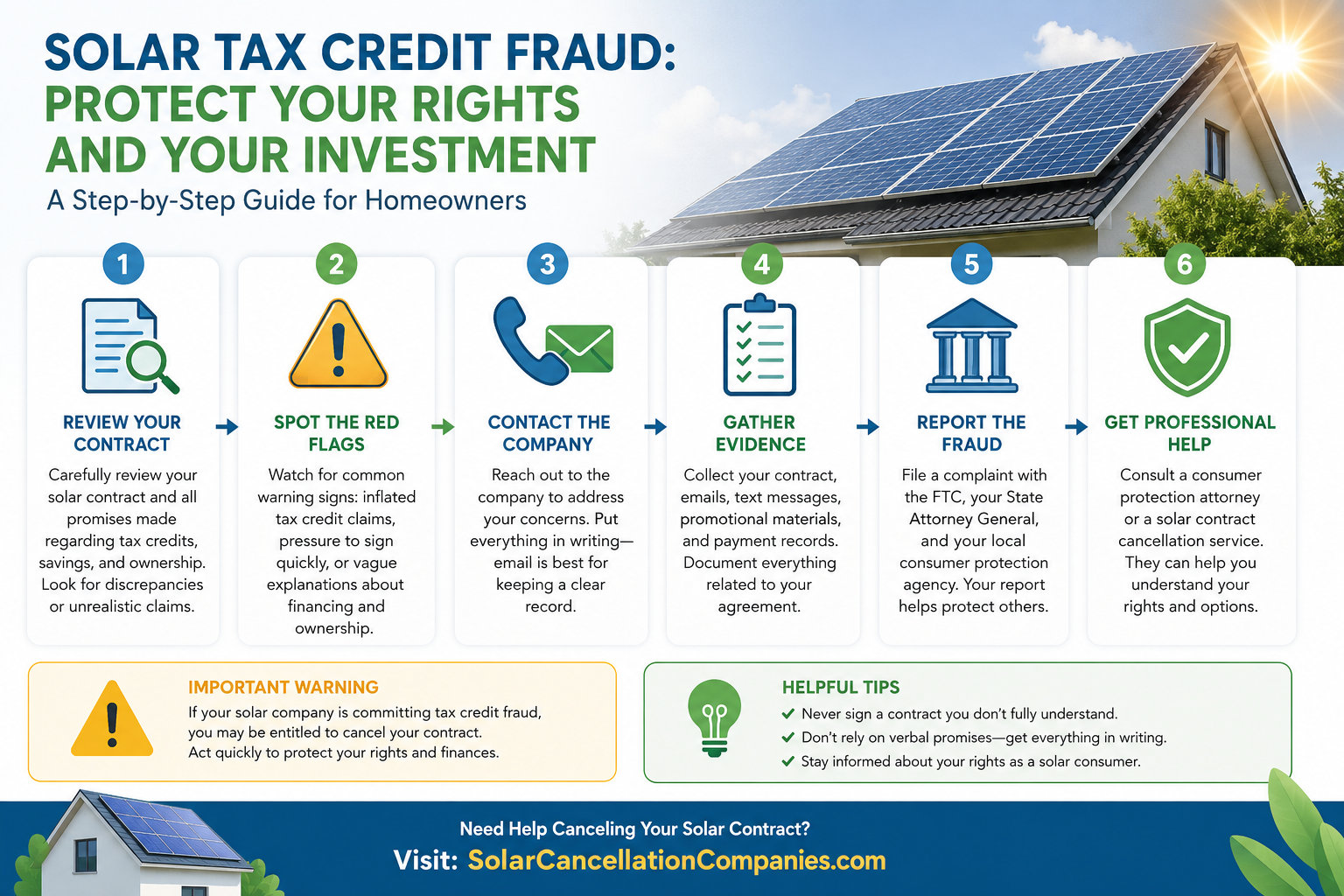
- Pull every document. Contract, financing papers, proposal, savings projection, change orders.
- Find the exact promise. Look for specific words about percentage, eligibility, or guarantees.
- Save your messages. Texts, emails, and voicemails count as evidence.
- Write a dated dispute letter. Send it to the installer and the lender. State exactly what was promised.
- File complaints right away. Don’t wait on one reply before contacting regulators.
- Get any new paperwork reviewed before signing a “fix.”
This is the core of any solar fraud complaint process: document first, dispute second, escalate third.
Who Reviews Solar Fraud Complaints
File with more than one for faster results:
- State Attorney General – handles deceptive sales complaints
- FTC – tracks fraud patterns nationally
- CFPB – covers misleading financing or loan terms
- State licensing boards – can investigate the contractor’s license
When You Need a Solar Contract Lawyer
A few signs say it’s time to call one:
- Your loan balance rose and the company won’t explain it in writing
- You have a written promise that conflicts with what happened
- The installer or lender ignores your dispute letter
- You’re asked to sign new paperwork to “fix” the deal
Bring your full document file to a consultation. A solar contract lawyer can quickly tell you if you have a breach of contract claim, a misrepresentation claim, or both.
Frequently Asked Questions
Can I cancel if the promised tax credit no longer applies?
Maybe. It depends on your state’s rules, your rescission window, and whether the credit was misrepresented, not just changed by law.
Is it legal for a solar company to guarantee a tax credit?
No. The outcome depends on your tax liability and install timing. A guaranteed number is a red flag.
What evidence helps prove solar tax credit fraud?
Proposals, projections, contracts, financing papers, texts, emails, and any recorded calls about the credit.
What agencies investigate solar fraud complaints?
Your state Attorney General, the FTC, the CFPB, and state contractor licensing boards.
What to Do Next, Based on Your Situation
Haven’t signed yet? Get every credit claim in writing first. Check your install date against the deadline yourself.
Just signed? Check your state’s rescission window today. It may still be open.
Installation hasn’t started? You have the most leverage right now. Don’t wait.
Installation is complete? Your options are narrower, not gone. Misrepresentation claims can still apply.
Tax credit was denied? Find out why first. Documentation issues are often fixable. Eligibility and timing issues may not be.
Loan payment increased? Get your amortization schedule in writing and compare it to your original contract right away.
Your Next Step
The law changed fast. Many homeowners got caught in the gap between what they were. The law changed fast. Many homeowners got caught in the gap between what they were promised and what their contract delivers. That gap is where misrepresentation claims live.
If your sales experience matches what’s described here, get your contract reviewed before signing anything else or letting another payment pass. Solar Cancellation Companies review solar contracts and financing agreements every day for homeowners in this exact spot. Reach out for a professional review, and find out clearly where you stand.