

Buying solar panels in Missouri means signing a contract, applying for permits, and often taking out a loan. Missouri solar panel laws cover all of these steps, but they do not work the same way for every homeowner. Your rights can depend on your city, your utility, how you signed your contract, and whether you financed the system. For free resources and access to reviewed specialists serving Missouri homeowners, visit Solar Cancellation Companies.
This guide explains what Missouri law says about solar contracts, permits, net metering, and cancellation, including two major 2026 updates: new limits on HOA solar bans and the end of the federal solar tax credit for new homeowners.
What Are Missouri’s Solar Panel Laws?
Solar panels are legal statewide, and Missouri has no special license just for owning a system. Installers do need state electrical and contractor credentials, and most projects need local permits.
No single agency oversees every part of solar. The Missouri Public Service Commission regulates net metering and interconnection. The Missouri Attorney General enforces consumer protection law. Cities and counties issue permits. State law sets the floor, and your city, utility, or contract can each add requirements on top of it. You can compare Missouri’s consumer protections to those in other states through our Solar State Laws directory.
Missouri Solar Consumer Protection Laws
Missouri’s main solar consumer protection law is the Missouri Merchandising Practices Act. It bans deception, false promises, and misleading claims. The Missouri Attorney General has sued solar companies under this law for overstating savings and skipping promised loan payments.
Watch for sales pressure that pushes you to sign the same day, verbal savings promises not written into the contract, vague “free solar” claims, and financing terms explained differently than what appears on paper.
If a salesperson misled you, write down what was said, save texts and emails, and compare it against your signed paperwork. This record matters if you later file a complaint or try to cancel.
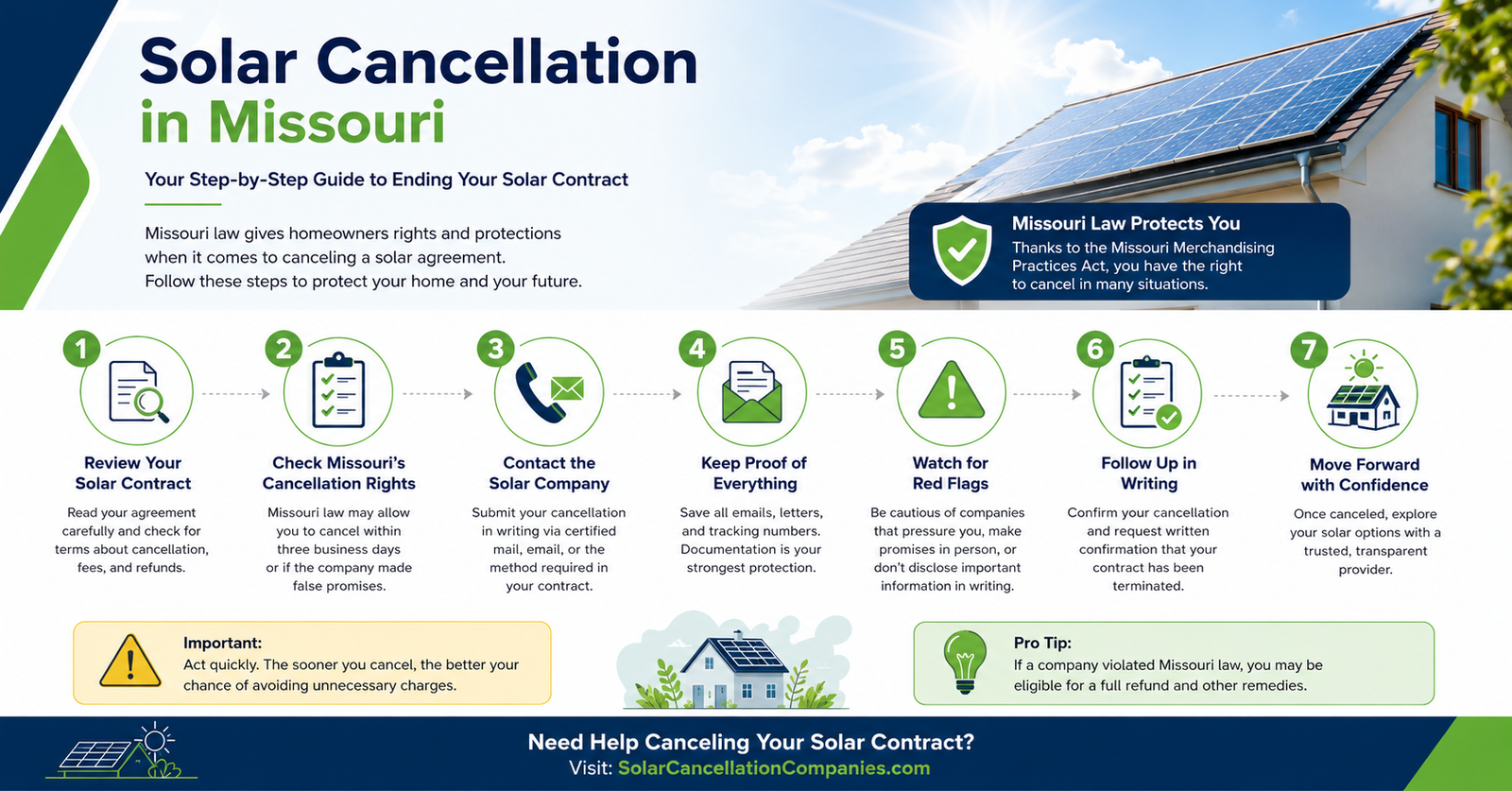
Can You Cancel a Solar Contract in Missouri?
Missouri has no solar-specific cancellation law. Your Missouri solar contract cancellation rights come from federal rules and your own contract.
The FTC Cooling-Off Rule gives you until midnight of the third business day after signing to cancel, but only if you signed at your home or somewhere other than the seller’s regular place of business, and the price meets the rule’s threshold. This is a real Missouri solar contract cooling period, but it does not cover every sale, including purchases made entirely online or by phone.
Many installer contracts also include their own written cancellation clause, sometimes longer than three days. Check your actual paperwork rather than assuming the federal minimum is your only option.
Once a deadline passes, cancelling gets harder but is not always impossible. You may still have options if the company misrepresented the deal or broke the contract. Cancelling after panels are installed is the hardest case and usually depends on warranty terms or legal grounds rather than a simple notice.
How to Cancel a Solar Contract in Missouri
- Reread your agreement for a cancellation or rescission clause.
- Confirm your deadline based on the signing date and location.
- Gather your contract, financing papers, and sales communications.
- Write a clear cancellation notice referencing your signing date.
- Send it by a trackable method, such as certified mail, and keep proof of delivery.
- Contact your solar lender separately, since cancelling the installer contract does not cancel a loan by itself.
- If the company refuses to cooperate, look into solar cancellation help that Missouri consumer agencies or a qualified attorney can offer.
Solar loans and installer contracts are usually two separate agreements. Cancelling one does not automatically cancel the other. If your loan is already funded, resolving things may involve a dispute process rather than a simple cancellation. If collection notices arrive, respond in writing and keep records.
Missouri Solar Permits and Interconnection
Most installations need a building permit, an electrical permit, or both, issued locally, and Missouri solar permit requirements differ by city or county. A typical permit package includes a site plan, electrical diagrams, structural details, equipment specifications, and contractor licensing information.
After installation, a local inspector checks the wiring and structure. Then your utility issues permission to operate, the approval that lets your system send power to the grid. Activating a system before that approval can create safety issues and jeopardize your net metering agreement. Timelines vary by utility, and delays are common when paperwork is incomplete.
Missouri Solar Net Metering Rules
Yes, Missouri has solar net metering. The Net Metering and Easy Connection Act, at RSMo 386.890, requires investor-owned utilities, municipal utilities, and rural cooperatives to offer net metering for qualifying systems up to 100 kilowatts.
Net metering credits the electricity your panels send to the grid against what you use later. Unused credits generally expire twelve months after they are issued. Exact rates and billing procedures come from each utility’s tariff, so Ameren Missouri, Evergy, and smaller cooperatives can apply the law somewhat differently.
Federal Solar Tax Credit Update for 2026
This is one of the most important recent changes. The federal residential solar tax credit, Section 25D, ended for systems installed starting January 1, 2026, under the One Big Beautiful Bill Act signed in July 2025.
Systems fully installed by December 31, 2025 could still claim the 30 percent credit. For 2026 installations, there is no federal residential credit, no matter when you signed or paid a deposit. Third-party owned systems, like certain leases, may connect to a separate business credit, but that credit belongs to the leasing company, not the homeowner.
Never treat a Missouri solar tax credit as guaranteed cash back. Eligibility depends on your personal tax situation, and a licensed tax professional can confirm what applies to you.
Missouri HOA Solar Panel Rules
HOAs cannot ban solar panels outright. Under RSMo 442.404, a homeowners association may not adopt a covenant that prohibits or unreasonably restricts rooftop solar.
In January 2026, the Missouri Supreme Court ruled in Eikmeier v. Granite Springs Homeowners Association that this protection applies even to older covenants written before the law took effect. An HOA can still set reasonable placement rules, but those rules cannot meaningfully cut your system’s output or raise its cost. If your HOA rejects a project, ask for its reasoning in writing.
Solar Liens, UCC Filings and Selling Your Home
Financed systems sometimes involve a UCC financing statement, a public filing that secures the lender’s interest in the equipment. This is not automatically the same as a lien against your house. When you sell your home, an active solar loan, lease, or PPA usually needs to be paid off or transferred to the buyer, and mortgage lenders sometimes require this before closing, so start early.
How to File a Complaint About a Missouri Solar Company
For deceptive sales or broken promises, file with the Missouri Attorney General’s Consumer Protection Section online or at 800-392-8222, and include your contract, communications, and a clear timeline. For interconnection or net metering disputes, the Missouri Public Service Commission handles complaints against regulated utilities. Filing a complaint does not automatically cancel your contract, and mediation can take weeks or months, so keep documenting while it proceeds.
Missouri Solar Compliance Checklist Before Signing
- Verify the installer’s license and reviews
- Compare the cash price and financed price, plus interest rate and fees
- Ask for the total repayment amount, not just the monthly payment
- Read the cancellation clause and note the exact deadline
- Avoid relying on tax credit promises for 2026 installations
- Confirm who pulls permits and schedules inspections
- Review warranty length and what it actually covers
- Ask what happens to financing if you sell your home
When Should You Get Help With a Missouri Solar Contract?
Explore the solar cancellation assistance available to Missouri homeowners if you’re facing an approaching deadline, if a company refuses to honor your cancellation request, or if your loan remains active after a canceled installation. Additionally, seek help if you feel misled during the sales process, if you are receiving collection notices, or if solar financing is complicating the sale of your home.
A solar contract lawyer for Missouri homeowners can review your specific contract language and advise on legal remedies. Solar Cancellation Companies is not a law firm and does not provide legal representation, but can help you understand your documents and next steps.
Frequently Asked Questions
What are the current solar panel laws in Missouri?
Missouri regulates solar through consumer protection law, net metering statute, local permitting rules, and HOA solar access law, with no single solar code.
Do you need a permit for solar panels in Missouri?
Yes, most installations need a building or electrical permit before work begins and before final inspection.
Can I cancel a solar contract in Missouri?
Sometimes. The FTC Cooling-Off Rule may give you three business days if you signed away from the seller’s regular business location. Your written contract may also include its own terms.
How long do I have to cancel a solar contract in Missouri?
It depends on where you signed and what your contract says. There is no single statewide deadline for every solar sale.
Does cancelling a solar contract cancel the loan?
Not automatically. The installer agreement and the loan are usually separate contracts, so you generally need to contact the lender directly.
Does Missouri have solar net metering?
Yes, under RSMo 386.890 for qualifying systems up to 100 kilowatts, though rates and procedures vary by utility.
Are there solar tax credits available in Missouri?
The federal 30 percent credit ended for residential systems installed starting in 2026. Systems completed by the end of 2025 could still claim it.
Can an HOA restrict solar panels in Missouri?
No outright ban is allowed, and this now applies to older covenants too, following a January 2026 Missouri Supreme Court ruling.
Where can I complain about a Missouri solar company?
The Missouri Attorney General’s Consumer Protection Section and the Missouri Public Service Commission are the main state options, depending on the issue.
Final Steps for Missouri Homeowners
Your best next step depends on where you are in the process. Still considering solar? Verify permits, financing terms, and realistic costs, and do not count on a 2026 federal tax credit. Just signed? Check your cancellation clause and deadline right away. Want to cancel? Document everything and send written notice through a trackable method. Financed the system? Treat the loan and the installer contract as separate problems. Already installed? Review permits, warranty, and financing before assuming your options are gone. Misled by a salesperson? Preserve your evidence and file a complaint with the Missouri Attorney General. Selling your home? Start resolving financing or lease transfer early. Facing a serious dispute? Speaking with a qualified Missouri attorney may be the right next step, or contact us to talk through your situation with a specialist at no cost.
Please Note: Solar Cancellation Companies is not a law firm and does not provide legal advice or legal representation. The information provided on this website is for general educational and informational purposes only. If your situation requires legal advice, consider consulting a qualified attorney licensed in your state.