
Many people go solar expecting lower electric bills. For some homeowners, that is not what happens. The utility bill still shows up, and the solar payment adds another monthly expense.
That can feel frustrating very quickly.
If your solar panels are not saving money, there could be several reasons behind it. High utility fees, expensive financing, or lower system output can all affect savings. Some homeowners also realize the original estimates did not match real monthly costs.
This guide explains why solar savings are not matching promises, what may be causing the problem, and what steps homeowners can take next.
Why Some Homeowners Feel Their Solar Investment Failed
The feeling of failure often starts with a gap. There is a gap between what the salesperson said and what you see on your bank statement.
The Expectation of Lower Energy Costs
Most people go solar to cut expenses. Sales reps often use flashy charts. They show a future with “zero-dollar” bills. This creates a high expectation. When the bill arrives and it is still $150, the disappointment is immediate.
Why Monthly Bills Still Feel Expensive
A common issue is the “double bill” effect. You have a utility bill for nighttime use. You also have a monthly solar loan payment. If these two combined are higher than your old bill, it feels like a loss. Homeowners often find solar panels cost more than expected during the first few years.
The Financial Pressure of Solar Loans and Utility Bills
Solar financing is often structured over 20 or 25 years. These payments stay steady or increase. If your utility company changes its rates, your savings might shrink. This creates intense financial pressure on families.
Why Solar Savings Do Not Always Match Sales Promises
Sales teams sometimes use “best-case scenarios.” They might ignore shade from trees. They might assume electricity prices will rise faster than they actually do. When these assumptions fail, solar savings not matching promises becomes a painful reality.
Why Your Electric Bill Is Still High After Installing Solar Panels
There are several technical and logical reasons for high costs. Understanding these helps you identify the root cause.
You Still Depend on the Utility Grid
Solar panels only produce power during the day. Unless you have a battery, you pull power from the grid at night. If you use a lot of energy after sunset, your utility bill will stay high. This is one of the top reasons solar panels may cost more than promised by installer.
Your Solar Financing Payment Is Increasing Total Monthly Costs
Many homeowners focus only on the “offset.” They forget the loan. If your loan payment is $200 and your utility savings are only $150, you are losing $50 every month. High dealer fees in the original contract often inflate these loan amounts.
Your Solar System Was Not Sized Properly
If your system is too small, it won’t cover your needs. If it is too large, you may have paid for equipment you don’t need. An improperly sized system is a common reason why are my solar bills still high.
Your Electricity Usage Increased After Installation
Some homeowners feel “guilt-free” once panels are on the roof. They might run the AC more often. They might buy an electric vehicle (EV). If your consumption goes up, your bill will too. Increased AC usage is a major factor in summer months.
Net Metering Policies Reduced Your Expected Savings
Net metering allows you to sell extra power back to the grid. However, many utilities are changing these rules. If your state moved to “Net Metering 3.0,” you get paid much less for your power. This change can make a once-profitable system feel like a burden.
Time-of-Use Billing Increased Peak Hour Costs
Utilities often charge more during “peak hours,” usually in the evening. Since your panels stop producing as the sun goes down, you pay the highest rates for evening power. This is a common solar panel complaint Texas electric bill owners face.
Your Solar System May Be Underperforming
A solar system underperforming can be due to many factors:
- Inverter problems: If the inverter fails, no power reaches your home.
- Dirty panels: Dust and pollen can block sunlight.
- Shading issues: New tree growth or neighbor additions can cast shadows.
- Installation mistakes: Loose wiring or bad sensors can lower output.
Signs Your Solar Savings Were Misrepresented
Did the sales process feel rushed? You might be a victim of misrepresentation.
The Salesperson Promised Unrealistic Savings
If a rep told you that you would “never pay a penny to the utility again,” they likely lied. Every home connected to the grid pays a minimum delivery fee.
You Were Told Your Electric Bill Would Disappear
Most people still see solar panels not reducing electric bill issue because of fixed charges. If the salesperson hid these fees, they misrepresented the truth.
Savings Projections Were Based on Inaccurate Assumptions
Check your original proposal. Did it assume your utility rates would go up by 10% every year? Most rates only rise by 2% to 4%. These “inflated” projections make solar look better than it is.
Financing Costs Were Not Fully Explained
Many solar loans have “dealer fees” hidden in the principal. These can be 20% to 30% of the total cost. If you weren’t told about these, your solar financing payments too expensive situation was planned from the start.
Tax Credit Savings Were Overestimated
The Federal Solar Tax Credit is a “credit,” not a “refund.” If you don’t owe enough in federal taxes, you won’t get the full amount back in one year. Sales reps often tell homeowners they will get a huge check in the mail, which is often false.
How To Check If Your Solar Panels Are Producing Enough Energy
Before taking legal action, you must verify the data.
- Review Your Solar Monitoring App: Check the daily and monthly production. Look for “flatline” periods where the system produced zero energy.
- Compare Actual Production to Original Estimates: Find your contract. It should list the “Year 1 Estimated Production.” If your app shows a number 20% lower, your system is underperforming.
- Analyze Your Utility Bills Month by Month: Look at the “kWh Delivered” versus “kWh Received.” This shows how much you are actually sending to the grid.
- Look for Inverter Errors: Most inverters have a light. If it is red or flashing, there is a technical fault.
- Request an Independent Solar System Inspection: Don’t rely on the original installer. Hire a third-party electrician to do a “performance audit.” This provides unbiased proof if you need to dispute a solar contract for false savings claims.
Why Solar Can Still Feel Expensive Even If It Saves Money Long-Term
There is a difference between “wealth building” and “cash flow.”
Solar is a long-term hedge against inflation. Over 25 years, you will likely save money as utility rates rise. However, for many families, the monthly “cash flow” is what matters. If your monthly out-of-pocket costs go up, the long-term benefit feels irrelevant. Solar panels not worth it is a common sentiment when the monthly budget is tight.
What Homeowners Can Do If Solar Panels Are Not Saving Money
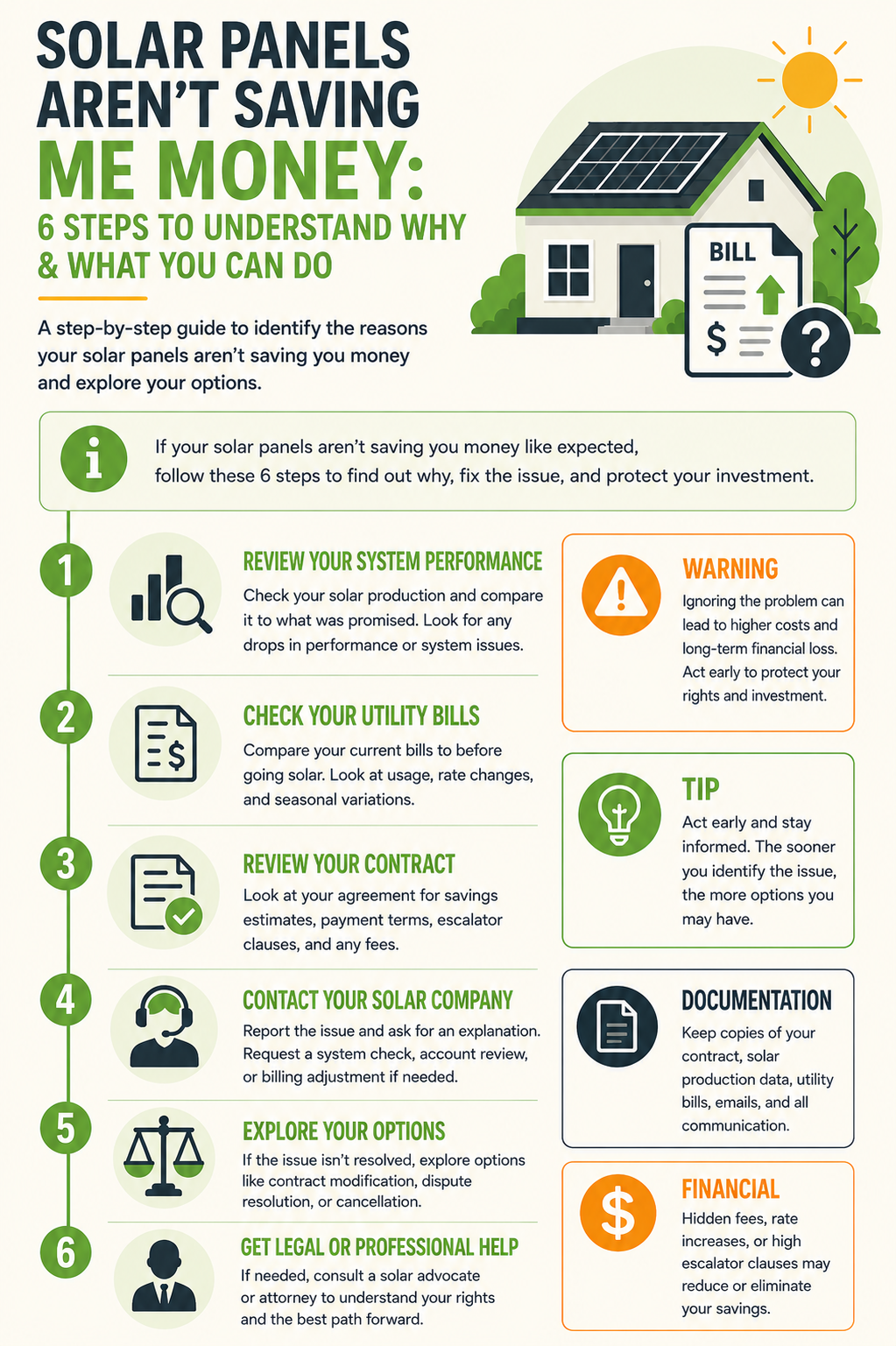
You are not stuck without options. Follow these steps to regain control.
- Gather Contracts and Bills: Create a folder with your signed agreement, your loan docs, and 12 months of utility bills.
- Request a Performance Review: Contact your installer. They explain why production doesn’t match the proposal.
- Contact the Financing Company: Send a written letter. State that the product is not performing as advertised.
- Document Everything: Keep a log of every phone call, name, and date.
- File Complaints: Use the Better Business Bureau (BBB) and your State Attorney General’s office. This is a vital step for a solar financing dispute in Florida or elsewhere.
- Consult an Independent Expert: Seek help from companies that specialize in solar contract disputes.
Can You Cancel a Solar Contract If You Are Not Saving Money?
Many homeowners begin looking into cancellation after realizing the savings are much lower than expected. Once the system is installed, getting out of the contract usually becomes harder. Still, that does not always mean homeowners are out of options.
What Counts as Misleading Savings Information?
Some people sign solar agreements after hearing promises about very low electric bills or major long-term savings. Later, the monthly costs look very different from what was originally explained.
Homeowners searching for what are my options if solar savings were misrepresented are often dealing with situations where the projected savings never matched real utility costs.
Why Arbitration Clauses Matter in Solar Contracts
A large number of solar agreements include arbitration clauses. These clauses often prevent disputes from going through normal court proceedings. Instead, the issue moves into a private legal process that can feel confusing without outside help.
For many homeowners, understanding these terms becomes important once payment problems begin.
When Legal Guidance May Help
Some homeowners end up carrying expensive solar loan payments while still receiving high utility bills each month. When the financial pressure keeps growing, legal guidance may help clarify what options are available.
In more serious situations, speaking with a solar contract lawyer California high bills professional may help homeowners better understand possible consumer protection rights and contract concerns.
Common Solar Myths That Confuse Homeowners
- “Solar Means No Electric Bill”: False. You still pay for grid connection and nighttime power.
- “Solar Savings Are Guaranteed”: False. Weather, dirt, and policy changes affect savings.
- “More Panels Always Mean More Savings”: False. If your utility doesn’t have good net metering, extra panels are a waste of money.
- “Solar Financing Always Lowers Monthly Expenses”: False. High interest rates and dealer fees can make solar more expensive than the grid.
How To Protect Yourself Before Signing a Solar Agreement
Many solar problems begin before the paperwork is even signed. A strong sales pitch can make the numbers sound better than they really are. That is why it helps to review every detail carefully before moving ahead.
A few simple checks can save homeowners from bigger problems later:
- Compare quotes from more than one solar company.
- Look closely at the estimated monthly savings.
- Read customer complaints, not only positive reviews.
- Ask if the financing adds dealer fees or extra costs.
- Review the full repayment amount, not just the monthly payment.
Spending more time on research may help homeowners avoid situations where solar panels cost more than expected after installation.
When Solar Panels No Longer Feel Like a Good Deal
Some homeowners expect solar to lower stress, but the opposite can happen. The loan payment stays high while the electric bill never drops enough to make a real difference.
For others, the costs become more noticeable over time. A growing loan balance or high remaining payments can also create problems when selling the property.
Homeowners facing solar financing payments are too expensive and sometimes look into refinancing or reviewing the loan terms again. Understanding the full financial picture early can help prevent more pressure later on.
Frequently Asked Questions
Why are my solar panels not lowering my electricity bill?
High energy use at night often keeps your bills high. Your system might also be too small for your home’s actual needs. Many power companies now use “Time-of-Use” rates. These plans charge much higher prices during the evening.
Why is my electric bill still high after solar installation?
You still have to pay “connection fees” to stay on the grid. You also pay for any power you use after the sun goes down. Check your app to ensure the system is actually on and sending power.
Can I cancel my solar contract if I am not saving money?
Walking away is hard once the panels are on your roof. However, you can dispute the deal if the company lied about your future savings. Proof of fraud or a system that fails to work can help your case.
How do I know if my solar system is underperforming?
Open your solar monitoring app and look at the energy numbers. Compare these to the “Estimated Production” in your original contract. If your system makes 20% less than promised, you likely have a problem.
What should I do if my solar financing payment is too high?
Look at your loan papers for hidden dealer fees. These costs often make the total balance much higher than it should be. Talk to a consumer advocate to see if the lender broke any federal laws.
Can a solar company be held responsible for misleading savings promises?
Yes. Most states have laws that stop companies from using fake math to sell products. If a salesperson made claims that were clearly false, the company could be liable for your financial losses.
Conclusion
If your solar panels are not saving money, please know you are not the only one. Many families expected much lower bills but ended up with higher monthly costs instead. This feels like a huge weight, but you do have choices.
Start by looking at your power bills and your solar production data. Compare what is happening now to what the salesperson told you in the beginning. Seeing these numbers in black and white will help you find the real issue.
If your solar savings are not matching promises, it is time to act. Search for solar savings disputes helps to see what your rights are. Moving quickly is the best way to protect your money and fix a bad situation.