

If you stop paying a solar loan, lease, or PPA, the agreement doesn’t just go away. Depending on what you signed, you could face default, credit reporting, collections, action against the equipment, or even a lawsuit.
Before you miss another payment, it helps to know three things: what type of financing you have, who actually receives your payment, and what your contract says about default, your right to fix things, and how the agreement can end.
The consequences look very different depending on whether you have an unsecured loan, a secured loan, PACE financing, a lease, or a PPA. This guide walks through each one in plain language.
First, Find Out What Type of Solar Agreement You Have
Before you decide anything, pull out the paperwork you signed.
The Consumer Financial Protection Bureau (CFPB) explains that home solar can be paid for in a few different ways. Some solar loans are secured by the panels themselves, while others aren’t secured at all. Leases and PPAs work differently, because in those deals the solar company usually owns the system, not you.
| What you signed | Who usually owns the panels? | What matters if payments stop? |
| Unsecured solar loan | Homeowner | Default, the lender speeding up what you owe, collections, and credit reporting |
| Secured solar loan | Homeowner | Same as above, plus the lender’s claim on the equipment |
| PACE financing | Homeowner | Property tax assessment and lien issues |
| Solar lease | Solar provider | The provider’s own rules on default, ending the contract, and equipment |
| Solar PPA | Solar provider | The provider’s own rules on payment, default, and ending the contract |
If you paid for solar using a HELOC, home equity loan, or your mortgage, treat that as its own issue. What happens next comes from the terms of that loan, not just from the fact that the money went toward solar panels.
Know which company handles which problem
Your installer and your lender are often two completely different businesses. Mixing them up can waste time and delay a fix.
- Installer: handles the installation, permits, and workmanship
- Lender: handles the financing terms and what you owe
- Servicer: handles collecting your payments
- Lease or PPA provider: owns the system and sets the contract terms
- Debt collector: handles a delinquent account
The CFPB has pointed out that solar sales and financing can feel like one single deal, even when they actually involve separate companies and separate contracts.
This matters most if you want to stop paying because something went wrong with the installation itself, since that’s often an installer problem, not automatically a financing problem.
What Actually Happens After You Miss a Solar Payment?
Here’s something worth knowing upfront: there’s no single nationwide rule that says a solar account goes into default after 30, 60, 90, or 120 days. It depends entirely on your paperwork.
Your own agreement decides when a missed payment turns into a formal default, and what the lender or provider can do about it.
What to look for in your contract
Search your agreement for these terms:
- the payment due date and any grace period
- late payment fees
- how “default” is defined
- notice requirements before action is taken
- your chance to fix (or “cure”) the problem
- acceleration, meaning the lender demands the full balance early
- whether the equipment secures the loan
- collection costs
- how a lease or PPA can be ended
A missed payment usually makes your account late first. If nonpayment continues, it can lead to default, collections, or the lender speeding up what’s owed, but this depends on your specific contract.
Understand acceleration clauses
An acceleration clause lets a lender demand the entire remaining balance, not just the missed payment, once a real default has happened. Don’t assume this kicks in automatically after a set number of days. Check your paperwork.
Leases and PPAs follow different rules
Don’t apply solar loan rules to a lease or PPA. Since the provider owns the system in those deals, what happens after a missed payment (default, ending the contract, or dealing with the equipment) depends entirely on that provider’s agreement and the law in your state.
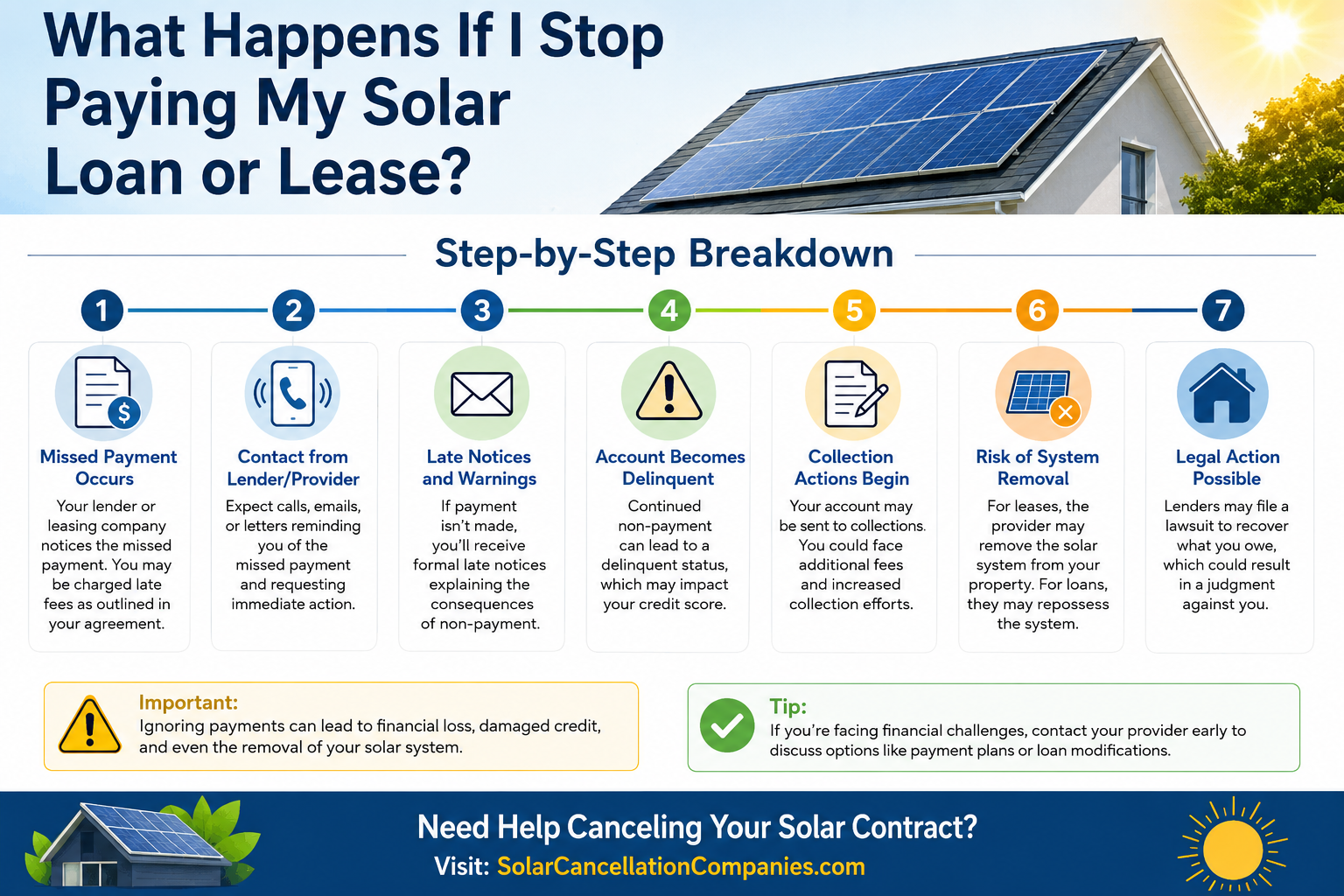
Can the Lender Repossess My Panels or Put a Lien on My House?
It depends on what actually secures your debt.
If the panels secure your loan
Some solar loans are backed by the equipment itself, while others aren’t secured at all, according to the CFPB. If yours is secured, the lender may have rights over the panels after a default.
This only applies if your loan paperwork actually gives the lender a security interest. Look for words like security interest, collateral, fixture, UCC, or repossession. What actually happens depends on your contract and the laws in your state.
A UCC filing isn’t the same as a lien on your whole house
Some solar lenders file something called a UCC financing statement, which covers the equipment. The CFPB explains this usually applies to the solar equipment, not your actual house.
That said, a UCC filing can still slow down or complicate a home sale or refinance, since a mortgage lender or title company may ask you to get it released or moved to a lower priority first.
In short: a UCC filing on your solar equipment is not the same thing as a mortgage lien on your entire home.
If a UCC filing is already causing problems with a sale or refinance, see our guide to solar UCC filings and home sale problems.
PACE financing works differently, and carries a bigger risk
If your solar system was financed through PACE (Property Assessed Clean Energy), treat it differently from an ordinary solar loan.
The FTC explains that PACE financing gets repaid through your property tax bill, and it creates a lien on your home. If you fall behind on the property tax payments tied to it, you could eventually face foreclosure.
PACE rules vary depending on where you live, so check your assessment paperwork and your current property tax status directly.
Will Stopping Solar Payments Hurt My Credit?
Only if the lender actually reports it. Lenders aren’t required to report every account to the credit bureaus, so there’s no universal rule that a missed solar payment shows up after exactly 30 days.
How long negative marks stay on your report
If accurate negative information does get reported, it can generally stay on your credit report for up to seven years.
There’s also no fixed rule that says everyone’s score drops by the same number of points after a solar default. Scoring impact varies from person to person.
If you spot something on your report that looks wrong, you can dispute it, both with the credit reporting company and with the business that reported it.
What If I Want to Stop Paying Because the Solar System Doesn’t Work?
This is one of the most important things to understand in any solar payment dispute.
You might still owe money on your financing even if:
- the project was never actually finished
- you never got permission to turn the system on
- the equipment is faulty
- it’s producing far less power than promised
- your installer stopped answering calls
- your installer went out of business
- the salesperson misrepresented the price, savings, or tax benefits
All of these are real problems, and they may give you a solid case against the installer. But on their own, they don’t automatically cancel your financing obligation.
The CFPB found that some solar loan agreements state your repayment doesn’t depend on how well the system actually performs. So the real question becomes: what claim do you have against the seller, and does that claim also reach into your financing agreement?
When the FTC Holder Rule might help
The FTC Holder Rule can apply to certain credit deals that a seller arranges for you. Where it applies, it lets you raise the same claims and defenses against the lender that you could raise against the seller.
But this rule has limits. It doesn’t apply to every solar loan, it doesn’t invent a claim you didn’t already have, it doesn’t cancel your debt automatically, and not every performance problem qualifies as a valid reason to stop paying.
Gather these documents before you act
Before treating an installer problem as a financing dispute, pull together:
- your installation agreement
- your financing agreement
- the original proposal and sales paperwork
- any written promises about savings or production
- warranty terms
- permitting and inspection records
- payment or funding records
- emails, texts, or service tickets documenting the issue
Once you have these, figure out whether the real problem sits with the installer, the lender, the servicer, or more than one of them at once.
If your installer has shut down, see our guide on what happens when a solar installer goes out of business.
Filing a complaint or disputing the installation doesn’t automatically pause your monthly payment, so don’t stop paying just because you’ve raised the issue.
What If My Solar Account Is Already in Collections?
Start by figuring out exactly who contacted you. The CFPB distinguishes an original creditor from a debt collector, and federal rules don’t treat them the same way.
A debt collector covered by federal rules generally has to send you validation information, either in their first message or within five days, unless an exception applies. That notice should tell you the creditor’s name, the amount claimed, and how to dispute it.
If you send a written dispute during that validation window, the collector generally has to pause collection until they send you proof of the debt.
If you’re already at this stage, see our guide on solar companies threatening collections.
Can a Solar Creditor Garnish My Wages?
Not just because you missed a payment. For most ordinary consumer debts like this, a creditor has to sue you and win a judgment before wage garnishment can even start. Federal and state law also limit how much can actually be taken.
Think of it as a chain of steps: missed payment, then maybe collections, then maybe a lawsuit, then a judgment, then possibly wage garnishment. Most accounts never make it through every step.
If you do get served with a lawsuit, that changes your priorities immediately. Focus on the court deadline first. Don’t let ongoing complaints to the installer distract you from responding to the lawsuit on time.
Does Turning Off Autopay Stop the Loan?
No. Turning off an automatic bank withdrawal only changes how you pay, it doesn’t erase what you owe.
The CFPB is direct about this: cancelling automatic payments on a loan doesn’t remove your obligation to pay another way.
It helps to think of these as two separate things. Stopping ACH authorization only controls automatic access to your bank account. Actually disputing or ending the debt requires a real contractual or legal reason, and stopping autopay isn’t one.
What Should You Do Before Missing Another Solar Payment?
If your account is still current, use this time wisely. Here’s a practical order to work through things.
1. Figure out exactly what you signed
Confirm whether you have a solar loan, a secured solar loan, a PACE assessment, a lease, a PPA, or a home equity product. Don’t rely on whatever the salesperson called it at the time.
2. List every company involved
Separate the installer, the lender, the servicer, the lease or PPA provider, and any collector. This stops an installer warranty issue from accidentally going only to the lender, or a financing dispute from going only to the installer.
3. Read the clauses that control what happens if you don’t pay
Look specifically for: default, late payment, acceleration, your cure rights, security interest, UCC, repossession, collection costs, early termination, transfer rules, and dispute procedures.
4. Check where your account actually stands right now
Is it current, past due, in formal default, accelerated, in collections, or already the subject of a lawsuit? Knowing this changes what you should do next.
5. If money is tight, talk to the creditor before you default
Ask whether they offer a hardship program, a payment plan, or any kind of modification. Don’t assume any option exists until you ask, and always get any change in writing.
6. If the installer caused the problem, document it thoroughly
Write down what was promised, what was actually delivered, what’s still unfinished, and what your financing agreement says. Then work out whether the installer’s failure legally affects your financing obligation.
7. If a debt collector reaches out, save the validation notice
Check the creditor’s name, the amount they’re claiming, the account details, and your dispute deadline.
8. If you’ve been sued, treat the court deadline as priority one
A solar dispute and a collection lawsuit can run at the same time. Once you’ve been served, responding to the court becomes more urgent than any ongoing complaint or negotiation.
What Should You Check Based on Your Situation?
| Your situation | What to check next |
| You haven’t missed a payment | Your financing type, the default clause, and any payment options available |
| Your payment is already late | Current balance, notices you’ve received, default terms, and how to cure it |
| Your system doesn’t work | Installer contract, warranty, financing agreement, and any seller-related claims |
| Your installer disappeared | Funding status, unfinished work, warranties, and your lender agreement |
| Your payment suddenly increased | Re-amortization and any expected prepayment clauses |
| You got a collection letter | The current creditor, amount claimed, validation info, and your dispute deadline |
| You found a UCC filing | What it actually covers, and whether it needs to be released or subordinated |
| You have PACE financing | Your property tax assessment and lien status |
| You got a lawsuit | The court response deadline and the debt being claimed |
| You want to sell your home | Payoff amount, transfer rules, UCC filings, and lease or PPA requirements |
Frequently Asked Questions
Can a solar company shut off my system if I stop paying?
Don’t assume every provider has this power. In a lease or PPA, the provider owns the equipment, but whether they can disable, terminate, or take back the system depends entirely on the specific agreement and your state’s laws. Read the default and equipment sections of your contract before believing any claims about remote shutdown.
Can I sell my house if I’m behind on solar payments?
Being behind doesn’t automatically make your home unsellable, but the financing usually needs to be sorted out before closing. A secured loan or UCC filing might require a payoff or a release. A lease or PPA may have its own transfer, payoff, or buyer approval steps. If a sale is coming up, check your agreement early.
What if the company collecting the debt isn’t the lender I originally signed with?
First, verify who’s actually claiming to own or collect the account now. A covered debt collector generally has to send you information identifying the debt and the creditor. A new company name doesn’t automatically mean the debt is fake, but it’s worth confirming before you act on a phone call or letter alone.
Can a solar lender still sue me over an old unpaid account?
Possibly. The time limit to file a lawsuit over a debt varies by state, by the type of debt, and sometimes by what law governs your agreement. The CFPB warns that making a payment, or even acknowledging an old debt, can sometimes restart that clock in certain states. Covered debt collectors also aren’t allowed to sue, or threaten to sue, over debt that’s already past that time limit.
Before You Turn a Solar Problem Into a Payment Default
A solar payment problem usually touches more than one contract and more than one company. Before you decide what to do next, it helps to separate four things: what actually went wrong with the project, who’s responsible for it, whether it affects your financing at all, and what stage your account is currently in.
That’s exactly where Solar Cancellation Companies (SCC) can help. SCC helps homeowners connect the dots between contract issues, financing, installer problems, UCC filings, collections, and cancellation questions, so you can figure out which problem needs your attention first.
Before reaching out to SCC, gather your solar contract, your financing agreement, your latest account statement, any default or collection notice you’ve received, and whatever records show what went wrong with the project. Having these ready makes it much easier to work out whether your next move is a financing dispute, an installer claim, a collection response, or a cancellation review.
This guide provides general consumer information and is not legal or tax advice.