

If something has gone wrong with your solar project and you’re wondering whether you can walk away from your GoodLeap loan, lease, or PPA, the honest answer is: it depends on four things, your contract type, how the sale happened, your state, and how far the project has progressed. There’s no single “GoodLeap rule” that applies to every homeowner. This guide walks through each factor so you can figure out which rule actually governs your situation, and what to do next if the cancellation window has already closed.
Who Is GoodLeap?
GoodLeap is a fintech and consumer lending company headquartered in Roseville, California, that finances residential solar, battery storage, and other home efficiency upgrades. It lends nationwide through a network of independent solar installers and contractors, rather than installing systems itself. That distinction matters for this guide: GoodLeap is the financing party, not the company that designed or installed your system.
GoodLeap only provides the loan, lease, or PPA and does not perform the installation, your relationship with the company is contractual and financial. Issues with workmanship, permitting, or project timelines are typically the installer’s responsibility, while payment terms, financing structure, and loan documents are GoodLeap’s. Keeping that separation in mind is the key to understanding your cancellation and dispute options, which is what the rest of this guide covers.
Quick Reference: Where You Likely Stand
Use this table to understand your situation before reading further.
| Your situation | What likely applies |
| Signed within the last few days, sale happened at your home (not a store/office) | You may have a 3 business day right to cancel under the FTC Cooling Off Rule |
| Signed recently, nothing installed yet | Check your contract for a Notice of Cancellation; check state specific rescission rules |
| Permitting or financing underway, no equipment installed | Look for a contractual cancellation clause; ask how much money has already been disbursed to the installer |
| Installation has started or equipment is on site | Cancellation is now fact specific, don’t assume rights have expired, but don’t assume they haven’t either. Document everything |
| System installed but not yet approved to operate (no PTO) | This is a performance/completion issue, not typically a cancellation scenario, raise it with the installer and utility |
| System operational, payments underway | Cancellation is unlikely to apply. You’re likely looking at a financing or workmanship dispute instead |
Your GoodLeap Contract Type Determines Your Options
GoodLeap finances solar in three structures, and the differences matter for cancellation, transfer, and dispute rights alike.
Solar loan: You own the system outright; GoodLeap simply lends you the money and you repay it over time. Because you hold ownership, questions about tax credits, home sales, and early payoff all trace back to your loan agreement’s specific language, not a general rule.
Solar lease: GoodLeap owns and maintains the system under its current lease product; you pay for the power it generates. Ownership staying with GoodLeap changes how cancellation and transfer work compared to a loan.
Power purchase agreement (PPA): Similar to a lease, except your payment is tied to actual electricity output at an agreed rate per kilowatt hour rather than a fixed fee. Some current GoodLeap lease and PPA products include scheduled annual rate increases, so check your payment schedule rather than assuming the rate is flat.
Don’t assume rights that apply to one of these products apply to another. Confirm which one you actually signed before you act. If you’re unsure which category your agreement falls into, our Solar Contract Type breakdown walks through how to tell them apart from your paperwork.
Your Installer Contract and Your GoodLeap Agreement Are Usually Separate
Most homeowners experience solar as a single purchase, but legally it’s often two contracts: an installation agreement with the solar company, and a financing agreement with GoodLeap. The Consumer Financial Protection Bureau has flagged this exact structure as a source of homeowner confusion. The sale feels unified even when the underlying obligations are not.
That separation has real consequences. Canceling or disputing the installer contract does not automatically cancel your GoodLeap agreement, and if your installer goes quiet or the project stalls, your financing typically continues on its own terms unless a specific clause, law, or approved resolution changes that.
| Agreement | Who’s involved | Common issue | What to check |
| Installer contract | Solar installation company | Incomplete work, permit delays, poor workmanship | Scope of work, completion date, warranty terms |
| GoodLeap financing agreement | GoodLeap | Payment amount, re amortization, cancellation terms | Loan/lease/PPA terms, funding status, payment schedule |
| Sales representations | Sales rep or installer | Claims about savings or tax credits | Written proposal vs. what you were told verbally |
Pull both agreements and read them side by side before contacting either company. Knowing which company owns which part of the problem will save you real time.
Do You Have a Three Day Right to Cancel?
This is the most misunderstood part of solar financing. Several distinct rules exist, and none of them applies automatically to every GoodLeap customer.
- FTC Cooling Off Rule: Gives buyers a three business day right to cancel sales made away from the seller’s normal place of business, door to door sales being the classic example. Whether it applies depends on where and how the sale actually happened, not on the fact that solar was involved.
- TILA / Regulation Z: The Truth in Lending Act, through Regulation Z, provides a rescission right in some consumer credit transactions, generally where a security interest is taken in your primary home. Not every GoodLeap loan meets these conditions.
- Contractual cancellation clauses: Independent of federal or state law, your own GoodLeap or installer agreement may contain a cancellation clause with its own deadline and conditions. Read the actual document rather than relying on assumptions.
- State specific rights: Rules vary meaningfully by state. California addresses solar consumer protections through the California Public Utilities Commission; Texas covers door to door rescission through the Texas Attorney General; Florida has its own solicitation statute. A right that applies in one state won’t necessarily apply in another. For a broader rundown of how these protections differ across the country, see our Solar State Laws guide.
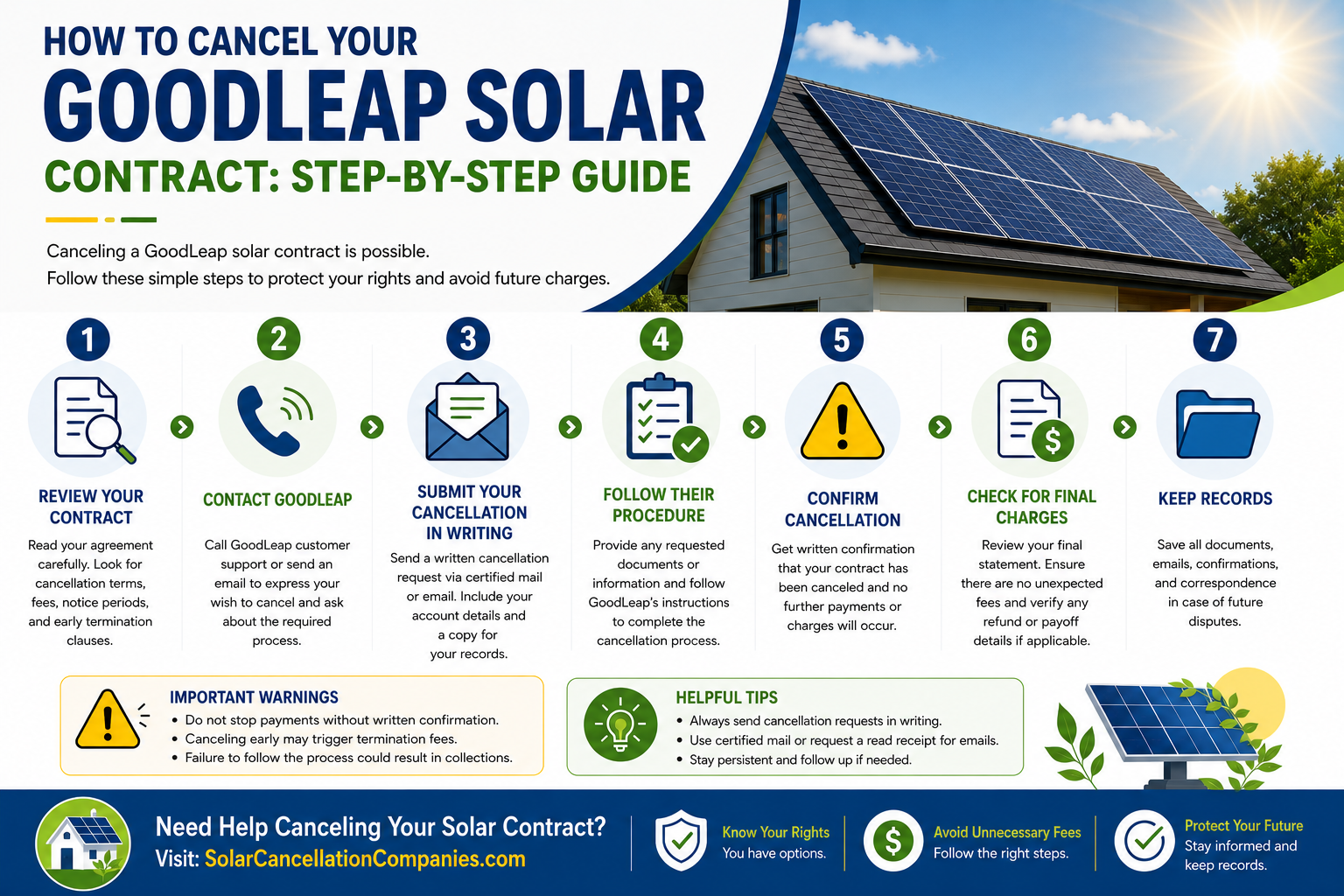
How to Actually Cancel Your GoodLeap Contract
If you’re still inside a valid cancellation window, whether that’s the FTC’s three-day rule, a state law, or your own contract’s clause, here’s what to actually do:
- Find your Notice of Cancellation form, usually a separate one-page form given at signing, not buried in the main contract.
- Send it in writing to both GoodLeap and the installer. A phone call to your sales rep doesn’t count.
- Send it before your deadline, using certified mail or a method that timestamps delivery.
- Keep proof you sent it. “I mailed it” won’t hold up in a dispute; a tracking number will.
- Get written confirmation back that the cancellation was received and processed.
- Don’t stop payments until you have that confirmation, or you risk looking like you defaulted.
- Ask in writing how any installed equipment or funds already paid will be handled.
- Check your bank and credit report afterward to confirm the account shows cancelled, not delinquent.
If your window has already closed or your contract has no clear rescission clause, this process doesn’t apply, you’re dealing with a dispute instead, covered next.
If the Cancellation Window Has Already Closed
Missing your cancellation window doesn’t mean you’re stuck. It just means “cancel” isn’t the right word for what you’re doing anymore. Depending on what actually happened, you’re now looking at one of these instead:
- A termination clause buried in your contract
- An unfinished-work claim against your installer
- A misrepresentation claim if you were misled during the sale
- A financing dispute you raise directly with GoodLeap or a regulator
None of these guarantee your contract goes away. What they do is give you a real path to fix the actual problem, whether that’s a job that never got finished, a bill that doesn’t match what you agreed to, or a sales pitch that didn’t match the paperwork.
If the Installer Never Finished the Job
Before deciding your next step, gather answers to these:
- What work remains, compared against your written scope of work?
- Has GoodLeap already funded the installer for some or all of the project?
- Is the installation physically complete, or only partial?
- Has the system received Permission to Operate (PTO) from your utility?
- What does your GoodLeap agreement specifically say about incomplete installation?
An unfinished installation does not automatically cancel your financing. The two issues are resolved through separate channels, even though they started with the same sale.
If the Installer Went Out of Business
If your solar installer closes or files for bankruptcy, your GoodLeap agreement doesn’t automatically disappear. Your payment obligations may continue under the financing agreement even if the installer can no longer finish or service the project.
Before contacting GoodLeap, work out exactly where your project stands:
- Is the system currently producing electricity?
- Which equipment and workmanship warranties are still active?
- Has another company taken over servicing or warranty obligations?
- Who is responsible for unfinished repairs, inspections, or warranty work?
- What do you still owe under your GoodLeap agreement?
Keep every contract, invoice, payment record, email, and project document. If you need to raise a financing dispute, pursue warranty coverage, or seek legal advice, these records can help establish what happened and what obligations remain.
If You Believe You Were Misled
If what you were told during the sale doesn’t match what you signed, on payment amounts, tax credit claims, savings projections, or financing terms, start building a record rather than jumping straight to an accusation. Collect your signed contracts and addenda, the original sales proposal, emails and texts with the sales rep or installer, any savings illustrations you were shown, and any marketing materials referenced during the sale, including anything online you might lose access to later. This doesn’t prove misrepresentation occurred, but it gives you, GoodLeap, or a regulator a factual basis to evaluate the claim.
Does the FTC Holder Rule Help?
The FTC Holder Rule works differently than most homeowners expect. For a covered credit contract, it can preserve claims or defenses you have against the seller (your installer) and let you raise them against the holder of the credit contract, in this case, GoodLeap. In practice, it keeps seller related problems from getting lost just because two separate companies were involved in the sale.
What it doesn’t do is cancel your financing agreement by itself. It’s a mechanism for preserving a claim, not a cancellation tool, and whether it applies depends on the specifics of your transaction.
Payment Changes, Home Sales, and the UCC 1 Filing
Selling your home: For a GoodLeap solar loan, homeowners generally have two paths: pay off the remaining balance from sale proceeds (the option GoodLeap says most homeowners choose), or have the buyer apply for an approved loan assumption, which is not guaranteed. If your agreement is a lease or PPA instead, the transfer process is different because GoodLeap, not you, owns the equipment.
The UCC 1 filing: GoodLeap’s Solar Loan UCC 1 and fixture filing secures the equipment itself, not your home, it is not a lien against your house. It can still surface during a refinance or home sale because it’s tied to the property record, so it’s worth asking your title company or lender how it will be handled.
Should You Stop Paying During a Dispute?
No. Filing a complaint does not automatically pause your payments. Stopping payments on your own may lead to consequences under your agreement. If you’re in a dispute, raise it formally and in writing with GoodLeap, and ask directly what your options are while it’s being resolved. Don’t make a one sided decision about payment on your own.
How to Raise a Dispute, Step by Step
- Identify the exact problem, payment, installation, or a sales claim.
- Pull your GoodLeap financing agreement and read the relevant terms.
- Pull your installer agreement and compare it to what actually happened.
- Confirm current project and funding status with both companies.
- Gather supporting evidence: contracts, emails, payment records.
- Contact the installer for workmanship or completion issues.
- Contact GoodLeap for financing or payment issues.
- Keep written records of every call and message, with dates and names.
- Escalate through a formal complaint channel if it stays unresolved.
- Consult an attorney for serious contract disputes.
For a walkthrough tailored to specific exit scenarios beyond GoodLeap, our Solar Exit Guides cover other lenders and installer situations in more depth.
Where to File a Complaint
- GoodLeap directly. The fastest first step for a financing specific issue, since they can pull your account and loan terms.
- CFPB Complaint Portal. The CFPB accepts complaints on consumer financial products, including solar loans, and generally routes eligible complaints to the company for a response. It doesn’t investigate every complaint, and filing one won’t cancel your loan, pause payments, or guarantee a refund on its own.
- Your state Attorney General. This may be an appropriate route if you believe deceptive practices occurred during the sale or financing. State Attorneys General can investigate consumer-protection issues and take enforcement action where warranted. In March 2024, the Minnesota Attorney General filed litigation against GoodLeap and other solar lenders alleging deceptive lending and dealer-fee practices. These are allegations, not proven findings, but the case shows that solar-financing practices can draw state enforcement scrutiny.
- State contractor licensing board. The right venue for a workmanship or licensing complaint against your installer.
Documents to Gather Before You Act
Your GoodLeap financing agreement, installer agreement, any Notice of Cancellation, current payment schedule, original solar proposal, financing disclosures, sale/installation/financing emails and texts, marketing materials shown to you, permit records, inspection and PTO records, installation photos, GoodLeap account and payment statements. Having these ready before you call or file anything will speed up whoever reviews your case.
If you’re still unsure what your GoodLeap paperwork means or which issue needs to be addressed first, Solar Cancellation Companies can help you review your solar contract situation and understand the next steps available based on your project and financing documents.
This article explains general consumer rights and contract structures. It isn’t legal advice. For a decision specific to your situation, consult an attorney or your state consumer protection office.
Frequently Asked Questions
Can I cancel a GoodLeap solar loan after signing?
It depends on your contract terms, how the sale happened, your state, and how far the project has progressed. No single right applies after signing in every case.
Does every GoodLeap solar contract have a three day cancellation period?
No. A three day right may apply under the FTC Cooling Off Rule or certain state laws, depending on how and where the sale happened. It isn’t automatic for every agreement.
Does canceling the installer contract automatically cancel GoodLeap financing?
Not automatically. These are usually separate agreements, so canceling one doesn’t necessarily cancel the other. It depends on the language in both agreements and applicable state law.
What if my solar installer went bankrupt?
It doesn’t automatically cancel your GoodLeap financing. Document your project status, funding, and any active warranties, then contact GoodLeap directly.
Does GoodLeap put a lien on my house?
No, its UCC 1 and fixture filing secures the solar equipment, not the home. It can still come up during a home sale or refinance.