

If your solar paperwork names Infinity Energy, Inc. of Rocklin, California, the company’s bankruptcy does not automatically cancel every agreement tied to your system. Infinity may have sold or installed your project while a different company controlled your loan, lease, PPA, or PACE financing.
Infinity Energy filed for Chapter 7 bankruptcy on February 20, 2025. Before you stop paying or send a cancellation notice, take a moment to check who actually receives your payment, who owns your system, and who services your account today.
Make Sure You Have the Right Infinity Energy
This guide covers Infinity Energy, Inc. of Rocklin, California, tied to California contractor license #998627.
That detail matters because a few other companies use similar names, like Infinity Energy or Infinity Solar. It’s easy to mix them up.
Before you read any further, check the legal name on your paperwork against what’s listed here. Look at your:
- installation contract
- financing agreement
- solar disclosure documents
- permit or contractor records
California’s Department of Financial Protection and Innovation (DFPI) also lists Infinity Energy Inc., license #998627, as an enrolled PACE solicitor working with PACE Funding Group.
If the name or license number on your documents doesn’t match, don’t assume anything in this article applies to your situation.
What the Bankruptcy Actually Changes
Infinity Energy, Inc. filed Chapter 7 in the U.S. Bankruptcy Court for the Eastern District of California, case number 25-20737-B-7.
This matters because you can no longer treat Infinity like a normal, operating company. You can’t call them up to negotiate a cancellation, schedule a repair, or work out new payment terms.
But here’s the key point: bankruptcy alone does not cancel a separate loan, lease, PPA, PACE assessment, or transferred service agreement. It only affects Infinity itself.
If you’re trying to understand that distinction, SCC’s guide on what happens when a solar installer goes bankrupt explains how installer closure can affect contracts, financing, warranties, and unfinished projects.
Why one project can involve several companies
A single solar deal often involves more than one business, even if it felt like one purchase to you. The Consumer Financial Protection Bureau (CFPB) points out that solar financing usually separates the installer from the lender.
So your first job isn’t to cancel anything. It’s to figure out which company controls each part of your deal.
| Name or role on your paperwork | What to figure out |
| Infinity Energy | Were they the installer, the seller, or both? |
| Lender | Who holds or services your solar loan? |
| Solar provider | Is there a lease, PPA, or separate service agreement? |
| Current servicer | Who handles billing and support now? |
| PACE administrator | Is your payment collected through property taxes? |
| Equipment manufacturer | Who covers your panel, inverter, or battery warranty? |
This matters extra for Infinity customers, since Infinity had real, documented ties to other solar-finance and service companies.
If Your Infinity Papers Also Mention Sunnova
Some Infinity customers signed an installation agreement with Infinity while Sunnova held the longer-term solar contract behind it.
Sunnova told the SEC that Infinity Energy made up 12% of Sunnova’s net originations in 2020. Sunnova described these as dealer arrangements, where dealers like Infinity originated Sunnova’s solar service agreements.
That’s why the name Sunnova matters if it shows up anywhere in your paperwork.
Sunnova later filed for Chapter 11 bankruptcy on June 8, 2025. After its court-supervised sale, Sunnova said it stopped operating independently, and that SunStrong Management took over servicing for most of the in-service customer systems it acquired.
If Sunnova appears on your contract or statements, SCC’s Sunnova bankruptcy guide explains the SunStrong transition, continuing payments, servicing, and what former Sunnova customers should check now.
For former Infinity customers, the chain can look like this:
Infinity Energy → Sunnova → SunStrong
This doesn’t apply to everyone. It only applies if Sunnova was actually part of your original agreement, and if your account was one of the ones moved over.
If Infinity Never Finished Your Installation
Before you think about cancellation, treat an unfinished project as exactly that: a project that’s stuck, not a contract to walk away from.
Start by figuring out exactly where the job stopped. You may have:
- signed the contract but never had anyone show up
- gotten a partial installation
- finished installation but never passed final inspection
- passed inspection but never got permission to operate
Each of these points to a different party and a different fix.
If your panels are installed but the system never reached permission to operate, SCC’s guide to solar interconnection delays and PTO problems can help you work out whether the installer, inspector, utility, or missing paperwork is holding things up.
If your project was tied to Sunnova, there’s one recent development worth knowing about. Sunnova says SunStrong is working with GoodLeap to help finish some in-progress installations.
That doesn’t mean GoodLeap owes you a finished system. It only applies to certain projects.
Before you hire someone else to finish the job
Check these five things first, so you don’t accidentally create a second problem while trying to fix the first:
- Is the project still active with a provider or lender?
- Have installation funds already been paid out?
- Which permits and inspections are already done?
- Has your utility approved you to operate the system?
- Has another company already been assigned to finish it?
Your Payment Type Decides Your Next Move
Infinity’s bankruptcy doesn’t affect every kind of payment the same way.
The CFPB notes that some solar loans are written so your payment obligation is completely separate from how well the system actually performs.
In plain terms: a broken, unfinished, or underperforming system does not automatically cancel a separate loan payment.
So figure out what kind of agreement you actually have before deciding what to do next.
| If you have | Check first | Why it matters |
| Solar loan | Your lender and current servicer | The debt may be separate from Infinity’s obligations as installer |
| Lease | The system owner and servicer | The owner may still control the equipment |
| PPA | The provider and servicer | Your payment and rights depend on that specific agreement |
| PACE | The administrator and your property tax bill | This is tied to a tax assessment, not a normal loan |
Don’t stop paying just because Infinity went bankrupt, or because your system isn’t working right. First, find out whether you actually owe that payment to Infinity, or to someone else entirely.
A New Contract May Give You a Cancellation Window, an Old One Won’t
Infinity’s bankruptcy, or a later servicing transfer, does not restart an expired cancellation period on your original contract.
But if you recently signed a new or replacement agreement connected to this project, check its cancellation terms right away.
For certain covered sales made at your home, the FTC’s Cooling-Off Rule gives you three business days to cancel.
That rule doesn’t cover every solar sale, so check whether yours qualifies.
California also has its own solar-specific protections. The state’s Solar Consumer Protection Guide gives homeowners generally at least three business days to cancel a solar contract, and five business days if you’re 65 or older.
These are California-specific rules, so don’t assume they apply if your Infinity deal happened in another state.
If your original cancellation window has already passed, focus on other parts of the agreement instead of trying to reopen that old window.
Keep Your Records If Tax Credits or Savings Are Part of the Dispute
If your Infinity sale included promises about guaranteed tax savings, a certain output, or a specific loan structure, hold onto everything.
The CFPB has warned that some solar sales pitches make tax credits and savings sound more certain than they really are.
There’s also a real deadline here worth knowing. The federal Residential Clean Energy Credit offered 30% for qualifying solar systems placed in service from 2022 through December 31, 2025. Under current law, systems placed in service after that date do not qualify for this credit at all, since Congress ended it early.
The credit is nonrefundable, and it depends entirely on your own tax situation.
Hang onto your original proposal, financing disclosures, texts, emails, and any sales presentations if these promises are part of your dispute. A misleading sales statement matters, but on its own it doesn’t automatically void your contract or guarantee a cancellation.
Where to Take an Infinity Complaint in California
Where you complain depends on what actually went wrong.
| Problem | Who to contact |
| Contractor conduct, abandonment, or bad workmanship | California Contractors State License Board |
| PACE financing issues | California Department of Financial Protection and Innovation |
| Consumer finance issues | Consumer Financial Protection Bureau |
| Deceptive sales or marketing | FTC or your state Attorney General |
| Utility or interconnection issues | Your utility, or the state utility regulator |
This matters even more for Infinity customers, since your installation, financing, and servicing may now sit with three different companies.
If your project is outside California, use the contractor board, Attorney General, and utility regulator in the state where you signed and installed.
Before You Take Any Action
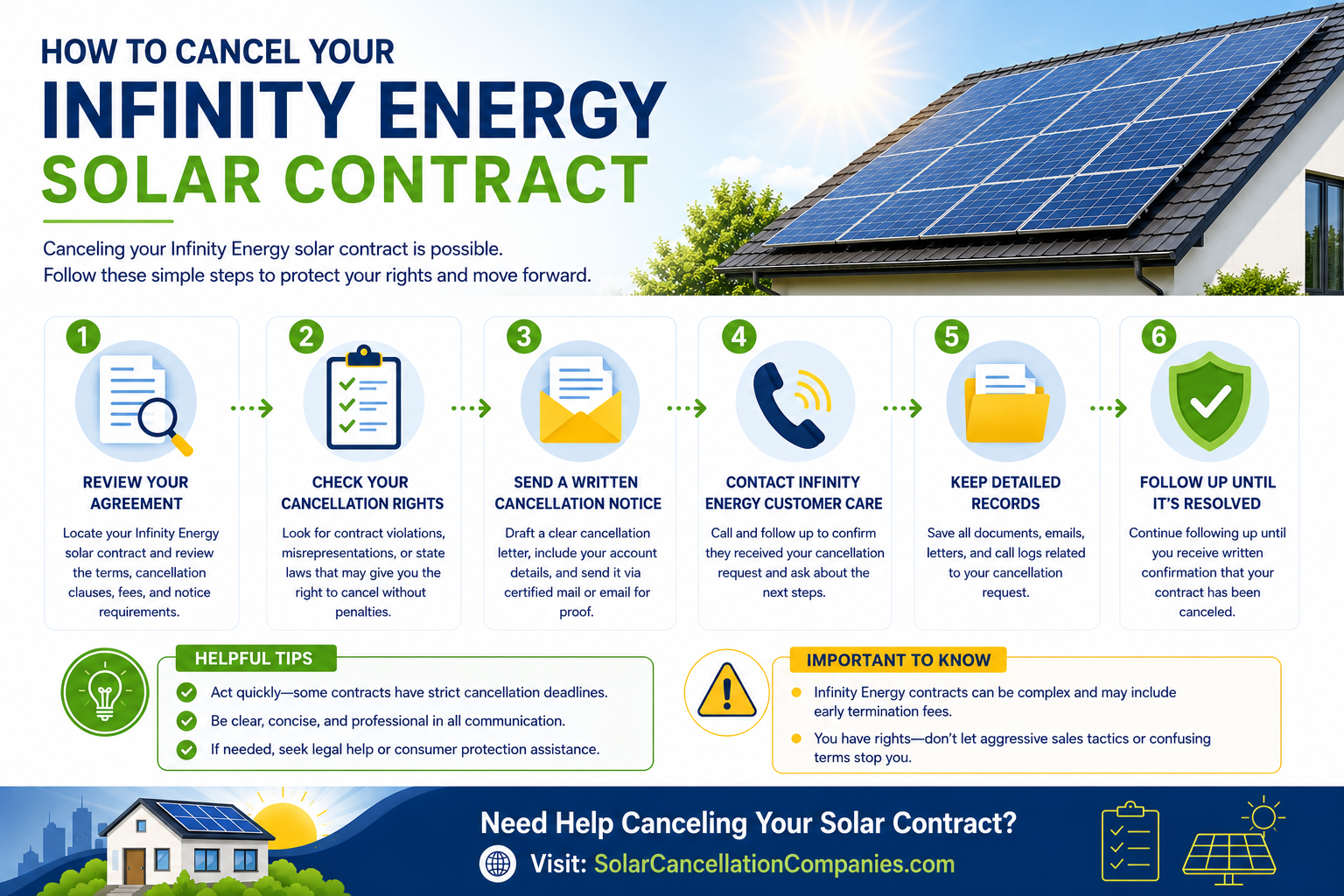
The most useful next step isn’t sending the same cancellation letter to every company you can think of.
Instead, break your situation into four parts:
- Installation. What did Infinity actually finish, and what’s still incomplete?
- Financing. Who currently receives your payment?
- Ownership and servicing. Who owns or services your system today?
- Contract rights. What does your agreement actually say about cancellation, transfers, repairs, or default?
Once you’ve sorted these out, you’ll have a much clearer picture of what you’re really dealing with: an unfinished install, a financing dispute, a transferred Sunnova account, a PACE assessment, a warranty issue, or a genuine cancellation question.
How Solar Cancellation Companies Can Help
An Infinity Energy case gets complicated fast, since the company that sold or installed your system may no longer be the one that controls your account today.
Solar Cancellation Companies helps homeowners map out that whole chain before taking any action. We can review your Infinity installation agreement alongside your lender, Sunnova, SunStrong, PACE, or other account documents, and help you figure out who actually controls your issue and what options are still open to you.
To get the most out of a review, gather your Infinity contract, financing agreement, latest statement, project-status records, sales communications, and any notice showing your account changed hands.
The goal isn’t to assume bankruptcy wiped everything clean. It’s to find out which obligation still exists, who controls it, and what to tackle first.
Frequently Asked Questions
Can I remove my Infinity Energy solar panels now that the installer is bankrupt?
Not automatically. First, find out who actually owns the equipment. If your system is tied to a lease, PPA, or similar agreement, another company may still own the panels even though Infinity installed them. Removing equipment before checking ownership could land you in a second dispute.
What happens if I want to sell my house with an old Infinity Energy system on it?
Start by identifying your financing structure. A loan may need to be paid off, while a lease or PPA may have its own transfer terms. If your project used PACE financing, that assessment can affect the sale too, since it’s tied to the property through a tax lien.
How do I know if my Infinity financing is PACE or a regular solar loan?
Look at where your payment shows up. PACE financing usually appears on your property tax bill, while a regular solar loan comes with its own lender or servicer and a separate monthly bill. Your financing contract should name the PACE administrator or lender directly.
Can Infinity Energy’s bankruptcy hurt my credit?
The bankruptcy itself won’t damage your credit. But if a separate lender or servicer still considers your payments due, missing them could still affect your credit under that agreement. Confirm who services your debt now, and dispute any billing issue through the right channel before assuming your obligation has ended.
This article offers general consumer information. It is not legal, tax, or financial advice.