

Yes, you may be able to cancel a Sunrun contract. But there is no single rule that applies to every customer.
What you can do depends on a few things. Your specific agreement, your state, how the sale happened, and whether installation has already started all play a part.
Start by finding your Sunrun Customer Agreement. Log in and go to Account, then Contracts & Docs. From there, check the cancellation, purchase, transfer, and performance terms that apply to you. If you can’t find your agreement, Sunrun says you can request a copy through Customer Engagement.
Which Sunrun Agreement Did You Sign?
Sunrun has used several different contract types over the years. Knowing which one you signed matters, because your options for getting out aren’t the same across all of them.
As of 2026, Sunrun’s contract disclosures filed with the SEC list these agreement types:
- monthly power purchase agreements (PPAs)
- prepaid PPAs
- monthly leases
- prepaid leases
- SHIFT agreements
- Flex agreements
- Storage Add-on agreements
SHIFT, Flex, and Storage Add-on agreements are newer. They were introduced in 2024. Sunrun also notes that the exact terms can differ depending on your location and your system.
Lease or PPA, know the difference
A lease and a PPA are not the same thing. With a lease, you’re generally paying for the use of equipment that Sunrun owns.
With a PPA, you’re paying for the electricity your system produces. That distinction changes what “getting out” of the contract actually looks like.
If your original paperwork came from Vivint Solar, use that original agreement as your starting point. Don’t assume Sunrun’s current terms automatically apply. Sunrun completed its purchase of Vivint Solar in October 2020.
Figure out your project stage
Next, figure out where your project stands. This matters just as much as which contract you signed.
- You signed, but installation hasn’t started yet
- Equipment is installed but the system isn’t turned on
- The system is installed and running
- You’re selling your home
- You’re dealing with a dispute over performance, sales tactics, or contract terms
Your stage can change what Sunrun says you’re allowed to do next.
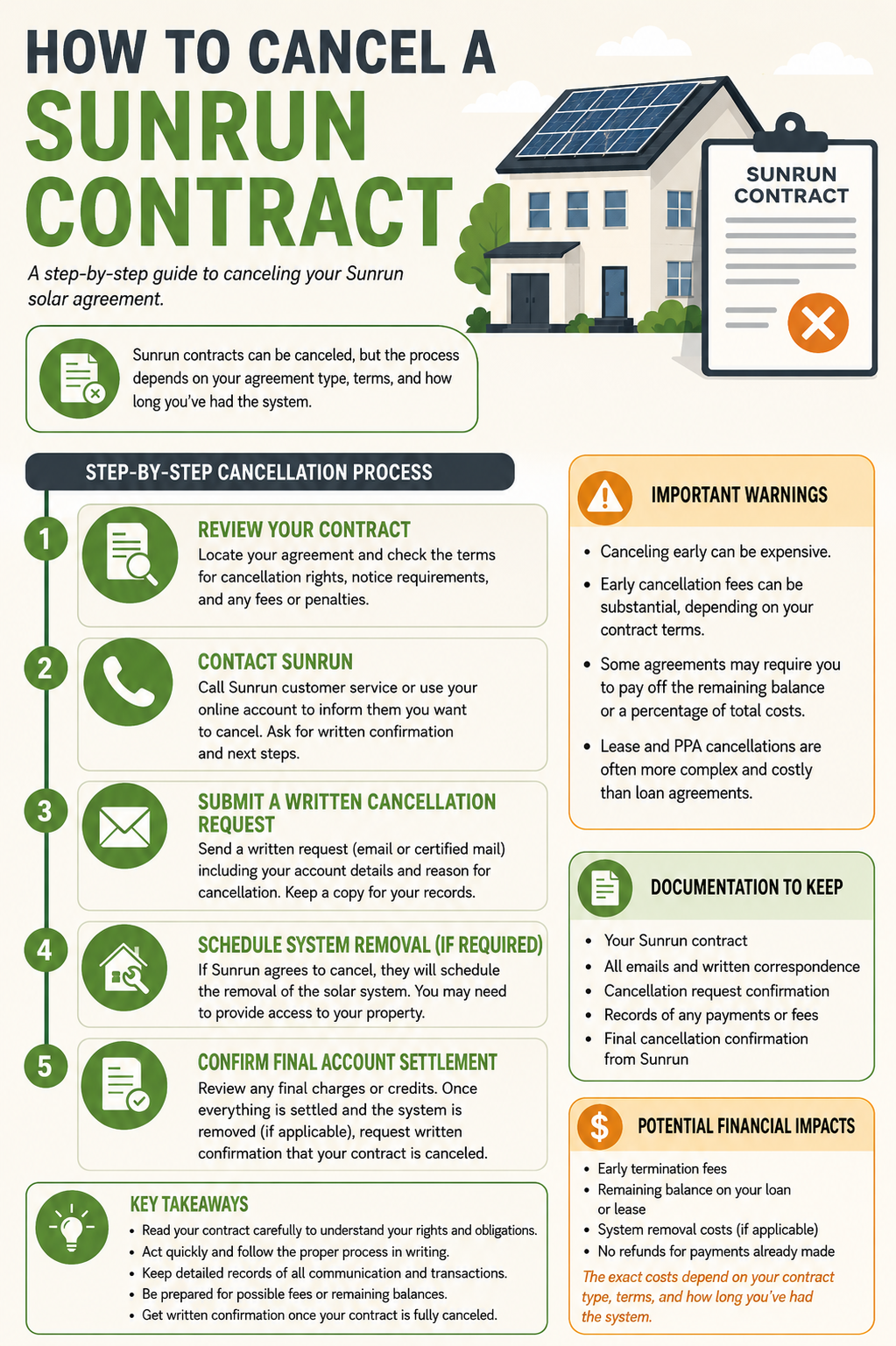
Are You Still Inside a Cancellation Window?
Check this one first. Some cancellation rights only last a few days, so timing matters more than anything else here.
The federal cooling-off rule
The FTC’s Cooling-Off Rule generally gives you three business days to cancel certain sales.
It covers sales of $25 or more made at your home, and sales of $130 or more made at certain temporary locations, like a hotel presentation or a trade show booth. It does not automatically cover every solar sale just because it involved a homeowner.
If your Sunrun agreement came from a qualifying in-home sale, check the cancellation notice you were given. Follow its deadline and instructions exactly.
State law may give you more
Some states go further than the federal rule. California is a good example.
California’s Solar Consumer Protection Guide says covered customers usually get at least three business days to cancel after receiving a signed, dated contract. If you’re 65 or older, that window is generally five business days.
The exact rules and exceptions can shift depending on how and where the deal was made. So here’s the order to check things in.
Federal rule, then state rule, then your Sunrun agreement, then your cancellation notice.
One more thing worth saying clearly: don’t trust online claims that every Sunrun customer gets 10 days to cancel, no matter what. Some older Sunrun contracts did include longer windows in specific situations, but that was never a company-wide rule, and it isn’t one today. For broader cancellation rules beyond Sunrun’s own terms, see SCC’s solar contract cancellation guide.
Can You Cancel Before Installation Starts?
Sunrun’s own filings with the SEC give a useful answer here. According to those filings, customers can cancel their Customer Agreement before installation begins, subject to certain conditions.
That’s good news, but it doesn’t mean every pre-installation cancellation is free or automatic. Before you cancel, review a few things in your paperwork.
- the cancellation or termination clause
- your Notice of Cancellation
- any conditions attached to canceling
- state-specific addenda
- your current project stage
- how you’re required to send your cancellation notice
Sunrun also says customers who originally chose a lease or PPA can switch to purchasing the system outright, as long as it’s done before installation.
If you’re outside your statutory cancellation window, ask Sunrun a direct question in writing: which contract provision applies to your cancellation, and exactly what amount, if any, they say you owe under it.
Avoid relying on a generic number you saw online for cancellation fees. There is no single nationwide fee that applies to every Sunrun customer, so get the specific figure in writing from them.
What Changes Once Installation Happens?
Installation is the biggest turning point in the whole process, so it’s worth understanding clearly.
Once your panels are installed, Sunrun says you can no longer switch your agreement type. If you started with a lease or PPA, you can only buy the equipment at the specific times your agreement allows.
When that purchase window opens, Sunrun says the price is based on fair market value, set at that time by an independent assessor.
In practice, this means you shouldn’t assume:
- you can buy out your contract immediately, whenever you want
- the buyout price will match whatever’s left on your monthly payments
- Sunrun has to remove the system just because you want out of the agreement
Your best move after installation is to find the purchase section of your agreement. Look specifically for when a purchase is allowed, and how the price gets calculated. If your agreement is specifically a PPA, SCC’s guide to getting out of a solar PPA explains the broader PPA exit issues to check.
Selling Your Home: Purchase, Prepay, or Transfer?
If you’re selling, you actually have three different paths with Sunrun. They’re easy to mix up, so it helps to separate them clearly.
| Option | What it does | When it matters |
| Purchase | Transfers ownership of the equipment under your agreement’s purchase terms | When your agreement allows a system purchase |
| Prepay | Pays some or all of the remaining service payments in advance | When you want to reduce or wipe out future payments during a sale |
| Transfer | Assigns your Sunrun Customer Agreement to the buyer | When you’re selling while still under an active lease or PPA |
According to Sunrun’s 2025 Form 10-K, a homeowner selling their house can either purchase the system or assign the Customer Agreement to the new owner. The new owner needs to meet Sunrun’s requirements and agree to take on the contract.
You can also prepay some or all of what’s left on your payments as part of the transfer. Just know that prepaying doesn’t transfer ownership of the equipment on its own; those are two separate things.
For monthly leases and PPAs, Sunrun currently runs sellers through its own transfer process. You and the buyer sign a transfer form, and the buyer completes a soft credit check. Sunrun finishes the transfer once escrow closes, and both sides get written confirmation.
Don’t assume selling your house automatically ends your Sunrun obligation. It doesn’t, unless the transfer or purchase actually goes through.
Sunrun’s SEC filing is direct about this: if a customer doesn’t purchase the system or successfully assign the agreement, Sunrun may go directly to the new homeowner, and may also try to collect remaining payments from the original customer.
Before you close on the sale, work through this short checklist.
- Ask Sunrun for its current transfer and purchase terms
- Give the buyer a copy of the actual Sunrun agreement
- Decide whether transfer, purchase, or prepayment fits your situation
- Complete every required transfer document
- Keep Sunrun’s written confirmation that the transfer is done
If you’re buying rather than selling the property, SCC’s guide to buying a house with solar panels covers the buyer-side checks before closing.
Does Poor Production Let You End the Agreement?
Not automatically, and this trips a lot of homeowners up.
Sunrun’s production guarantee applies to monthly lease and PPA agreements, though it may not apply everywhere. Sunrun currently reviews production against its estimates every 24 months and issues a credit if your system falls short of the guarantee in your contract.
Here’s the catch: your actual agreement controls the real terms, not a general company policy. Sunrun’s 2026 contract disclosures show performance guarantees as low as 0% and as high as 90% or 85%, depending on the agreement.
If your system seems to be underperforming, work through it step by step.
- Find the performance or production guarantee in your contract
- Check the guaranteed percentage
- Check the measurement period it uses
- Read the exclusions closely
- Compare your actual production against the contract’s standard
- Ask for the exact remedy your agreement promises
Poor production can support a contractual remedy, like a credit. It’s not, on its own, a free pass to cancel the whole contract.
What If the Sales Pitch Didn’t Match the Contract?
This is a different problem than simple buyer’s remorse. Here, the question is whether something you were told during the sale doesn’t match what’s actually in your paperwork.
Useful evidence to gather includes:
- your original proposal
- any savings estimates you were given
- texts or emails from the salesperson
- ads you were shown during the sales process
- statements about who owns the system
- statements about incentives or rebates
- the signed agreement and any addenda
The FTC has specifically warned solar shoppers about misleading claims involving “free” solar, guaranteed savings, government programs, financing terms, and incentives.
That said, a disputed statement from a salesperson doesn’t automatically void your Sunrun agreement. What matters is the evidence, the actual contract language, your state’s laws, and what remedies are realistically available.
If you’re heading toward a dispute, hold onto every piece of sales material you have before you escalate anything. SCC’s solar contract misrepresentation guide explains how to organize this evidence and separate a sales dispute from ordinary cancellation.
Is Your Payment Actually a Separate Solar Loan?
It’s worth double-checking this, because a Sunrun lease or PPA is not the same as a separate loan you might have taken out to buy solar equipment outright.
If you financed your system, you’re really dealing with two separate agreements.
Your Sunrun or installer agreement covers responsibilities for the solar project itself.
Your lender agreement covers repayment and financing terms.
Disputing your installation agreement won’t automatically get you out of a separate financing contract. They need to be handled independently.
The Consumer Financial Protection Bureau has also flagged UCC filings tied to solar lending. A UCC filing on your equipment isn’t the same as a lien on your whole home, though it can still create complications during a home sale or refinance. SCC’s solar UCC lien guide goes deeper into that issue.
What to Do If Sunrun Says No
If Sunrun turns down your request, ask them to point to the exact provision they’re relying on. Don’t accept a vague answer.
- Cancellation denied? Ask which provision or condition applies.
- Purchase denied? Ask for the specific date your agreement allows a purchase.
- Transfer denied? Ask which requirement hasn’t been met yet.
- Performance claim denied? Ask exactly how they calculated your production against your guarantee.
Keep your written request, your agreement, any supporting documents, and Sunrun’s response all together in one place.
If a separate loan is the real issue, reach out to your lender directly, and contact the Consumer Financial Protection Bureau if needed.
For sales practices that felt deceptive, the FTC and your state’s Attorney General or consumer protection office may take complaints. Just know that filing a complaint doesn’t cancel your contract on its own. It’s a separate track from actually getting out of the agreement.
Frequently Asked Questions
Can I cancel after installation but before permission to operate?
There’s no confirmed nationwide rule that lets you cancel automatically just because your system hasn’t been switched on yet. Sunrun treats equipment installation, not activation, as the point after which you can no longer change your agreement type. Check your actual contract and any state law that might apply to your situation.
Does stopping autopay cancel my contract?
No. Stopping your payments only changes how you’re paying, not whether you owe anything. Sunrun’s current terms say you can cancel recurring payments separately, but unpaid amounts can still be due under your Solar Power Service Agreement. Don’t use this as a workaround for a real cancellation.
Can I make Sunrun remove the panels before my agreement ends?
Sunrun lists removal as an option at the end of a lease term, alongside buying the system at fair market value or renewing annually. That’s not the same as a right to demand early removal in the middle of an active agreement. Check your contract for any earlier removal terms.
How do I contact Sunrun about a cancellation or contract issue?
Existing customers can call Sunrun Customer Support at 855-478-6786, or use the support options inside the Sunrun app. Keep in mind that calling customer service doesn’t necessarily satisfy a formal, written cancellation requirement. If your agreement or state law specifies how a cancellation notice must be delivered, follow that method exactly and keep proof you sent it.
Get Help Reviewing Your Contract
Every Sunrun situation comes down to two things: the agreement you actually signed, and the stage your project is at right now.
If you signed yesterday, you’re probably racing a cancellation deadline. If your panels are already up, you likely need to look at purchase windows instead. Selling your home calls for a transfer or prepayment plan, and an underperformance issue comes down to your specific production guarantee.
Solar Cancellation Companies helps homeowners work through solar contracts, financing paperwork, cancellation questions, and installer disputes. If Sunrun has said no to your request, your agreement doesn’t make sense to you, or you’re just not sure what applies to your case, we can help you sort through the documents and figure out what actually needs to happen next.
The goal here was never to promise that every Sunrun contract can be canceled. It’s to help you understand what your agreement actually allows, what law applies to you, and which step makes sense to take next.
This article is general consumer information, not legal advice. Contract rights and state laws vary.