
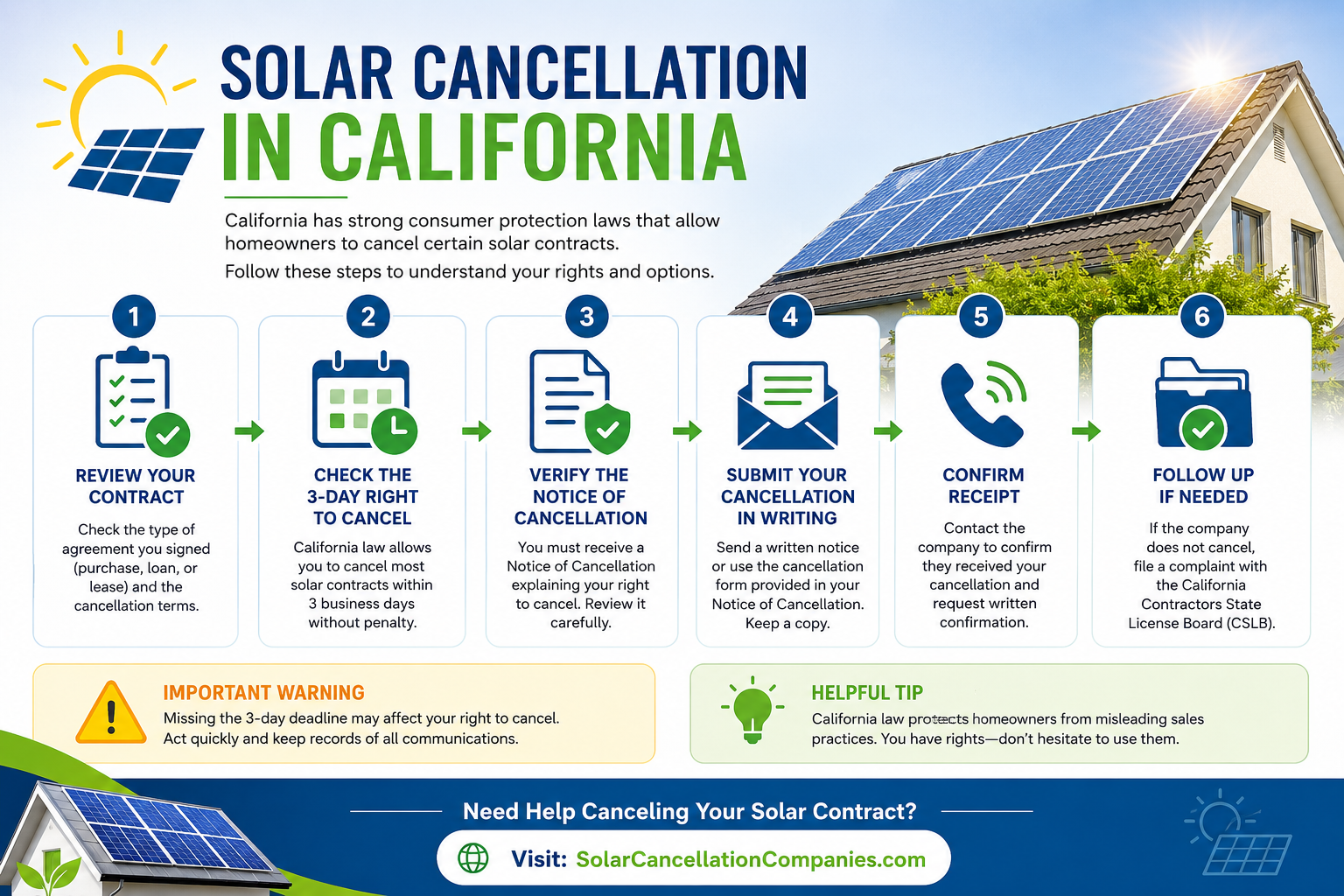
California generally gives you three business days to cancel a covered home improvement contract. If you’re 65 or older, you get five business days. The deadline depends on when you received your signed, dated contract along with the required cancellation notice, and different rules can apply if you signed at the contractor’s place of business. Start by pulling together your contract, cancellation notice, solar disclosures, and the date you received everything.
If that window has already closed, don’t assume you’re out of options. California has separate rules covering disclosures, contract language, contractor payments, salesperson registration, financing, and complaints. These won’t guarantee cancellation, but they’ll tell you what to look into next. SCC’s solar contract cancellation guide explains the broader cancellation process when your situation goes beyond California’s initial cancellation window.
Are You Still Within Your Cancellation Window
For a covered home improvement contract, you generally get three business days to cancel. If you’re 65 or older, that stretches to five business days. This window starts once you receive a signed and dated copy of your contract that includes the required cancellation notice.
That makes the date you actually received your paperwork just as important as the date you signed.
Check these details:
- the date you signed
- the date you received your signed, dated contract
- whether the cancellation notice was included
- whether you were 65 or older when you signed
- where the contract was negotiated
You can send your cancellation notice by email, mail, fax, or hand delivery, as long as it reaches the contractor by the deadline. Your contract should list an address or email for this.
You also don’t need to use the contractor’s exact cancellation form. For qualifying home solicitation contracts, written notice works as long as it clearly shows you don’t intend to be bound by the agreement.
One important exception. The standard three or five day notice doesn’t apply if you negotiated the contract at the contractor’s place of business. That doesn’t mean you have no other options, just that this particular rule may not be the one that applies to you.
There’s also a separate seven business day notice for certain repairs to property damaged in a declared disaster. That’s a narrow, specific rule and shouldn’t be confused with a typical solar installation.
The federal FTC Cooling-Off Rule can also matter for some qualifying door-to-door transactions, but it does not cover every solar sale. If a salesperson came to your home and you signed during or shortly after that visit, SCC’s guide to door-to-door solar sales complaints and cancellation rights can help you identify which parts of the sales process deserve closer review.
Did the Solar Company Give You the Right Paperwork
If your standard cancellation window has passed, the real question isn’t just “did I miss three days.” It’s this instead.
What documents did the solar company actually give you, and when did you get them?
California requires very specific paperwork for residential solar sales.
Start With Your Signed Contract
Your home improvement contract needs to include:
- the contractor’s name, address, and license number
- the salesperson’s name and registration number, if it applies
- the total contract price
- any separate finance charges
- a description of the work and equipment
- your down payment amount
- a progress payment schedule
- approximate start and completion dates
- required consumer notices
Your contractor also has to give you a signed and dated copy before any work begins.
Check for the Cancellation Notice
Your contract should include either a Three Day Right to Cancel or Five Day Right to Cancel notice, unless an exception applies. It should also come with a Notice of Cancellation form. If that form is missing, you can file a complaint with the Contractors State License Board, known as CSLB.
There’s an added protection for qualifying home solicitation contracts too. Until the seller meets certain legal requirements, you may still be able to cancel the contract, even later than usual.
That said, a missing document doesn’t automatically void your entire solar loan, lease, power purchase agreement, or installation contract. The type of contract you have and the circumstances of your sale still matter, so it’s worth reviewing carefully rather than assuming the worst.
Look for Both Required Solar Disclosure Forms
For covered residential solar sales, California requires two disclosure documents.
- Solar Energy System Disclosure Document, Cover Page
- Solar Energy System Supporting Information
These documents address information such as system cost, financial obligations, estimated bill savings, and cancellation rights.
The California Public Utilities Commission’s solar disclosure guidance confirms that the Cover Page has been in effect since January 1, 2019, while the longer Supporting Information document took effect on November 1, 2025.
If you signed an older contract, don’t assume the absence of the newer Supporting Information form automatically proves a violation. Check which requirements applied when your transaction occurred.
Was Your Sale Conducted in Another Language
California has a specific protection if your solar pitch happened mainly in a language other than English.
Your contract and disclosure documents are required to be written in whatever language was mainly used during the sales presentation or in the marketing materials shown to you. Your cancellation notice needs to match that same language too.
So if your salesperson pitched you mostly in Spanish, Chinese, Korean, Vietnamese, Tagalog, Armenian, Portuguese, Dari, or another language, compare that against what paperwork you actually received.
Hold onto these items:
- your signed contract
- disclosure forms
- texts and emails
- marketing materials
- any sales communications you have on record
- your cancellation notice
A language mismatch is worth raising in a complaint or contract review. It doesn’t automatically guarantee your whole agreement gets cancelled, but it’s a real factor worth documenting.
Did Money Change Hands Before the Work Was Done
California’s payment rules matter most when a solar job stalls but a lot of money has already moved.
For a covered home improvement contract, your down payment can’t be more than $1,000 or 10% of the total price, whichever is smaller. After that, your contractor generally can’t ask for or accept payment beyond what the completed work or delivered materials are actually worth.
This rule reaches further than just the contractor too. It also covers advance payments made by a lender or financing company on your behalf.
This is worth checking closely if:
- your solar loan has already been funded
- your installer received a large payout
- only part of your system got installed
- work stopped before the job was finished
- your installer walked away from the project
Line up your contract’s payment schedule against your invoices, lender records, installation progress, delivered equipment, and inspection reports.
There are some exceptions. A contractor using approved bonds or joint control arrangements may not be bound by these same down payment and progress payment limits.
So a large upfront payment is a red flag worth investigating. On its own, it isn’t proof that your contract has to be cancelled.
What to Check If Your Installer Stopped Work or Closed Down
When a California solar installer vanishes, shuts down, or leaves your system half finished, more than one company is usually involved.
Separate the parties first.
| Party | What to check |
| Solar contractor or installer | Installation work, permits, equipment, completion, warranties, CSLB license |
| Home improvement salesperson | Whether they held an active registration, where required |
| Lender or financier | Loan balance, payout history, payment terms, servicing |
| Utility | Interconnection status and permission to operate |
Solar sales reps are generally required to register as Home Improvement Salespeople, with a few limited exceptions. You can look up both contractor licenses and salesperson registrations through CSLB.
If your project was abandoned, gather:
- your contractor’s CSLB license information
- the salesperson’s registration, if applicable
- permit and inspection records
- what equipment was actually installed
- what work is still unfinished
- how much you’ve already paid
- your lender’s payout history
- your interconnection and permission to operate status
- warranty paperwork
One note on funding. California’s Solar Energy System Restitution Program is no longer accepting new claims. CSLB made this change to preserve remaining funds for claims already submitted, so don’t count on this program if you’re just starting to look into your options now.
A CSLB complaint may still be useful, though. CSLB generally handles violations of California’s Contractors License Law for up to four years after the incident. That’s simply how long you have to file a complaint. It isn’t a four year window to cancel your solar contract.
Were You Misled About Savings, Financing, or the Tax Credit
If your real concern is what you were promised rather than the construction itself, compare the original sales pitch against California’s required disclosures and your actual financing agreement.
Check Your Savings Estimate
California requires disclosure of total installation cost, expected savings, the assumptions behind those savings, and how financing affects the numbers. State regulators also cap the assumed yearly electricity rate increase used in these savings estimates at 10%. Keep in mind these figures are still estimates, not guarantees.
If your actual savings look very different from what you were promised, compare:
- your original proposal
- the Solar Energy System Supporting Information form
- electricity use assumptions
- estimated system production
- assumed utility rate increases
- your financing payments
- your actual utility bills
A gap between promise and reality doesn’t hand you an automatic right to cancel. But it does give you something concrete to point to when raising a complaint or review.
Compare Your Cash Price to Your Financed Amount
Some solar financing problems become clearer when you compare what the system would have cost in cash with the amount actually financed.
Put these figures next to each other:
Cash price → financed amount → dealer/program charges → loan principal → monthly payment
A higher financed amount doesn’t automatically make the loan unlawful. But if you can’t explain the gap from your paperwork, it deserves closer attention.
SCC’s guide to solar dealer fees and loan disclosures explains what to check when the financed amount appears much higher than the system’s cash price.
Be Careful With 2026 Tax Credit Claims
This matters most if your contract was sold using the old “30% federal tax credit” pitch.
According to current IRS Residential Clean Energy Credit guidance, the 30% residential clean energy credit applies to qualified property placed in service from 2022 through December 31, 2025. Property placed in service after December 31, 2025 does not qualify for that credit.
If your 2026 sale leaned on that credit to sell you the deal, keep your proposal, messages, and any financing numbers that referenced it. Whether that creates a real legal remedy depends on your specific situation, so it’s worth reviewing with a professional rather than assuming.
Is Your Loan a Separate Problem From Your Installer
Often, yes.
Solar financing can feel like one single transaction with your installer, but the installer and lender are frequently separate companies with separate agreements, even when everything gets presented to you at once.
That distinction matters a lot if you’re trying to stop a project.
Your installer handles the construction agreement, the actual work, the equipment, and the project timeline.
Your lender controls the loan itself, including your balance, your payments, and its own separate terms.
Cancelling or disputing your installation agreement doesn’t automatically erase a separate loan.
If financing is part of your situation, ask yourself:
- Who originally issued the loan?
- Who’s servicing it now?
- How much was actually financed?
- How much money has been paid out so far?
- When did each payout happen?
- What does your loan agreement say about cancellation or installer disputes?
- Is your lender asking for payments while your system remains unfinished?
If the issue has already moved into collection notices or debt demands, SCC’s guide on a solar company threatening collections covers the documents and parties homeowners should identify before responding.
Which California Agency Handles Your Problem
Sending the same complaint to every agency at once tends to slow things down. California splits responsibility across different regulators.
| Your problem | Where to go |
| Contractor conduct, abandonment, workmanship, licensing | California Contractors State License Board (CSLB) |
| A solar financing company under state oversight | California Department of Financial Protection and Innovation (DFPI) |
| A solar loan or similar financial product | Consumer Financial Protection Bureau (CFPB) |
| Utility tariff or interconnection issues | Your utility, or the CPUC |
| Broader deceptive business practices | California Attorney General or the FTC |
Here’s a useful distinction. The CPUC doesn’t regulate solar companies or contractors directly. Construction related complaints usually belong with CSLB, while problems involving many rooftop solar lenders get routed to DFPI.
DFPI takes complaints about financial service providers under its authority, including a separate process for PACE financing issues. Not every lender falls under DFPI though, so it’s worth confirming who actually regulates your specific lender first.
The CFPB also accepts complaints about solar loans directly through its consumer complaint system.
Filing a complaint creates a record and can prompt a review or investigation. It won’t automatically cancel your contract or wipe out a debt on its own. CSLB is upfront that its complaint process doesn’t guarantee you’ll get your money back.
Need Help Reviewing a California Solar Contract?
A California solar dispute can involve several documents and more than one company. You may have an installer saying the cancellation period ended while a lender is still requesting payments. Your project may be unfinished, your disclosures may not match what you were told, or you may simply be unsure which agreement controls the problem.
Solar Cancellation Companies can help you organize the situation before you make your next move. SCC helps homeowners understand their solar contract, financing documents, cancellation timeline, project stage, and the parties involved so they can see which options may be worth pursuing.
If you’re unsure whether your problem is with the installer, lender, salesperson, or contract itself, start with a free solar contract review from Solar Cancellation Companies. There is no cost or commitment to submit the initial review.
This article provides general information about California solar contract and consumer protection rules. It is not legal or tax advice.
Frequently Asked Questions
Can I cancel a California solar contract if I never received a Notice of Cancellation?
Possibly. California requires a cancellation notice for many covered home improvement contracts. For certain qualifying home solicitation contracts, cancellation rights may continue until the seller meets required legal conditions. A missing notice does not automatically cancel every solar contract or financing agreement.
What if my solar sales pitch was in Spanish but my contract was in English?
That language difference may be important. California generally requires the contract, solar disclosures, and cancellation notice to use the language mainly used during the sales presentation or marketing. Keep both the sales materials and signed paperwork if you plan to raise the issue.
Does filing a CSLB complaint automatically cancel my solar contract?
No. A CSLB complaint can create a formal record and may lead to a review of contractor conduct, licensing, abandonment, or workmanship. It does not automatically cancel your solar agreement, erase your loan, or guarantee that you will recover money.
Can an unregistered solar salesperson affect my contract in California?
It may be relevant to your complaint. California generally requires home improvement salespeople to be registered with CSLB, subject to limited exceptions. Check the salesperson’s registration status and save their name, sales messages, proposal, and contract before deciding how to proceed.