
Solar panels sound like a simple win. Lower bills, a smaller footprint, maybe a tax credit. But plenty of Idaho homeowners sign a contract and then feel stuck. The installer stops answering calls. The bill goes up instead of down. Panels sit on the roof, but nothing gets turned on.
This guide breaks down Idaho Solar Panel Laws in plain language. You will learn what protections exist before you sign, what your options look like after, and where to turn if a sales pitch turns into a real problem. For free resources and access to reviewed specialists serving Idaho homeowners, visit Solar Cancellation Companies. This guide is an educational resource, not a sales pitch.
Idaho Solar Panel Laws at a Glance
Idaho does not have one single solar law. Instead, several Idaho solar regulations work together to protect homeowners. These include the Idaho Consumer Protection Act, the Residential Solar Energy System Disclosure Act, contractor licensing rules, and utility tariffs approved by state regulators. Federal rules may also apply, depending on how and where you signed your contract. You can compare Idaho’s protections to those in other states through our Solar State Laws directory.
Federal protections that may apply
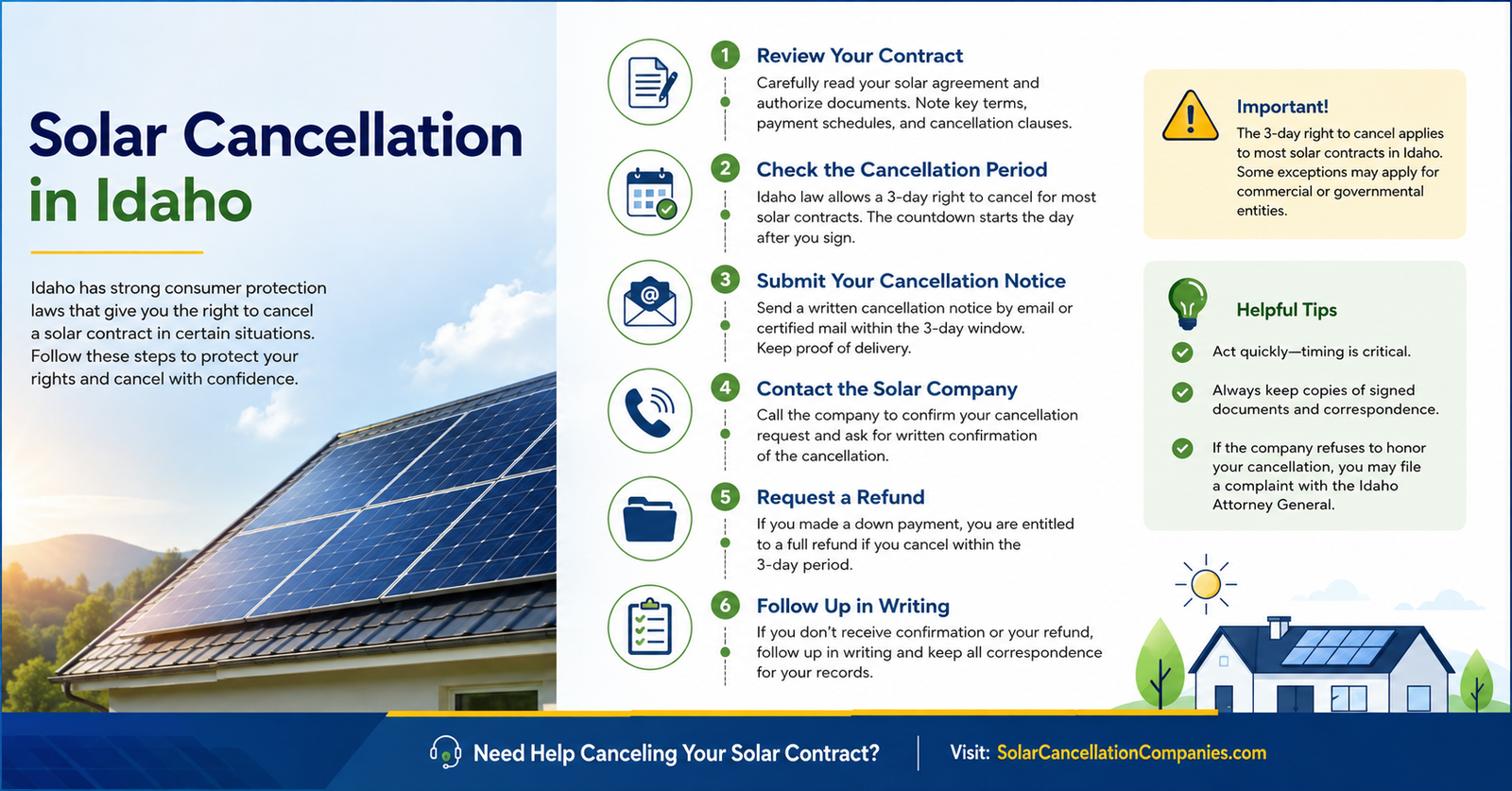
If a salesperson visited your home and you signed there, the FTC Cooling Off Rule may give you three business days to cancel. If you financed your system, federal lending rules tied to the Consumer Financial Protection Bureau may also apply.
How Idaho solar laws affect homeowners
These laws work together to give you a paper trail. The retailer must disclose key facts before you sign, and the Consumer Protection Act gives you a path to push back if something was misrepresented.
Quick summary table of Idaho solar regulations
| Law | What It Covers | Who Enforces It |
| Idaho Consumer Protection Act | Unfair or deceptive sales practices | Idaho Attorney General |
| Residential Solar Energy System Disclosure Act | Required written disclosures before signing | Idaho AG and district courts |
| FTC Cooling Off Rule | Three day cancellation for door to door sales | Federal Trade Commission |
| Idaho PUC tariffs | Net billing and export credit rates | Idaho Public Utilities Commission |
Can You Legally Cancel a Solar Contract in Idaho?
Yes, in many situations. Idaho’s disclosure law requires solar retailers to tell you about any cancellation rights before you sign. This is often called Idaho solar contract cancellation, and whether it is simple or difficult depends on your project stage, your financing setup, and the exact wording in your contract.
How project stage affects your legal options
| Project Stage | How Easy It Is to Cancel |
| Before installation starts | Usually easiest, especially within a few days of signing |
| During permitting | Often still possible, though some fees may apply |
| After equipment delivery | Harder, restocking or delivery fees may apply |
| After installation | Difficult, may require negotiation or proof of misrepresentation |
| After utility activation | Hardest, focus shifts to repair, warranty, or legal claims |
Understanding Idaho’s Solar Consumer Protection Laws
Idaho Consumer Protection Act
The Idaho solar consumer rights you have mostly trace back to the Idaho Consumer Protection Act. It bans unfair or deceptive trade practices in any consumer transaction, including solar sales. The Idaho Attorney General can investigate complaints and take action against companies that violate it. The Consumer Financial Protection Bureau has documented how deceptive solar sales practices including false savings claims, fake government program affiliations, and undisclosed financing costs, are among the most reported complaints in residential solar nationally.
Residential Solar Energy System disclosure requirements
The Residential Solar Energy System Disclosure Act is Idaho’s most solar specific law. It requires a solar retailer to give you a written disclosure statement before you sign anything. That statement must include the installer’s contractor registration number, any savings estimates and the assumptions behind them, a warning that future utility rules could change your export credits, and a clear statement that the company is not affiliated with any utility or government agency. If a company skips these steps, it may be violating Idaho solar disclosure requirements, and that can strengthen your case later.
Contractor licensing and homeowner protections
Idaho requires solar installers to register as contractors. Working with an unregistered contractor is a red flag.
Utility and permitting regulations
Local building departments issue permits and inspect the work. Your utility, whether that is Idaho Power, Rocky Mountain Power, or Avista, must approve interconnection before your system can turn on. These steps fall under Idaho solar permitting requirements and Idaho solar installation laws. Understanding Idaho solar contract laws before you sign protects you long after the ink dries.
Solar Loan vs Solar Installation Contract
Many homeowners are surprised to learn they signed two separate agreements. One with the installer for equipment and labor. One with a lender for financing. These are not the same contract, and cancelling one does not automatically cancel the other.
Not sure which type of agreement you have? Our Solar Contract Type guide explains the difference between a loan, lease, and PPA and why each requires a separate cancellation action with a different party.
If your installer disappears mid project, your loan payments may still be due. Contact the installer first, in writing, then contact your lender separately. The installer owes you a working system. The lender owes you the loan terms you agreed to.
Idaho Utility Rules and Why Savings Sometimes Fall Short
Idaho does not have one statewide net metering mandate. Export credit rates vary by utility instead. Idaho Power moved from net metering to net billing in 2024, and its export credit rate has since dropped by roughly 31 percent, following a 2025 Idaho Public Utilities Commission order. Rocky Mountain Power and Avista each run their own separate tariffs.
Your installer’s original savings estimate may have used older, higher export credit rates. If your bill looks different than promised, this is often why. It is not automatically fraud, but it is worth comparing your contract’s assumptions against your utility’s current tariff.
Solar Sales Misrepresentation in Idaho
Watch for these warning signs:
- Claims of free solar with no real cost
- Promises tied to a fake government program
- Guarantees that you will never pay another electric bill
- Pressure to sign the same day
- Verbal promises that never make it into the written contract
- A signature on the contract you do not remember making
If you spot any of these, do not sign until you get everything in writing. Ask for the installer’s contractor registration number. Take your time, even if the salesperson creates urgency.
Idaho Solar Contract Checklist Before You Sign
- Total project cost, in writing
- Financing terms and interest rate
- Estimated savings and the assumptions behind them
- Production estimates for your specific roof
- Cancellation clause and cooling off period
- Warranty length and what it covers
- Who is responsible for roof damage
- Arbitration clause, if any
- Hidden fees, including for late payments or early payoff
What Cancelling a Solar Contract Might Cost
Cancellation costs vary widely. If you act within a cooling off period, cancelling may cost you nothing. Past that window, you may face a cancellation fee, equipment removal costs, or a full loan payoff if financing is already funded. If you hire an attorney, add legal fees to the mix.
It depends on the contract, financing agreement, project stage, and applicable state and federal laws. There is no single answer that fits every homeowner.
How to File a Solar Complaint in Idaho
Start with your installer, in writing. If that does not resolve things, contact your lender. From there, the right agency depends on the problem.
| Problem | Who to Contact |
| Sales fraud | Idaho Attorney General |
| Financing dispute | Consumer Financial Protection Bureau |
| National advertising violations | Federal Trade Commission |
| Utility billing or interconnection issues | Idaho Public Utilities Commission |
| Contractor licensing problems | Local building department or state licensing authority |
Following this Idaho solar complaint process in order gives you the strongest paper trail if you need to escalate later. You can also find reviewed specialists through the Solar Cancellation Companies directory.
Frequently Asked Questions About Idaho Solar Panel Laws
Can I cancel a solar contract in Idaho after signing?
Often yes, especially soon after signing or before installation begins. Idaho law requires disclosure of cancellation rights. Your exact options depend on your contract, financing, and project stage.
What is the Idaho Consumer Protection Act?
It is a state law that bans unfair or deceptive trade practices, including in solar sales. The Idaho Attorney General enforces it against companies that mislead homeowners.
Does Idaho have a cooling off period for solar contracts?
Idaho’s disclosure law requires retailers to state any cancellation rights in writing. Federal rules may add a three day window for door to door sales.
Who regulates net metering in Idaho?
The Idaho Public Utilities Commission approves each utility’s tariff for export credits. Idaho Power, Rocky Mountain Power, and Avista each set different rates.
Key Takeaways for Idaho Homeowners
Idaho solar law gives you real protections, but they only work if you use them. Read your contract closely before you sign. Keep every email, text, and brochure in case a problem comes up later. Know your project stage, since that shapes your options more than anything else.
If your situation feels complicated, that is normal. Solar Cancellation Companies can help you understand where you stand. Contact Solar Cancellation Companies today for a free no-obligation review of your Idaho solar contract and a licensed Idaho attorney can offer legal help specific to your agreement.