
Solar panels can cut your power bill. But a solar deal can also bring real risk. Many homeowners sign fast. Then the questions start.
You may wonder about permits, loans, or your right to cancel. You may worry about liens or selling your home. This guide covers what to check and what to do next, and Solar Cancellation Companies is a resource built for exactly this kind of question.
What Are the Solar Panel Laws in Mississippi?
Yes, solar panels are legal across Mississippi. No state law bans rooftop solar.
The Mississippi Public Service Commission sets rules for grid hookups and power credits. This applies to the state’s big utilities. Local governments handle permits and inspections. Your own utility may add extra rules too.
If you use a co-op or city utility, PSC rules may not fully apply. Some co-ops set their own terms. Always check with your actual utility first.
Do You Need a Permit for Solar Panels?
Yes. Mississippi solar permit requirements come from your city or county, not from a single state form. Most solar jobs need a building or electrical permit.
Your installer usually applies for permits on your behalf. Ask who handles this in writing before work starts.
Permit fees change by area and system size. Do not assume one flat price applies everywhere.
After the install, a local inspector checks the work. This must happen before your utility turns your system on.
Delays often come from missing paperwork or busy schedules. Ask your installer for a real permit timeline.
What Are Mississippi Solar Interconnection Requirements?
Your panels cannot send power to the grid right away. Your utility must first approve the hookup. This is a separate step from finishing the install.
Your installer sends in an application with your system details. The utility checks it and may run its own inspection.
Once approved, you get permission to operate. Only then can your system legally send out power.
Utility delays, missing papers, or gear issues can push back your start date. Ask your installer how they handle these delays.
Does Mississippi Have Net Metering?
Not in the usual sense. Mississippi does not pay full retail price for your extra solar power.
These Mississippi net metering rules, officially called Distributed Generation Rules, work differently than in many other states. Under this plan, extra power sent to the grid earns a credit. That credit is based on the utility’s own cost to produce power, plus a small bonus. It is often lower than the rate you pay.
Home systems have a size cap. Rules can also differ between big utilities and co-ops. Some co-ops skip these rules entirely.
Before you trust a savings estimate, ask your installer to explain your credit rate in writing.
What Solar Tax Credits Are Available?
Mississippi has no state solar tax credit. Homeowners have mostly relied on the federal credit instead.
That federal credit ended for systems installed starting in 2026. If you buy and install solar this year, do not expect a federal tax credit on that cost.
A separate credit still applies to leased systems. But the leasing company claims it, not you. Any savings may only partly reach your monthly bill.
Never sign a deal based on a tax credit promise alone. Check current rules with a tax pro first.
How Do Solar Loans and Financing Work?
Homeowners typically pay in cash, with a loan, on a lease, or through a power purchase agreement. Each path brings different costs and risks.
Loans often bake dealer fees into the price. Interest can push your total cost well past the sticker price. Ask for your full payback amount in writing.
Some solar loans use a filing tied to the gear, not a home lien. Ask your lender what type of filing applies to your loan.
Canceling your installer deal does not cancel a separate loan. You often must contact your lender to handle that.
What Consumer Protections Apply to Solar Sales?
Solar firms cannot use false claims about savings, tax perks, or output. Federal Trade Commission rules against false ads apply in Mississippi too.
Door-to-door sales may carry extra cancellation rights. This depends on where you signed. Watch for pressure tactics, rushed signings, and spoken promises left out of the deal.
Save every paper tied to your purchase. Keep your contract, quotes, savings claims, texts, emails, and payment records.
Can You Cancel a Solar Contract in Mississippi?
It depends on your case. Mississippi solar contract cancellation rules do not set one single cancellation deadline for every contract, and cancellation rights vary widely by state beyond just the federal minimum.
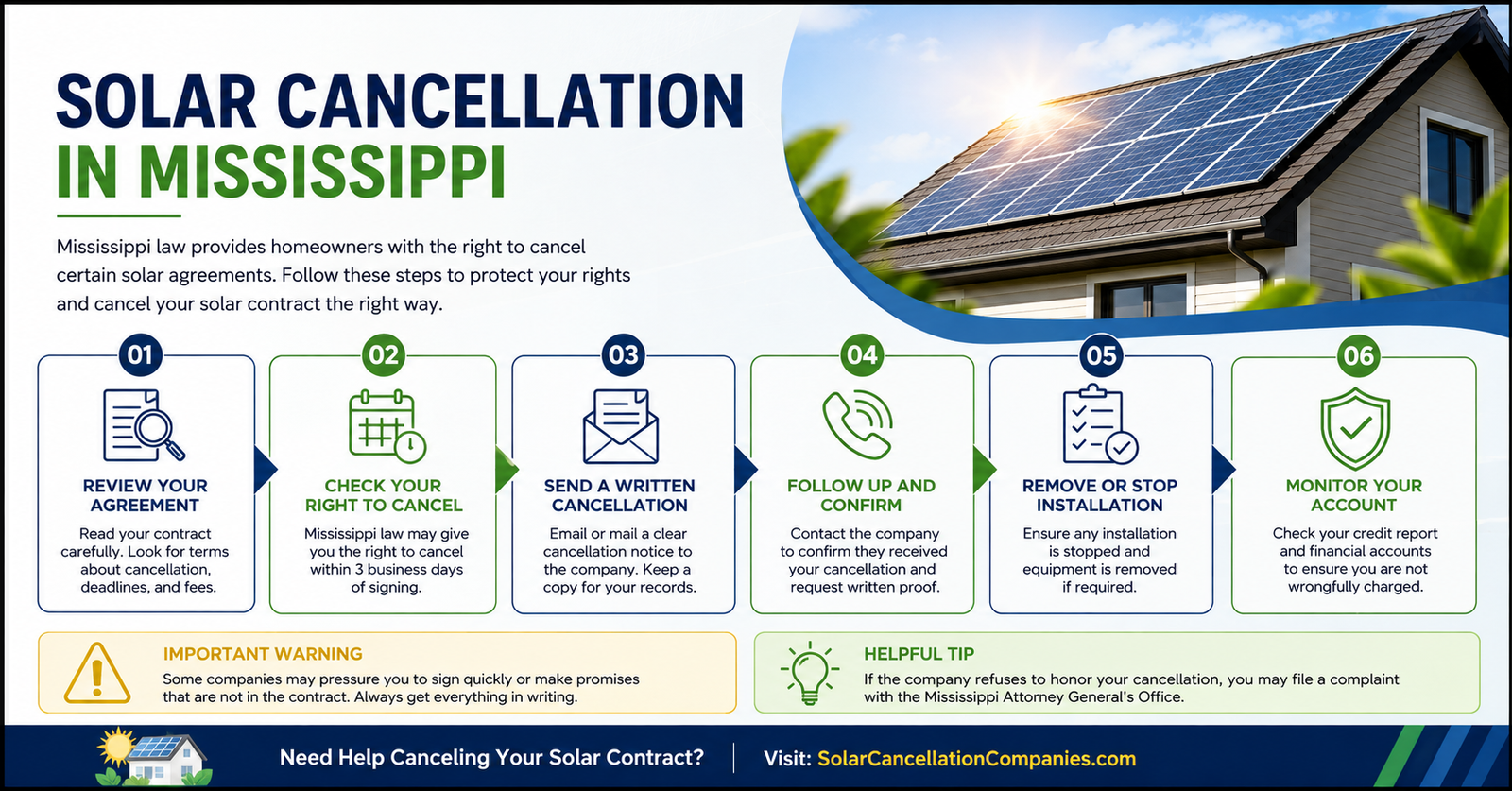
Some sales, especially those signed at your home and away from the seller’s usual shop, may carry a federal three-day cancellation right. Other terms come from your own contract.
Check your signed deal first. Look for a part on cancellation rights or rescission.
If work has already started, canceling gets harder. Your options depend on your contract and how far the work has gone.
How to Cancel a Solar Contract
If you plan to cancel a solar contract Mississippi-style, first check your contract for a cancellation deadline and the required method. Some deals need written notice sent within a set window.
Put your cancellation notice in writing, even after a phone call. Keep a copy of everything you send.
Contact the installer and lender in writing about the problem. If that fails, think about a complaint with a consumer group, or check our solar exit guides for how similar cases have played out.
Keep proof of delivery, like a mail receipt or an email reply. Ask for written proof your cancellation notice was received.
Do not just stop paying without written proof. That step alone can hurt your credit.
What if the Cancel Period Has Passed?
You may still have options. Check your full contract for other exit terms beyond the cancellation window.
If the installer misled you about savings or tax perks, write down what was said. Compare those claims to your actual contract.
Contact the installer and lender in writing about the problem. If that fails, think about a complaint with a consumer group.
Some homeowners find it helps to get outside review of a contract once a deadline has passed.
What Are the Biggest Solar Risks?
Higher than expected loan costs top the list. Fees and interest can push your total cost well past the ad price.
Other common problems include bills that do not drop as promised, plus delays, roof damage, weak output, and installers who stop calling back.
Selling a home with solar debt can also slow things down. Buyers and lenders often want that debt paid off or moved first.
Can an HOA Restrict Solar Panels in Mississippi?
Mississippi has no state law that protects solar access from HOA rules. This gives an HOA real power to limit, or even block, solar through its rules.
Check your HOA’s rules before you sign a contract. Send in any needed approval request before work starts, not after.
What Happens When You Sell a Home With Solar Panels?
If you own your system outright, it usually transfers with the home. It works like any other upgrade. Keep your papers ready for buyers.
If you still owe on a loan, that debt usually must be paid or moved at closing. A lease may need buyer approval, which can slow a sale.
Start checking your loan balance and transfer rules early. Do this well before you list your home.
Mississippi Solar Contract Red Flags
Watch for guaranteed savings, “free solar” claims, and promised tax breaks with no paperwork. Pressure to sign right away is also a warning sign.
A contract with no clear cancellation terms needs extra care. If loan terms differ from what the salesperson said out loud, get it in writing.
Where Can You Report Solar Problems?
Utility and billing complaints usually go to the Mississippi Public Service Commission. Worries about false sales claims may fall under the Federal Trade Commission.
Loan disputes often start with your lender. From there, they may move to financial regulators if unresolved.
Frequently Asked Questions
Is it legal to install solar panels in Mississippi?
Yes. No state law bans rooftop solar. Local permits and utility approval are still needed.
Does Mississippi have net metering?
Not in the usual sense. The state credits extra power at a lower rate than retail power.
Does Mississippi offer a state solar tax credit?
No. Mississippi has no state credit. The federal home credit also ended for systems installed in 2026.
Can I cancel my solar contract?
It depends on how and where you signed, plus your contract terms. Some sales carry a federal three-day cancellation right.
Can a solar company place a lien on my home?
Some loans use a filing tied to the gear, not your home. Ask your lender what applies to you.
Can an HOA block solar panels here?
Mississippi has no solar access law. So HOA rules may carry real weight. Check your governing papers first.
What Should Mississippi Homeowners Do Next?
If you have not signed yet, check costs, financing, and cancellation terms first. If you just signed, look for a cancellation deadline right away.
If you are trying to cancel, put it in writing and keep proof. If a loan is causing trouble, review both your installer deal and lender agreement.
If you are selling your home, confirm your loan balance and transfer rules early.
Solar Cancellation Companies offers solar cancellation help that Mississippi homeowners can rely on to understand their contract and cancellation options. If you feel unsure where you stand, an experienced team can help you review your paperwork and plan your next step, or start by browsing our company lookup.
NOTE: Solar Cancellation Companies is not a law firm. It does not give legal advice or legal representation.