

If you just signed a solar agreement in Utah, or you are still deciding whether to sign one, you likely have one question above the rest. Can you get out of it if something feels wrong? Utah solar panel laws combine state disclosure rules, federal cancellation protections, city permitting, utility export rules, and the actual contract you signed. No single rule covers every homeowner the same way. This guide covers when you can cancel, what your loan has to do with your installer, and where to turn if a company will not cooperate, and resources like Solar Cancellation Companies can help you work through exactly that.
What Do Utah Solar Laws Cover?
Utah solar laws 2026 focus mainly on disclosure and cancellation, while your city handles permits and your utility handles interconnection. The Utah Division of Consumer Protection oversees solar retailer registration under the Residential Solar Energy Consumer Protection Act, and DOPL licenses contractors. Your written contract fills in whatever state law leaves open, so what you signed matters as much as the statute itself. Your rights also shift with how you paid. A cash purchase, a solar loan, a lease, and a power purchase agreement (PPA) each create different obligations, since a lease or PPA means a third party owns the equipment while you own it outright with cash or a loan. Check your agreement’s title to confirm which category applies to you.
Your Rights Before You Sign
Utah Code Title 13, Chapter 52, updated by House Bill 57 effective May 7, 2025, requires solar retailers to give you a signed copy of the agreement, electronically and on paper unless you decline paper, along with disclosures covering price, financing, production estimates, and your Utah solar contract cancellation rights. A retailer cannot begin installation until four business days after providing that signed copy, and the agreement is not enforceable against you unless these steps are followed. An underperforming system must also be repaired to at least 90 percent of its original estimate within six months of your written notice.
Can You Cancel a Solar Contract in Utah?
Sometimes, but not automatically. Whether you can cancel depends on how the sale happened, how much time has passed, and what your specific agreement says.
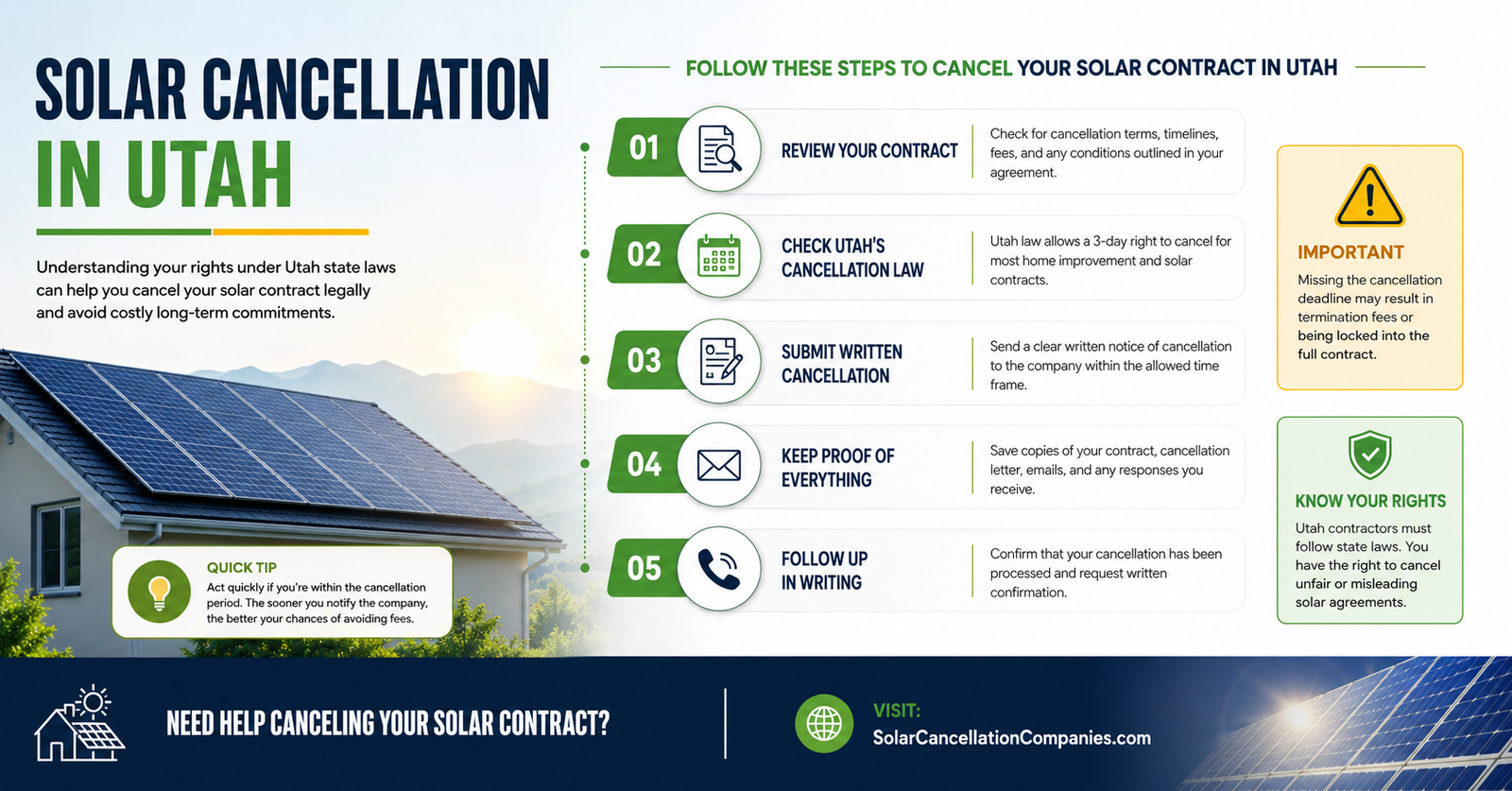
Utah’s Consumer Sales Practices Act gives buyers a three-business-day right to cancel a Utah solar cooling-off-period-style sale, but this applies specifically to direct solicitation sales, meaning agreements signed away from the retailer’s regular place of business, such as at your home. The federal FTC Cooling Off Rule offers similar protection. If you signed at a showroom instead, this right may not apply, and you would rely on your contract’s own cancellation clause. To find your real Utah solar contract cancellation deadline, count from the date you received the fully signed agreement, not the date you first spoke with a salesperson.
- Reread your signed agreement for a cancellation clause and deadline.
- Confirm the date you received the signed copy, since that date often starts the clock.
- Send written cancellation the way the contract requires, and keep proof of delivery.
What If the Deadline Has Already Passed?
A missed deadline is not automatically the end of your options. If installation has not started or permits were never filed, you may still have room to negotiate an exit, especially if delays or missing disclosures point to a company error. Misrepresented savings or hidden fees may support a separate claim outside the standard Utah solar cancellation process. Our solar exit guides cover this kind of situation in more depth if you want to see how other homeowners approached it. Utah allows six years to sue over a written contract dispute and four years for a verbal promise, and if an installer refuses to discuss cancellation, get every response in writing.
Your Solar Loan Is a Separate Agreement
Cancelling the installation contract does not automatically cancel your loan. The installer and lender are usually different companies connected only by paperwork, so confirm loan closure separately and verify no funds were released. Watch for dealer fees folded into the loan balance and payment plans that assume a tax credit you may not receive. A solar loan is typically secured through a UCC filing on the equipment, not a mortgage-style lien, but that filing can still surface during a title search or refinance.
Permits and HOA Rules
Under Utah solar permit requirements, most installations need a building permit and an electrical permit, followed by inspection before your utility grants permission to operate. Your installer typically files these, but confirms they were actually pulled. Separately, Utah’s Solar Rights Act limits how much an HOA can restrict a reasonably sited system. Under Utah Code 57-8a-701, an HOA generally cannot prohibit solar on a detached home where it does not own the roof, and any rule that cuts production or raises cost by more than 5 percent is void, though HOAs with rules predating January 2017 may be treated differently.
Net Metering and Your Electric Bill
Utah closed traditional net metering to new applicants back in 2017. Homeowners installing today generally receive a net billing arrangement instead, with export credits recalculated each year and set well below the retail electricity rate for Rocky Mountain Power customers. Other utilities set their own terms. Utah solar net metering will rarely erase a bill completely once fixed charges, seasonal production, and loan payments factor in, so treat zero bill promises with caution.
Solar Tax Credits in 2026
This is where outdated information causes real financial harm. The federal 30 percent residential credit under Section 25D ended for systems placed in service after December 31, 2025. If you buy or finance a system with cash or a loan in 2026, that federal credit is no longer available. Only leased or power purchase systems may still pass along savings tied to a business side credit through 2027, since the company claims it, not you. Utah’s own Utah solar tax credit for residential systems ended for installations completed in 2024 or later. If a salesperson claims a 2026 purchase still qualifies, ask for the specific tax form and year, and remember a tax credit reduces what you owe the IRS; it is not a rebate check.
Selling or Refinancing With Solar
An unpaid solar loan does not block a home sale, but it must be paid off or transferred at closing, so confirm the payoff amount early. A lease or PPA typically must transfer to a qualifying buyer or be bought out before closing. If refinancing, tell your lender about the solar financing early, since a UCC filing can otherwise surface unexpectedly during underwriting.
Where to File a Utah Solar Complaint
For disclosure or contract violations, contact the Utah Division of Consumer Protection, which can fine a supplier up to $2,500 per violation, and you may separately sue for actual damages or $2,000 per violation plus attorney fees. For a licensed contractor issue, contact DOPL. For an HOA dispute, Utah’s HOA Ombudsman offers free advisory opinions. For broader deceptive sales concerns, the Utah Attorney General’s Office and the FTC both accept complaints.
Contract Checklist Before You Sign
- Cash price and total financed price, shown separately
- Interest rate, loan term, and any dealer fee added to the balance
- Cancellation deadline and required delivery method
- Who handles permits, inspections, and any roof damage
When Should You Get Help?
Consider outside help if your cancellation deadline is close or already passed, your installer will not respond in writing, or a solar loan is interfering with selling your home. Solar cancellation company Utah assistance typically means a contract review and support communicating with the installer or lender, and our company lookup is a good place to compare vetted options. Solar Cancellation Companies is not a law firm and does not give legal advice, and we do not promise a guaranteed outcome.
Frequently Asked Questions
Can I cancel a solar contract after signing in Utah?
Sometimes. If your sale qualifies as a direct solicitation sale, such as one arranged at your home, you generally have three business days to cancel in writing. Sales signed elsewhere depend on your contract’s own terms.
How many days do I have to cancel a solar contract in Utah?
Three business days is the commonly cited window for qualifying direct solicitation sales under state and federal cooling-off rules. Always confirm the exact deadline against your own signed paperwork.
Can a Utah HOA stop me from installing solar panels?
Generally no. Utah Code 57-8a-701 voids outright prohibitions on detached homes, though an HOA may still set reasonable placement rules that do not significantly raise cost or reduce production.
Can I sell my Utah home with a solar loan?
Yes, but the loan balance usually needs to be paid off or transferred at closing, so confirm the payoff amount with your lender early in the sale.
Final Takeaway
If you have not signed yet, review the full cost, financing terms, cancellation language, and permit responsibilities before committing. If you recently signed, find your cancellation deadline today and check your loan separately. If your window has passed, do not assume you have no options. If you are already in a dispute, gather your contract, loan documents, messages, and payment records before deciding your next move.
Understanding Utah solar panel laws starts with understanding your own paperwork. If a Utah solar agreement or cancellation situation is not adding up, Solar Cancellation Companies can review what you signed and help you find a reasonable next step. Contact us, we are not a law firm and do not promise a specific outcome, but we can help you understand where you stand.