

If you’ve signed a solar contract and are now feeling uncertain, you’re not alone. Many homeowners later realize they were rushed through the process or didn’t fully understand the agreement before signing.
Maybe the savings numbers looked too good to be true. Maybe the salesperson pressured you to sign quickly. Maybe your loan payment doesn’t match what you agreed to. Whatever the reason, you deserve clear answers, not more sales talk. For free resources and access to reviewed specialists serving Washington homeowners, visit Solar Cancellation Companies.
This guide covers your real options for Washington solar contract cancellation. You’ll learn what RCW 19.95 protects, how to cancel the right way, and who to contact if a company refuses to help.
Washington Solar Contract Cancellation at a Glance
Can you cancel a solar contract in Washington State?
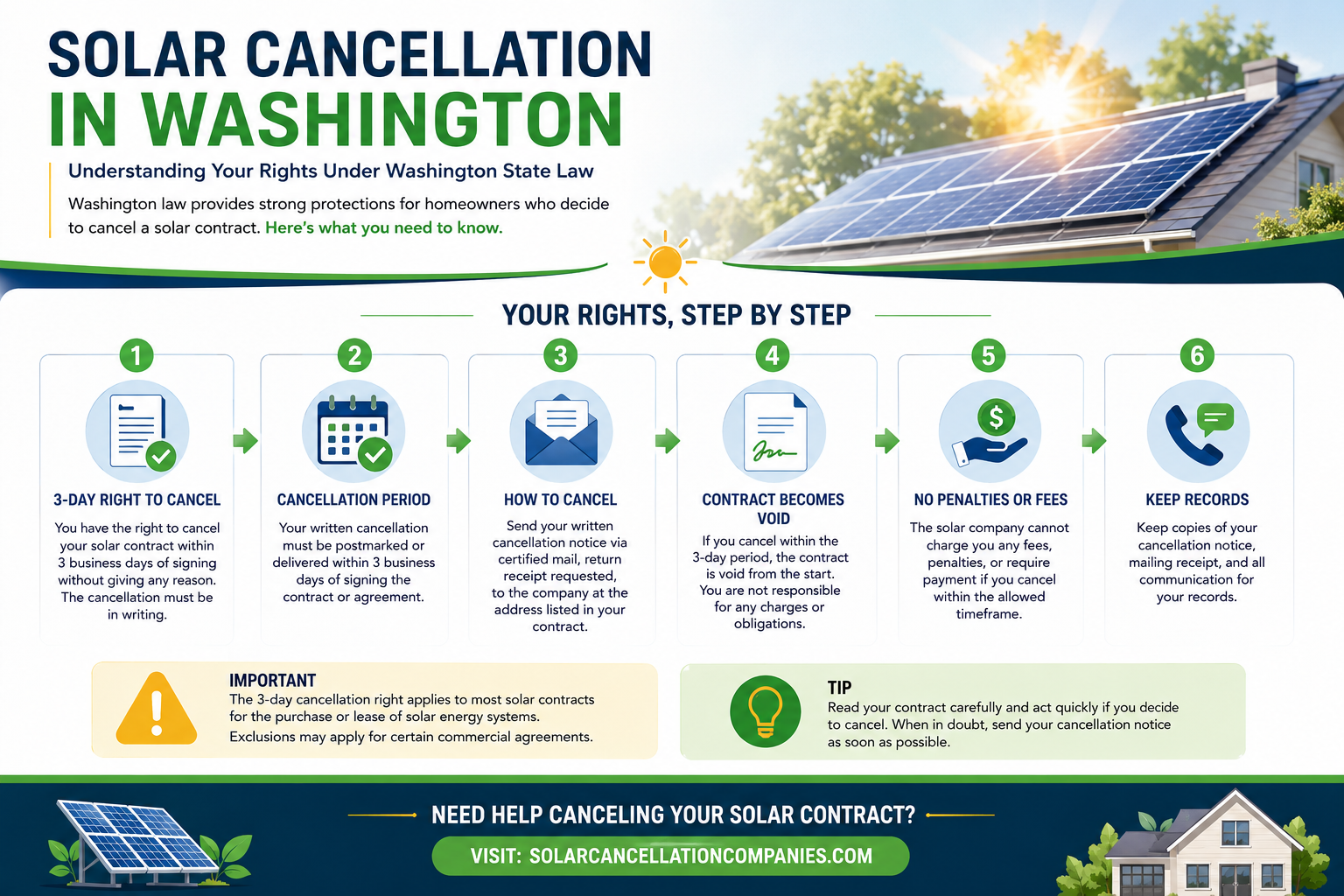
Yes, in most cases. Washington gives you three business days to cancel solar contract Washington deals after you sign. This rule covers cash sales, loans, and leases alike.
After that window closes, cancellation gets harder. It can still work out, depending on your contract and how the sale happened.
What RCW 19.95 means for homeowners
RCW 19.95 cancellation rights come from Washington’s solar consumer law. It requires clear pricing, plain cancellation language, and your initials on that notice.
The law also blocks early payments and holds companies to their promises.
What to do if your cancellation period has expired
Check your contract first. Was the cancellation notice missing or unclear? That gap can matter a lot. You may also have a claim if the company misled you about savings or fees. Our Solar State Laws directory covers how Washington’s rules compare to those in other states and what options remain after the cooling-off window closes.
Understanding Washington Solar Contract Cancellation Laws
What is RCW 19.95?
RCW 19.95 is the Washington solar cancellation law. It sets rules for how solar companies sell, price, and finance home solar systems.
It applies to contracts over $1,000, loans, leases, and power deals too.
How RCW 19.95 protects Washington homeowners
Companies must give you a written notice, in capital letters, about your right to cancel. You must initial it before signing.
They must also list your true cost per watt and any fees at each payment stage.
When Washington cancellation rights may not apply
Contracts under $1,000 fall outside this law. So does work you design and install yourself under a license exemption.
How RCW 19.95 differs from other Washington rules
RCW 19.95 targets solar sales alone. A wider rule, RCW 19.86, covers false or unfair sales tactics in any industry.
Many homeowners end up using both rules together when a solar sale went wrong in more than one way.
Can You Cancel a Solar Contract in Washington?
Cancelling during the three day window
This path is simple. Send written notice within three business days. Use email or tracked mail. No fee applies.
Cancelling after the three day window
This depends on your contract and the company’s conduct. Missing details or false claims can still open a path forward.
Cancelling before work has started
If crews have not shown up yet, you often have more room to negotiate. Check your payment schedule closely, since fees can kick in once permits or design work begin.
Cancelling after permits are approved
Permit approval alone does not remove your rights. It often triggers a new payment stage though, so check your contract for fees tied to that step.
Cancelling after work has started
This is the toughest case. You may owe for work already done, unless the company broke license or contract rules.
Cancelling after the solar system is fully installed
Full cancellation is not likely at this stage. Your best options often shift toward warranty claims, loan disputes, or a formal complaint over false claims. Our Solar Exit Guides cover how post-installation disputes have been resolved with major solar installers and their lender partners.
Washington Solar Contract Cancellation Timeline
Day zero starts the clock the moment you sign. Your three day window begins right away, and weekends still count as calendar days toward your deadline.
Once the deadline passes, the company can start work and bill you. A state office review often takes a few weeks or months.
Formal disputes can stretch longer, especially if a lender or a lawyer gets involved. Keep this in mind and act early. Waiting rarely helps your case.
How to Cancel a Solar Contract in Washington Step by Step
Follow these steps in order.
- Review your contract and find the cancellation clause.
- Check your deadline using your signing date.
- Gather your offer, contract, and messages.
- Send written notice by email and tracked mail.
- Tell your lender in writing too.
- Save proof of every message you send.
- File a complaint if the company ignores you.
Papers You Need Before Cancelling a Solar Contract
Gather these papers for a Washington solar cancellation checklist before you send anything. Having them ready speeds up every step that follows.
- Signed solar contract
- Loan or lease agreement
- Original sales offer
- Emails and text messages with the seller
- Your written cancellation notice
- Proof of delivery, such as a certified mail receipt
- Utility or interconnection documents, if applicable
- Permit records, if applicable
- Photos of your roof or solar equipment
Can You Cancel a Financed Solar Contract?
Solar loans vs leases vs PPAs
A loan means you own the system and repay a lender. A lease or power deal means a third party owns it instead. Understanding which type you signed matters greatly for how you approach cancellation. Our Solar Contract Type guide explains the legal difference between each structure and what it means for your exit options.
Loan approval and credit impact
Approval does not erase your right to cancel. A timely cancellation should not hurt your credit score.
Loan funding rules
Under RCW 19.95, a company cannot collect payment before your three day window ends. A loan should not release major funds early either.
Dealer fees
Many solar loans add a dealer fee of fifteen to thirty percent. This fee is rarely spelled out, which can break lending rules.
Loan disputes
If your loan terms do not match what you were told, contact your lender first. You can also file a complaint with the Consumer Financial Protection Bureau.
Common Reasons Homeowners Cancel Solar Contracts
- Savings claims that ignore local rates
- High-pressure, same-day signing
- Hidden dealer or loan fees
- Confusion over tax credits
- Long delays before installation
- Poor follow-up communication
What If the Solar Company Misled You About the Contract?
This is a common Washington solar contract dispute. False savings claims, forged signatures, and hidden fees all raise real concerns.
Other red flags include free solar claims that turn out to be loans, wrong tax credit promises, and bait and switch pricing that changed after you signed.
You may have a claim under state consumer law. A Washington solar contract lawyer can review your exact case. You can find reviewed specialists through the Solar Cancellation Companies directory.
What Happens After You Cancel?
A valid, on time cancellation should return your deposit and stop your loan. The company must release any lien on your home.
If your cancellation gets denied, write down the date and reason. Then move toward a formal complaint.
Where to File a Complaint in Washington
Washington UTC
The UTC mainly regulates power utilities and listed community solar firms. A Washington UTC solar complaint fits best when net metering or a listed provider is involved.
Washington Attorney General
For most false sales claims, start with the Washington Attorney General’s Consumer Protection Division. This is the main path for most Washington solar complaint cases.
Contractor license and loan
Solar companies need a state license through Labor and Industries. For loan issues, contact your lender first, then the Consumer Financial Protection Bureau if needed.
Comparison of Washington Complaint Options
| Agency | Best For | Typical Result |
| Attorney General | False sales claims | Review and talks |
| UTC | Community solar, net metering | Formal or informal review |
| Labor and Industries | Unlicensed companies | License action or fines |
| Lender or CFPB | Hidden fees, loan errors | Loan review and correction |
Washington Attorney General Solar Complaint Process
File your complaint online through the Attorney General’s website. Attach your contract, messages, and any proof of false claims.
Use specific dates and facts rather than general frustration. Clear details help staff review your case faster.
Expect an initial review, then maybe talks between you and the company. Not every complaint ends in a full refund, but a documented pattern helps future homeowners too.
Can a Solar Company Sue You for Cancelling?
This is rare when you cancel on time with proof. Good records protect you if a dispute grows.
If a company threatens legal action after a valid cancellation, talk to a Washington solar lawyer before you respond.
When Should You Hire a Washington Solar Contract Lawyer?
Consider legal help if your cancellation gets denied, if you suspect fraud, or if a lender will not fix hidden fees.
Legal help also makes sense if a company threatens you with legal action. For simple, on time cancellations, you often will not need one.
Common Mistakes That Can Delay or Weaken Your Case
- Cancelling by phone only, with no written record
- Missing the three-day deadline by one day
- Forgetting to notify the lender separately
- Deleting emails or text message threads
- Waiting weeks before taking action
- Assuming a verbal promise is part of the contract terms
Washington Solar Contract Cancellation Checklist
- Confirm your signing date and cancellation deadline
- Gather your contract and related communications
- Send your written cancellation notice by email and mail
- Notify your lender in writing
- Keep copies of every receipt and confirmation
- Follow up if you don’t receive a response within a week
- File a complaint if needed
Frequently Asked Questions
Can I cancel after three days?
Sometimes. Missing details or false claims can support a later cancellation. Review your Washington solar consumer rights and consider a legal review if your deadline has passed.
Can I cancel my loan?
Yes, but tell your lender in writing. Cancelling the solar contract alone will not cancel your loan or lease.
Will my credit be affected?
A timely cancellation should not hurt your score. A small, short term dip may come from the first credit check instead.
What papers do I need?
Your signed contract, loan papers, sales offer, and any messages with the seller. Save your written cancellation notice too.
Should I contact UTC or the Attorney General?
Start with the Attorney General for most sales issues. Contact the UTC only for community solar or net metering disputes.
What if I was misled?
Write down every claim made during the sales pitch. Compare it to your contract. This can support a stronger complaint later.
Can I be charged a fee to cancel?
Not during your three day window. A company cannot charge a cancellation fee if you cancel within three business days using proper written notice.
Can I cancel after the system is installed?
Full cancellation is not likely once work is complete. Focus instead on warranty claims, loan disputes, or a formal complaint over false claims.
Conclusion
Your next step depends on where you stand today. Still inside the three-day window? Send your written notice now, to both the company and your lender.
Is the window closed already? Check your contract for missing notices or false claims before you assume you are stuck.
Simple, on-time cancellations rarely need outside help. Denied requests or suspected fraud are where a complaint or a quick legal review pays off.
Either way, gather your papers first. A clear paper trail is your strongest tool, whether you handle this yourself or bring in help. Contact Solar Cancellation Companies today for a free no-obligation review of your Washington solar contract.