

If you signed up for solar through Trinity but your bill, lease, or PPA shows another company name, that is the first issue to sort out before trying to cancel. Trinity installs systems, but its lease and PPA options are provided through third-party partners, so Trinity may not be the company that can approve a buyout, transfer, or termination. Check the name on your actual agreement and latest bill first, then match your next step to where the project stands.
Start by Finding Out Who Really Holds Your Agreement
Trinity may have sold and installed your system without owning your long-term lease or PPA at all.
Trinity says its lease, loan, and PPA options are offered through financing partners, not Trinity directly. It also notes that a separate company owns the equipment under most lease and PPA deals.
That one fact should shape everything you do next.
| Your issue | Who to check with |
| Installation, design, or workmanship problems | Trinity’s installation agreement |
| Lease or PPA payments | The company named on your lease or PPA, or your current servicer |
| Buyout or purchase requests | The contract owner or current servicer |
| Transferring the system when you sell your home | The contract owner or current servicer |
| Equipment or warranty issues | Whoever the warranty or agreement assigns responsibility to |
| Utility hookup problems | Trinity and your utility, depending on the cause |
Check the first page of your solar agreement, your latest bill, your payment portal, and any letters about your account changing hands.
Don’t assume that ending things with Trinity automatically cancels a separate agreement owned by another company. Trinity Solar’s payment page confirms its financing comes through outside partners.
Make Sure You’re Looking at the Right Kind of Contract
A Trinity lease, a PPA, and a solar loan are three very different things, and each creates a different exit problem.
With a lease, you’re generally paying for the right to use the equipment. With a PPA, you’re paying for the electricity it actually produces. In both cases, Trinity says an outside company usually owns the system.
A solar loan works differently. There, you own the system yourself while paying off the company that financed it.
Before you ask how to cancel anything, find the exact name of your agreement. If your paperwork says “Power Purchase Agreement,” don’t follow lease-specific advice. And don’t assume loan payoff rules apply if you actually signed a lease or PPA.
How Much Time You Have to Cancel Depends on How and When You Signed
If you recently signed with Trinity, three separate things could give you the right to cancel:
- Federal law
- Your state’s law
- The agreement you actually signed
These three don’t automatically line up with each other. A right that lets you cancel a Trinity installation contract won’t necessarily cancel a separate lease or PPA from another company too.
Your Federal Cooling-Off Right Comes With Conditions
The FTC’s Cooling-Off Rule can give you three business days to cancel certain sales made at your home or a few other specific locations.
For sales made at your home, this rule generally applies once the price is $25 or more. It does not give every solar customer an automatic three-day right to walk away.
Your sale has to actually fit the rule, and there are exceptions. Check exactly how and where you signed, and follow the cancellation steps that came with your paperwork. See the FTC Cooling-Off Rule for the full details.
Some States Give You Extra Protection
A few states where Trinity operates have their own added rules on top of the federal one.
Connecticut: Home-improvement contracts covered by state law usually give you three business days to cancel. Connecticut’s Department of Consumer Protection counts Saturday as a business day for this purpose.
Pennsylvania: Covered home-improvement contracts generally give you three business days to back out without penalty, though there are some exceptions written into the law. You can find more detail in SCC’s Pennsylvania solar cancellation law guide.
New York: Covered residential solar agreements must generally let you cancel within three business days of receiving your paperwork, with no charge. New York also requires these agreements to clearly spell out any termination fees and how they’re calculated.
If you’re on Long Island, take extra care. LIPA and its utility contractor aren’t covered by New York’s usual solar rules in the same way. SCC’s New York solar cancellation law guide explains how the wider state framework works.
The real takeaway isn’t that every Trinity customer gets three days. It’s that you need to work out which rule actually covers your specific deal.
If Installation Hasn’t Started Yet, Check Both Agreements
If nothing has been installed, first check whether you’re still inside any cancellation window, whether that’s a state law, a federal rule, or your own contract’s terms.
Then look at both your Trinity installation agreement and any separate lease, PPA, or financing agreement you signed. Treat them as two different documents, because they usually are.
Here’s a simple order to follow:
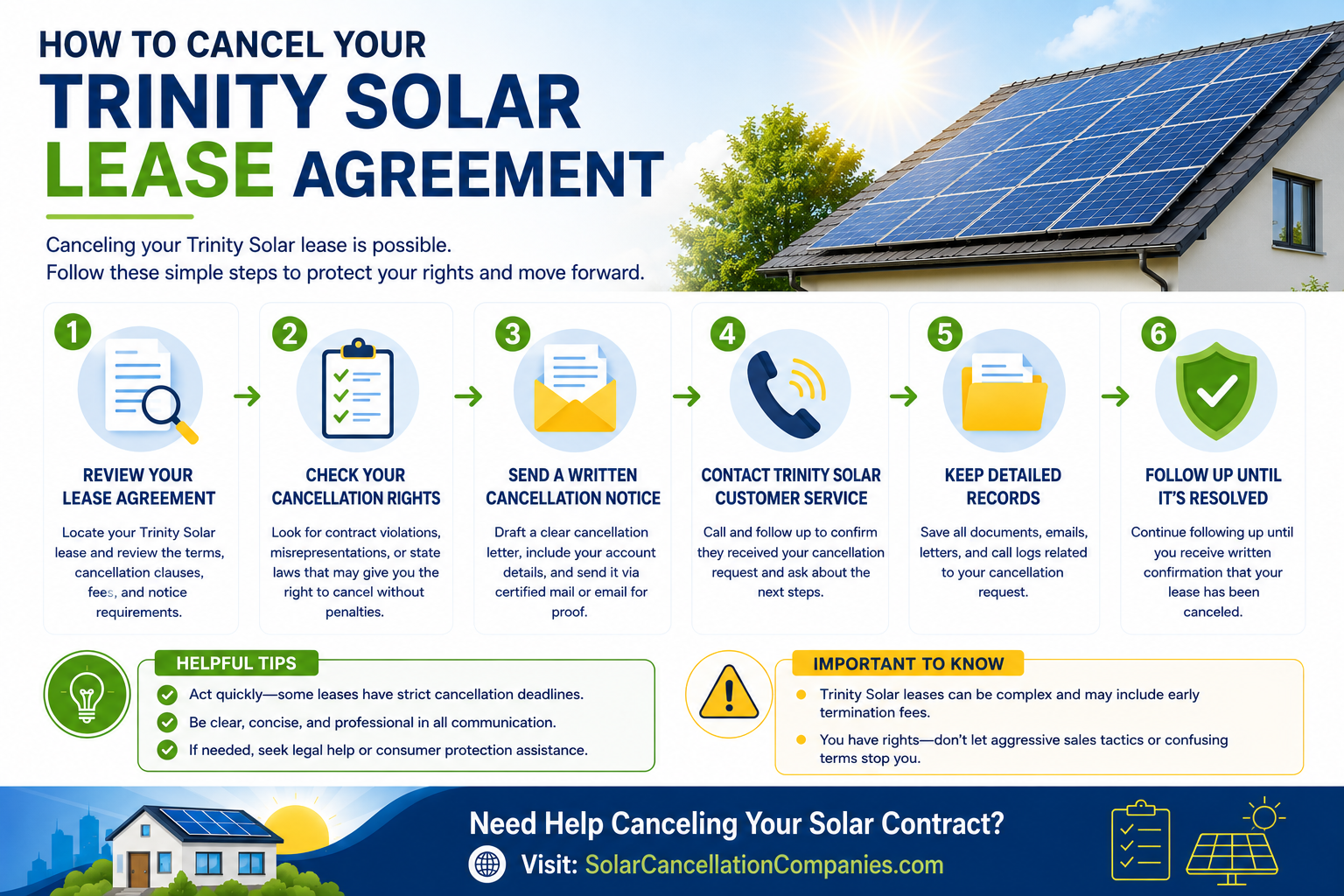
- Gather every agreement you signed.
- Find the cancellation section in each one.
- Check the deadline and how you’re supposed to give notice.
- Send that notice to every party the paperwork names.
- Keep proof that your notice was sent and received.
- Ask for written confirmation showing exactly which agreements were cancelled.
Don’t assume there’s a standard design, permit, or cancellation fee that applies to everyone. Any fee a company asks for should be tied back to something written in your contract or another real legal basis.
Installed but Not Yet Turned On? Check What Your Contract Says Happens Next
A system that’s installed but not yet approved to run creates a different situation than either a brand-new contract or a lease that’s been active for years.
Check these things:
- Does Trinity consider the installation finished?
- Have the required inspections happened?
- Has your utility given permission to operate?
- Has your lease or PPA payment actually started?
- Does your agreement name a specific event that triggers payments?
Don’t rely on a general assumption that installing the panels automatically starts every lease. Trinity itself tells customers to check their actual agreement for payment terms, production promises, purchase rights, and maintenance duties.
If things have stalled, hold onto your utility emails, inspection records, installation dates, service requests, and any messages with Trinity or your contract provider.
Once Your Agreement Is Active, the Fine Print Runs the Show
Once any cancellation window has passed, the written agreement becomes the thing that matters most.
The FTC warns that ending a solar lease early can be difficult and expensive. It suggests checking your agreement for termination charges, purchase options, removal terms, maintenance duties, and what happens at the end of the contract.
For a Trinity lease or PPA, look for the sections that cover:
- ending the contract early
- buying out the system
- when you’re allowed to buy it
- transferring it to someone else
- what happens if you or the company fall behind, and how to fix it
- removing the equipment
- how disputes get resolved
Trinity’s own PPA guidance says buyout terms can be different from one agreement to the next, so there’s no single verified Trinity cancellation fee or buyout formula that applies across the board. If a company quotes you a number, ask exactly where in the contract that figure comes from, and ask for the math in writing.
If Your Paperwork Says Sunnova, Here’s Where Things Stand in 2026
Some Trinity customers have a lease or PPA that names a different company entirely: Sunnova.
Trinity was one of Sunnova’s largest dealer partners for years, selling and installing systems that Sunnova then owned and financed.
Sunnova filed for Chapter 11 bankruptcy in June 2025. In August 2025, a bankruptcy court approved the sale of nearly all of Sunnova’s assets to Solaris Assets, LLC, a company formed by a group of lenders and backed by GoodFinch Management. That sale closed on September 3, 2025, and the court confirmed Sunnova’s Chapter 11 plan later that year.
As part of that sale, SunStrong Management took over the day-to-day servicing of accounts for nearly all in-service Sunnova customers. That includes billing, monitoring, collections, and general support. SunStrong has also taken on servicing for other companies caught up in solar bankruptcies, including former SunPower and PosiGen customers.
In plain terms: if your paperwork still says Sunnova, don’t send a buyout, billing, or servicing request straight to Trinity. Check your most recent bill or any letter about your account to confirm who is actually handling it today, since ownership of these portfolios has changed hands more than once. SCC’s Sunnova bankruptcy and contract guide walks through this transition in more detail.
Service Problems Are a Reason to Dispute, Not an Automatic Cancellation
Bad production numbers, broken equipment, repairs that never happened, or roof damage can all matter a lot. But the first question to answer is who was actually responsible for fixing the problem.
Trinity says warranty and service duties can be split between the installer, the equipment maker, the system owner, and other providers. So the answer isn’t always Trinity.
If service is the reason you want out, start collecting evidence. Useful records include your production history, utility bills, service requests, inspection results, warranty documents, and any written replies from Trinity or your contract provider.
Then check whether your agreement includes a “notice and cure” step. Many contracts give the company one chance to fix a problem before you can move on to another remedy.
The same idea applies if you need the panels removed for roof work. Since leased or PPA equipment usually belongs to another company, confirm who is allowed to remove and reinstall it, and whether doing so affects your warranty. Needing roof access doesn’t mean you have to cancel the whole agreement.
Selling Your Home? Check Transfer Rules Before You Ask for a Payoff
Selling your house doesn’t automatically end a Trinity lease or PPA.
Trinity says these agreements may allow a transfer to the new buyer, require the buyer to qualify financially, allow a purchase instead, or follow some other process entirely.
Before you list your home, ask your current contract owner or servicer:
- whether the agreement can transfer to the buyer
- whether the buyer needs to qualify
- whether you can just buy the system outright
- how any purchase price is worked out
- what paperwork the transfer needs
For more on this, see SCC’s guide to cancelling or handling a solar lease when you move. And don’t ask Trinity for a “payoff” until you’ve confirmed Trinity is even the right company to give you one.
If a Company Says No, Get Their Reason in Writing
A rejection is much easier to challenge once the company tells you exactly which clause they’re relying on.
Ask them to spell out:
- which agreement they say controls the situation
- which specific clause blocks your cancellation
- whether they believe your deadline already passed
- whether any other option is still available to you
- how they calculated any amount they’re asking for
Then compare their answer against your actual signed agreement, line by line.
If you think you were misled during the sales process, the FTC or your state’s consumer protection office may be able to help. A New York solar dispute may also fall under the state’s Department of Public Service complaint process. The right regulator depends on the type of problem, since an installation issue with Trinity isn’t the same thing as a billing dispute with a separate lease owner.
What to Gather Before You Contact SCC
The fastest way to untangle a Trinity problem is to lay out the full contract chain in one place.
Before reaching out to Solar Cancellation Companies, gather your Trinity installation agreement, your lease or PPA, your latest bill, any recent servicing notices, cancellation forms, warranties, permission-to-operate records, and any written history of your dispute.
SCC can help you work out which company controls each part of your situation, where your project currently stands, and what your next practical step should be, whether that’s cancelling, transferring, disputing, or something else.
If you signed through Trinity but aren’t sure who actually owns your agreement or what your options are, SCC can review your contract and help you figure out the next step before you send any notices, ask for a buyout, or escalate a dispute.
Frequently Asked Questions
The salesperson called it a lease, but my paperwork says PPA. Which one is it?
Go with what’s written in the signed agreement, not what you were told out loud. A lease and a PPA work in different ways, so this distinction matters.
If the salesperson described your deal differently than the paperwork does, hold onto the proposal, texts, emails, and any sales materials that show what you were told. Those records can matter if your dispute involves what you were promised at the time of sale.
I never got a full copy of my Trinity or financing agreement. Now what?
Ask Trinity, and whoever is currently billing or servicing your account, for a complete copy. Don’t assume your agreement is automatically void just because you can’t find your copy of it. You’ll need the actual document to confirm who owns the contract, what the cancellation terms are, and how payments and transfers work.
Does an arbitration clause stop me from cancelling?
Not on its own. An arbitration clause is usually about how disputes get resolved, not whether you can cancel in the first place. Read it alongside your agreement’s actual cancellation and termination sections. In New York, covered residential solar agreements are required to clearly disclose any arbitration terms.
My Trinity lease or PPA is close to ending. What should I check?
Read the end-of-term section before assuming the panels automatically become yours, or that they’ll automatically be removed. Check whether your contract offers a purchase option, a renewal, removal, or continued service. These terms vary by provider and agreement, so your signed contract is what actually decides what happens next.
This guide gives general information only. What you can actually do depends on your signed paperwork, your state’s laws, how far along your project is, and who currently owns or services your contract.