
If you signed a solar contract in New York and want out, you may have a cancellation right, but there is no single three-day rule that covers every solar agreement. Your deadline can depend on whether you signed a home-improvement contract, bought through a door-to-door sale, received an agreement from a covered solar provider, or used certain home-secured financing.
Start by checking what you signed, when you signed it, when you received the completed agreement, and whether there is a separate loan, lease, or PPA.
Can You Cancel Your New York Solar Contract Right Now?
Possibly. The key question is which New York or federal rule applies to your agreement.
New York law specifically includes solar energy systems within its definition of home improvement. A qualifying home-improvement contract generally must contain a three-business-day cancellation notice under New York General Business Law §771.
But that is not the only possible rule.
A solar sale made at your home may fall under New York’s Door-to-Door Sales Protection Act. Covered solar providers can also be subject to separate New York Public Service Commission rules. Certain in-home sales may fall under the federal FTC Cooling-Off Rule, while some financing secured by your principal dwelling can have a separate federal rescission right.
Before deciding that your deadline has passed, identify:
The agreement → signing date → receipt date → sales method → financing structure.
Those facts determine which rule matters.
Which Three-Business-Day Rule Applies to Your Agreement?
The biggest mistake is treating every New York solar contract as if the same three-day deadline applies.
| Your situation | Possible rule | Main trigger | Important limitation |
| Qualifying solar home-improvement contract | NY GBL §771 | After the day you sign | Must fall within Article 36-A |
| Qualifying door-to-door solar sale | NY Personal Property Law Article 10-A | After the day you sign | Statutory scope and exclusions apply |
| Covered residential solar/DER agreement | NYPSC UBP-DERS | After you receive the agreement | Applies only to covered providers and agreements |
| Certain in-home sales | FTC Cooling-Off Rule | Covered transaction date | Federal exclusions apply |
| Certain credit secured by your principal dwelling | TILA / Regulation Z | Latest applicable disclosure or transaction event | Ordinary unsecured solar loans do not automatically qualify |
New York home-improvement contracts
GBL §770 expressly includes solar energy systems within the definition of home improvement.
For qualifying contracts under Article 36-A, §771 requires notice that the homeowner may cancel until midnight of the third business day after the day the agreement or offer is signed.
The statute requires written cancellation. If notice is mailed, it is treated as given when properly addressed, postage prepaid, and deposited in a mailbox.
If this rule applies and you are still within the period, follow the cancellation instructions in your contract and preserve evidence showing when notice was sent.
Door-to-door solar sales
New York’s Personal Property Law Article 10-A creates a separate right for qualifying door-to-door transactions.
The seller must also comply with specific notice requirements. Under §428, a covered seller must provide the required cancellation forms, a completed contract or receipt, and an oral explanation of the cancellation right.
This matters because a homeowner who thinks “my three days are already gone” may need to check whether those requirements were ever satisfied.
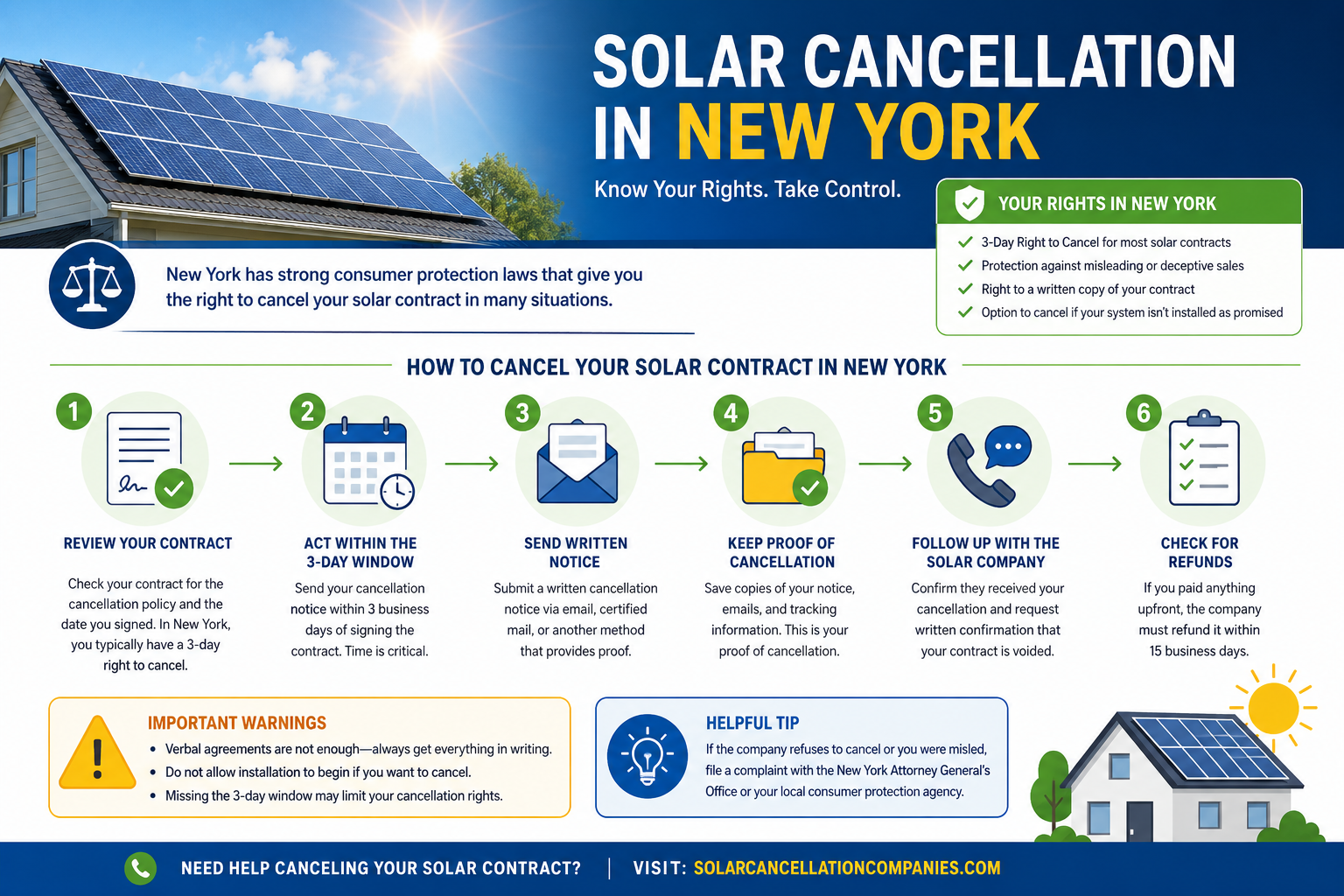
Did Your Door-to-Door Cancellation Period Actually Start?
For a qualifying New York door-to-door sale, failure to provide the required cancellation notices can affect when the ordinary period begins.
Section 428 states that until the seller complies with its notice obligations, the buyer may notify the seller of the intent to cancel, and the normal three-business-day period begins when the seller complies.
So if a salesperson came to your home and you never received the required cancellation paperwork, do not assume that counting three business days from your signature settles the issue.
This is not an unlimited cancellation right for every solar contract. The transaction must first fall within New York’s door-to-door law.
Certain transactions may also be covered by the federal FTC Cooling-Off Rule, which provides a three-business-day cancellation period for some sales made at a consumer’s home or another covered location. The rule has exclusions, so it should be checked separately rather than applied automatically.
Did You Receive the Solar Agreement After You Signed?
For some New York solar customers, the receipt date matters just as much as the signing date.
The New York Public Service Commission’s Uniform Business Practices for Distributed Energy Resource Suppliers, known as UBP-DERS, apply to qualifying CDG and on-site mass-market distributed-generation providers.
For covered residential agreements, the provider must state that the customer may rescind within three business days after receiving the agreement, without charge or penalty.
That is different from the signing-based rule under New York’s Home Improvement Contract Law.
If you are reviewing a recent solar sale, write down both dates:
Date signed and date the completed agreement was received.
Do not assume they trigger the same rule.
What Should You Check in a Covered New York Solar Agreement?
New York’s UBP-DERS rules make the contract itself central to a cancellation or dispute review.
Covered on-site solar agreements can be required to disclose important terms such as the system price, payment structure, estimated production, installation schedule, warranties, termination provisions, potential incentives, property-sale restrictions, and responsibility for maintenance and repairs.
For certain contracts, a production guarantee is also required.
The goal is not simply to ask, “Did I get a contract?”
The better question is:
Does the contract accurately show the financial, performance, and termination terms I was actually sold?
Check the Standard Customer Disclosure Statement
Covered customers must receive a Standard Customer Disclosure Statement, or SCDS, as part of the sales agreement.
One particularly important New York rule is that when the SCDS conflicts with another term in a covered agreement, the term stated in the SCDS constitutes the agreement with the customer.
Compare the SCDS with the main agreement for:
price, payment terms, escalation, termination rights, warranties, and system obligations.
A mismatch can be important, but it should not be described as automatically voiding the contract.
What If the Salesperson Promised Large Savings or Tax Benefits?
New York regulates how covered solar providers present savings estimates.
Under UBP-DERS, when a covered provider uses savings projections for mass-market customers, the forecast must use a baseline based on the three-year average of actual historical utility rates for the customer’s utility and service class.
A provider may assume utility-rate increases of up to 3% per year, but that assumption must be disclosed.
If your concern is that the savings promise was unrealistic, compare the proposal and written forecast with the assumptions disclosed in the contract and your actual system performance.
New York General Business Law §349 also prohibits unfair, deceptive, or abusive practices in New York commerce. For qualifying home-improvement contracts, GBL §772 can also matter where an owner relied on false or fraudulent written representations.
That makes emails, texts, proposals, and written savings estimates worth preserving.
Be careful with 2026 federal tax-credit claims
The IRS states that the federal Residential Clean Energy Credit applied at 30% to qualifying residential property installed through December 31, 2025. It is not available for residential property placed in service after that date.
So a salesperson discussing a new 2026 residential installation should not simply assume you will receive the former 30% federal credit.
New York’s state solar credit is separate. The New York Department of Taxation and Finance continues to provide a residential solar credit equal to 25% of qualified expenditures, up to $5,000, subject to eligibility rules.
Neither credit should be treated as guaranteed money for every homeowner.
What If Your Solar Loan Has Already Been Approved or Funded?
Separate the companies involved before deciding what needs to be challenged.
The installer or seller may control the installation contract. The lender provides financing. A separate servicer or assignee may later collect the debt.
When GBL §771-a applies, a home-improvement contractor must disclose financing-related activity and associated fees or payments and obtain written agreement from the parties.
That does not mean every solar loan and installation contract are legally the same agreement.
For a financed purchase, compare the cash price, financed price, amount financed, disclosed charges, and any payment structure tied to expected tax benefits.
If GoodLeap is involved, SCC’s GoodLeap solar contract cancellation guide covers lender-specific issues separately.
Does federal TILA give you another rescission right?
Only in certain financing transactions.
Under federal Regulation Z, a rescission right can apply when a creditor retains or acquires a security interest in the consumer’s principal dwelling. The normal three-business-day period runs from the latest of specific transaction and disclosure events.
An ordinary unsecured solar loan does not gain this rescission right merely because the money was used to pay a solar installer.
If you are considering this route, check whether your financing documents actually show a security interest in your principal dwelling and whether you received the required rescission disclosures.
What Options Remain After Three Business Days?
If the ordinary cancellation window appears to have passed, the next question is not simply “How do I cancel anyway?”
It is:
Is there another documented legal, contractual, or disclosure issue that changes the situation?
A homeowner may need to examine whether a qualifying door-to-door seller failed to provide required notices, whether the contract contains its own termination right, whether written sales claims materially conflict with the agreement, or whether qualifying home-secured financing has a disclosure problem.
If none of those issues exists and the homeowner simply changed their mind, there is no verified New York rule giving every solar customer an indefinite right to cancel.
For a lease or PPA where the contract allows a buyout rather than cancellation, SCC’s solar buyout guide explains that separate route.
Where Should You Take an Unresolved New York Solar Complaint?
The correct regulator depends on the problem.
| Problem | Best starting point |
| Covered DER agreement, disclosure, or provider conduct | Provider, then New York Department of Public Service |
| Alleged deceptive consumer sales conduct | New York Attorney General |
| Local contractor licensing problem | Applicable city or county licensing authority |
| Solar financing or servicing problem | Lender/servicer and applicable financial regulator |
| Covered federal cooling-off issue | Federal Trade Commission |
| Rescission, litigation, collections, or major contract dispute | Qualified legal counsel |
Under UBP-DERS, covered providers must maintain complaint procedures. They generally must acknowledge or respond within two days and, if the first response is only an acknowledgment, provide a response within 14 days.
Covered CDG and on-site mass-market DG providers must also register with the New York Department of Public Service.
That means homeowners can check both what the provider promised in the contract and whether the company is operating within New York’s DER regulatory framework.
For installation contractors, remember that New York does not have one statewide home-improvement contractor license. Licensing requirements can exist at the city or county level.
Do the Same Rules Apply on Long Island?
Not always.
The statewide UBP-DERS framework expressly excludes the Long Island Power Authority and its utility contractor from its general applicability provision.
LIPA maintains a separate UBP-DERS-LIPA framework for its territory.
If your property is served within LIPA territory, do not assume that every statewide PSC procedure applies in exactly the same way. Check the relevant LIPA rules while also considering New York statutes such as the Home Improvement Contract Law and Door-to-Door Sales Protection Act where applicable.
What Should You Check Before Taking Action?
A New York solar contract review should begin with the documents, not assumptions.
Start with the installation agreement, loan, lease or PPA, Standard Customer Disclosure Statement, proposal, cancellation notices, and written sales communications. Record both the signing date and receipt date. Then identify the installer, provider, lender, and servicer separately.
From there, determine which rule actually fits your situation.
If you are still within a valid cancellation period, follow the required notice procedure promptly and preserve proof. If the ordinary period appears to have passed, focus on documented disclosure problems, contract terms, financing issues, or sales representations rather than assuming another cancellation right exists.
Solar Cancellation Companies can help homeowners organize the agreement, financing, and New York-specific issues involved before deciding the next step. Request a solar contract review.
Legal information notice: This article provides general consumer information, not legal advice. Your rights depend on your contract, transaction, and individual circumstances.
Frequently Asked Questions
Does a missing term in my New York solar contract automatically make it void?
Not automatically. New York law sets requirements for qualifying home-improvement contracts, but a missing disclosure or contract term does not by itself mean the agreement is automatically cancelled. The specific violation and available remedy need to be reviewed.
What if my solar loan was transferred to another lender or company?
A transfer does not necessarily erase every issue connected to the original sale. For certain qualifying New York door-to-door transactions, Personal Property Law §431 can preserve some claims or defenses against an assignee, subject to statutory limits.
Does a New York investigation against my solar company cancel my contract?
No. A regulatory investigation, enforcement action, or restriction on a provider does not automatically terminate an existing solar agreement or loan. Check the actual regulator order, your contract, and which company still holds each obligation.
Can I cancel because my New York solar contract does not include a required production guarantee?
A missing production guarantee may matter if your agreement is one of the covered contracts for which UBP-DERS requires one. However, the omission should not be treated as an automatic cancellation right; it is a contract and regulatory compliance issue that should be reviewed.