

Most homeowners never expect a solar buyout to cost so much. You signed a lease or power purchase agreement years ago. Now you want to sell your home or end the contract. And the quote you got back feels way too high.
You are not alone. Thousands of homeowners across California, Texas, Florida, and beyond face the same problem. High buyout quotes. Unclear math. And very little help on what to do next.
This guide explains what drives solar buyout costs. It shows you how to spot an inflated quote. And it gives you the exact steps that have helped real homeowners pay less.
What Is a Solar Buyout and Why Does It Matter?
A solar buyout is when you pay a set amount to end your lease or PPA. You either take full ownership of the system or simply exit the contract. The amount depends on your agreement type, how long you have had it, and how your provider does the math.
There are three common agreement types. A solar lease means you pay a fixed monthly fee to use the system. A solar PPA means you pay per kilowatt hour of power the panels make. A solar loan means you own the system from day one and make monthly loan payments.
Buyouts happen most often when you sell your home and the buyer will not take over the contract. They also happen when you want to get out early. End of term buyouts are usually lower. Early buyouts, especially in the first five to ten years, tend to be much higher. And they leave more room to negotiate.
What Factors Affect the Cost of a Solar Contract Buyout?
Before you can negotiate, you need to know what is in that number. Buyout quotes are not random. They are built from several parts.
Remaining Contract Balance
The provider adds up all the payments you still owe. The further you are from the end date, the higher this figure will be.
System Age and Depreciation
Solar panels lose value over time. A ten year old system is worth less than a new one. Some companies do not apply fair depreciation. That is where you can push back hard.
Fair Market Value Calculations
Providers may use their own formula to assign a value to the system. That formula is not always clear. And it is not always fair. You have every right to question it.
Escalator Clauses
Many contracts include annual rate increases of two to three percent. If yours does, those rising payments get added into the buyout figure.
System Performance and Maintenance History
A system that has not worked well may be worth less on the open market. If your system has had problems or failed to hit its promised output levels, that is a real point you can raise in talks.
Administrative and Processing Fees
On top of the base amount, providers often add fees. These can include processing charges, document costs, and transfer fees. Some of these can be removed if you ask the right way.
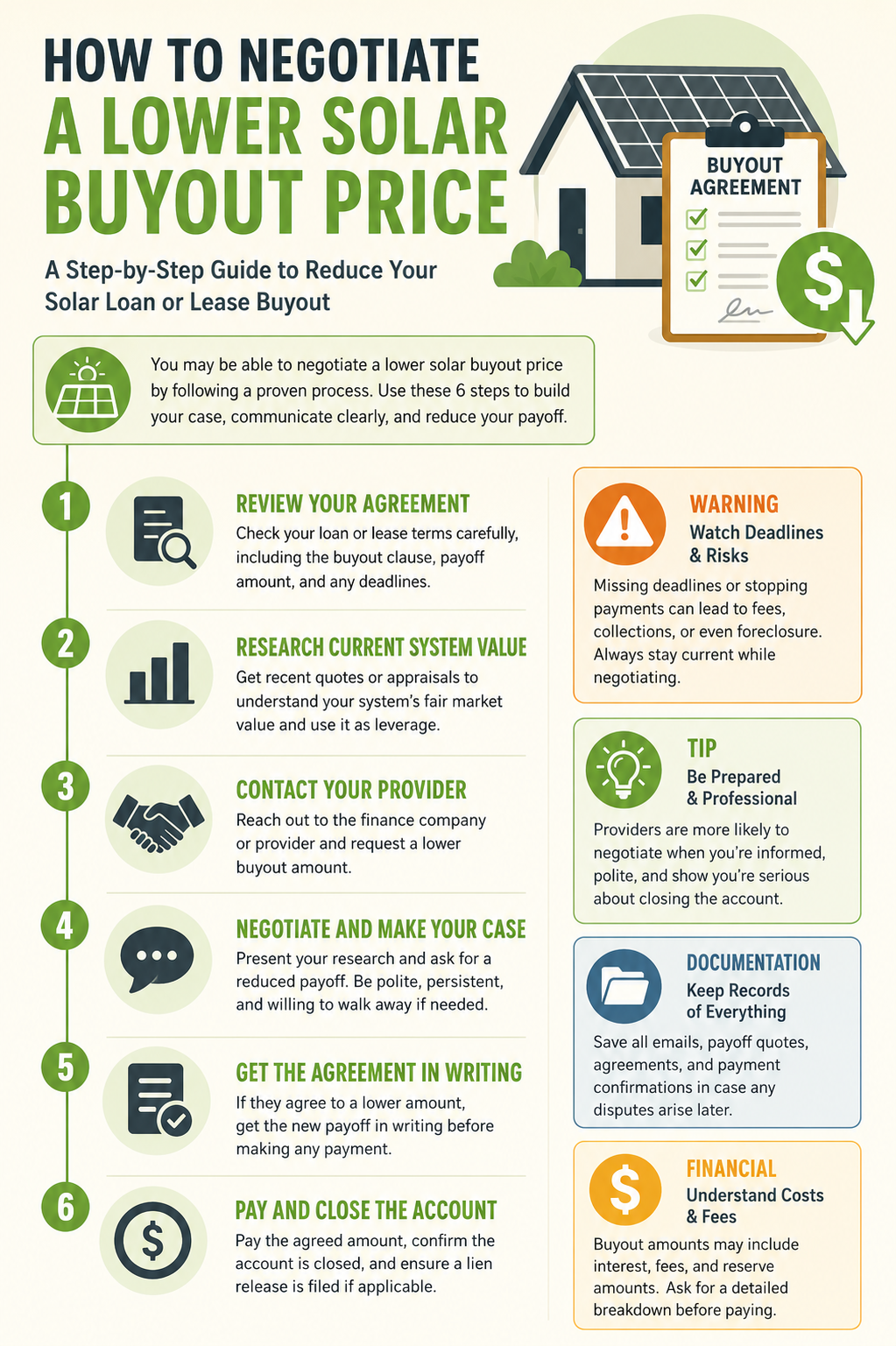
How to Tell Whether Your Solar Buyout Quote Is Fair
Getting a quote and accepting it are two very different things. Here is how to check whether the number makes sense.
Review the Buyout Terms in Your Agreement
Your original contract should include a buyout or early exit clause. Pull it out. Compare the way the buyout is meant to be calculated against what you were quoted. If the numbers do not line up, say so.
Compare With Current Market Value
Get an outside estimate of what the system is worth today. Solar equipment loses value steadily. If the quote treats an old system like a new one, that is a red flag worth acting on.
Request a Detailed Breakdown
Ask for a full list of every charge. Any provider that will not explain the quote line by line is not giving you what you deserve. You are entitled to see how each number was reached.
Warning signs of an inflated buyout amount:
- No itemized breakdown was provided
- Market value was assigned to an old system without any depreciation
- Fees are listed without clear descriptions
- The quote is much higher than the total of your remaining payments
- No mention of the buyout clause from your original contract
Quick checklist before accepting any buyout quote:
- Pull out your original lease or PPA agreement
- Find the buyout or exit clause
- Compare the quoted amount to your remaining payment total
- Request a full cost breakdown in writing
- Get an outside valuation of the system
Documents to Gather Before You Start Negotiating
Going into talks without your paperwork puts you at a real disadvantage. These are the key documents to have ready.
- Your full solar lease or PPA agreement
- The buyout and early exit clause
- System output reports from the past 12 to 24 months
- Any output guarantees included in your contract
- Service and repair records
- Transfer and ownership restriction clauses
If your system has not hit its promised output levels, write it all down. That gap between what was promised and what was delivered is solid leverage.
Proven Solar Buyout Negotiation Strategies That Can Reduce Costs
Negotiating a solar buyout is not about arguing. It is about showing facts and asking the right questions. These steps have helped real homeowners pay less.
Ask for a Complete Valuation Breakdown
Do not negotiate against one big number. Ask the company to send a full list of every item in the quote. Once you see the line items, you will know exactly where to focus.
Use System Depreciation as a Negotiation Point
Solar panels lose roughly 0.5 to 1 percent of output per year. If your system is eight or ten years old, it is worth far less than a new one. Show that math clearly and let it speak for itself.
Compare the Quote to Current Market Prices
Look up what a similar solar system costs to buy and install today. If the buyout quote is close to or above that number, something does not add up. Point that out directly.
Challenge Unnecessary Fees
Administrative fees, processing charges, and transfer costs are often open to debate. Ask which fees are required by your contract and which ones are not. The ones that are not required can often be cut.
Use Performance Issues as Leverage
If the system has not hit its promised output, you have a strong case. Lower output means lower value. And if the company made a promise it did not keep, that matters too.
Time Your Negotiation Strategically
Companies tend to be more open near the end of a quarter or fiscal year. If you are not in a rush, waiting for the right time can work in your favor.
Escalate When Necessary
If the person you are speaking to will not move, ask to speak with the contract resolution team or customer retention group. Decisions made at that level are often very different.
Hidden Solar Contract Exit Costs You May Not Expect
Beyond the quoted buyout amount, other costs can pop up when you exit a solar contract. Here are the ones that catch homeowners off guard most often.
- Processing and document fees: Often 200 to 500 dollars, sometimes open to debate
- Transfer fees if a buyer takes over the contract: Typically 500 to 1,000 dollars
- Equipment removal costs if ownership is not transferred: Can exceed 1,500 dollars
- Reinstallation charges if panels need to be moved
- Tax effects depending on how the buyout is set up
Always ask for a total cost to exit, not just the buyout amount. The real number can be several thousand dollars more than the first quote.
Solar Contract Exit Options Compared
A buyout is not your only way out. Here is how the main options stack up.
| Option | What It Means | Best For | Typical Cost Range |
| Buy Out the System | Pay a set amount and take full ownership | Homeowners who plan to stay long term | $10,000 to $30,000+ |
| Transfer the Agreement | New buyer takes over the contract | Home sales where the buyer agrees to take it | $500 to $1,000 transfer fee |
| Prepay Remaining Balance | Pay off future payments at a reduced rate | Those who want ownership without a full buyout | Varies by contract |
| Contract Cancellation | Exit based on a breach or dispute clause | Cases involving poor output or misleading terms | Legal costs may apply |
Selling a Home With Solar Panels: What You Need to Know
Solar agreements make home sales harder than most sellers expect. Buyers are often cautious about taking over a long contract they did not sign. Knowing your options ahead of time makes a big difference.
How Solar Agreements Affect Home Sales
Leased or PPA solar systems do not transfer ownership on their own. The buyer has to agree to take over the contract. Many buyers will not do that, especially if payments are high or the term runs many more years.
When Buyers Refuse Transfers
This is when sellers get pushed into a buyout on short notice. That kind of pressure weakens your position. The earlier you plan, the better your options will be.
Steps to Take Before Listing Your Home
- Contact your solar provider and ask for a current buyout quote
- Review all transfer rules and any fees that come with them
- Factor the buyout cost into your listing price plan
- Tell potential buyers about the solar agreement upfront
- Think about buying out the system before listing if it helps attract buyers
What to Do if the Solar Company Refuses to Negotiate
Not every company will work with you in good faith. If you keep hitting a wall, here are your next steps.
Review Your Contract for Dispute Steps
Most contracts include a formal dispute process. Follow each step exactly. Skipping steps can hurt your position later if things go further.
Check for Arbitration Clauses
Many solar contracts require arbitration instead of going to court. Read what your agreement says before you file anything or make any threats.
File a Consumer Complaint
Your state attorney general and the Consumer Financial Protection Bureau both take complaints about contract disputes. A formal complaint can sometimes prompt a company to reconsider its position.
When Legal Review May Help
For large amounts or complex disputes, a contract lawyer who knows solar agreements in your state can be a smart move. A legal review can surface angles you may have missed on your own.
Example Solar Buyout Cost Calculation
Here is a simple example of how a buyout amount might break down in real life.
| Component | Details | Estimated Amount |
| Remaining monthly payments | 84 months at $180 per month | $15,120 |
| Depreciation adjustment | System is 8 years old | minus $3,200 |
| Administrative fee | Processing charge | plus $400 |
| Transfer fee (if needed) | Buyer takeover cost | plus $750 |
| Estimated Total Buyout | $13,070 |
This is a basic example. Your real figures will depend on your contract. The key point is that pushing on depreciation and fees can lower the total by thousands of dollars.
Common Mistakes Homeowners Make During Solar Buyout Negotiations
- Accepting the first quote without asking for a full breakdown
- Starting talks without reading the original contract first
- Missing system performance issues that could reduce the quote
- Not getting a second or third opinion on what the system is worth
- Waiting until the last minute, such as right before a home sale closes
- Agreeing to terms by phone without getting anything in writing
- Not pushing back on admin fees that may not be required by contract
FAQS
Can you negotiate a solar lease buyout price?
Yes. Many providers will talk. Your best chance is showing depreciation, poor output, or errors in their quote. Always ask for a full breakdown before you start.
How is a solar buyout amount calculated?
It usually includes remaining payments, a market value for the system, and extra fees. The exact method depends on your provider and your contract terms.
What happens if I do not pay the solar buyout?
You stay bound by the contract. The company may report the unpaid balance or take legal steps. Read your agreement’s default and exit clauses carefully before deciding anything.
Is a solar buyout worth it when selling a home?
It depends on the cost and the effect on your sale. Some buyers accept a transfer. Others will not. If a buyout is needed, work it into your net sale math before you decide.
Can poor system performance reduce my buyout amount?
Yes. If the system missed its promised output levels, you have a real basis to argue the value is lower than quoted. Document the shortfall with output reports.
Do I need a lawyer to negotiate a solar buyout?
Not always. Many homeowners do it on their own. But for large amounts or stuck disputes, a contract lawyer who knows solar cases in your state can be worth the cost.
Your Next Step: Do Not Accept the First Number
A high solar buyout quote is a starting point. It is not the final answer. Many homeowners have brought that number down by asking the right questions and showing up with the right paperwork.
Before moving ahead, take time to understand what makes up that amount and look closely at the terms in your agreement. A few extra steps now may help you avoid unnecessary costs later. If you want help reviewing your situation, Solar Cancellation Companies helps homeowners understand their contracts and explore available options before making a final decision.