

If SunStrong has shown up on your solar bill or in your online account, you’re probably asking one simple question. Can you cancel the contract, especially if you originally signed with SunPower, Sunnova, PosiGen, or another company?
Here’s the short answer. SunStrong taking over your account does not, by itself, cancel your original agreement. It also doesn’t give you a new right to cancel. SunStrong says your existing financing terms generally remain the same after the transition, aside from changes you were already expecting, such as a scheduled price increase or a shift in sales tax.
Before you decide what to do, dig up your original contract. Figure out who you originally signed with, whether it’s a loan, a lease, or a power purchase agreement (PPA), and what you’re actually trying to fix. You might need to cancel. Or you might need a buyout, a transfer, a billing fix, a warranty claim, or help with a service dispute.
Why Is SunStrong Managing Your Old Solar Agreement
Many homeowners dealing with SunStrong never chose SunStrong in the first place.
That’s because SunStrong is a fairly new company that manages solar accounts on behalf of other businesses. It handles billing, collections, customer support, transfers, and similar tasks for solar systems owned or financed by other parties.
Its growth followed two major shake-ups in the solar industry. SunPower and some of its related companies filed for Chapter 11 bankruptcy in Delaware on August 5, 2024. SunStrong says it took over management of more than 110,000 former SunPower customers and their solar systems in the third quarter of 2024. If your original installer went under entirely rather than being absorbed by a servicer, SCC’s guide on solar company bankruptcies walks through how that typically plays out for warranties and financing.
Sunnova Energy International and related entities filed their own Chapter 11 cases in Texas on June 8, 2025. SunStrong says more than 400,000 former Sunnova customers joined its portfolio in the third quarter of 2025, along with a batch of former PosiGen customers in the first quarter of 2026. SCC’s Sunnova bankruptcy guide covers what happened to customer contracts through that process in more detail.
So if your bill, your app, or the phone number you call for support suddenly changed, the real question isn’t “why do I have a SunStrong contract now?” It’s this: what happened to the agreement you originally signed, and who is responsible for each piece of it today? That distinction shapes almost every option you have.
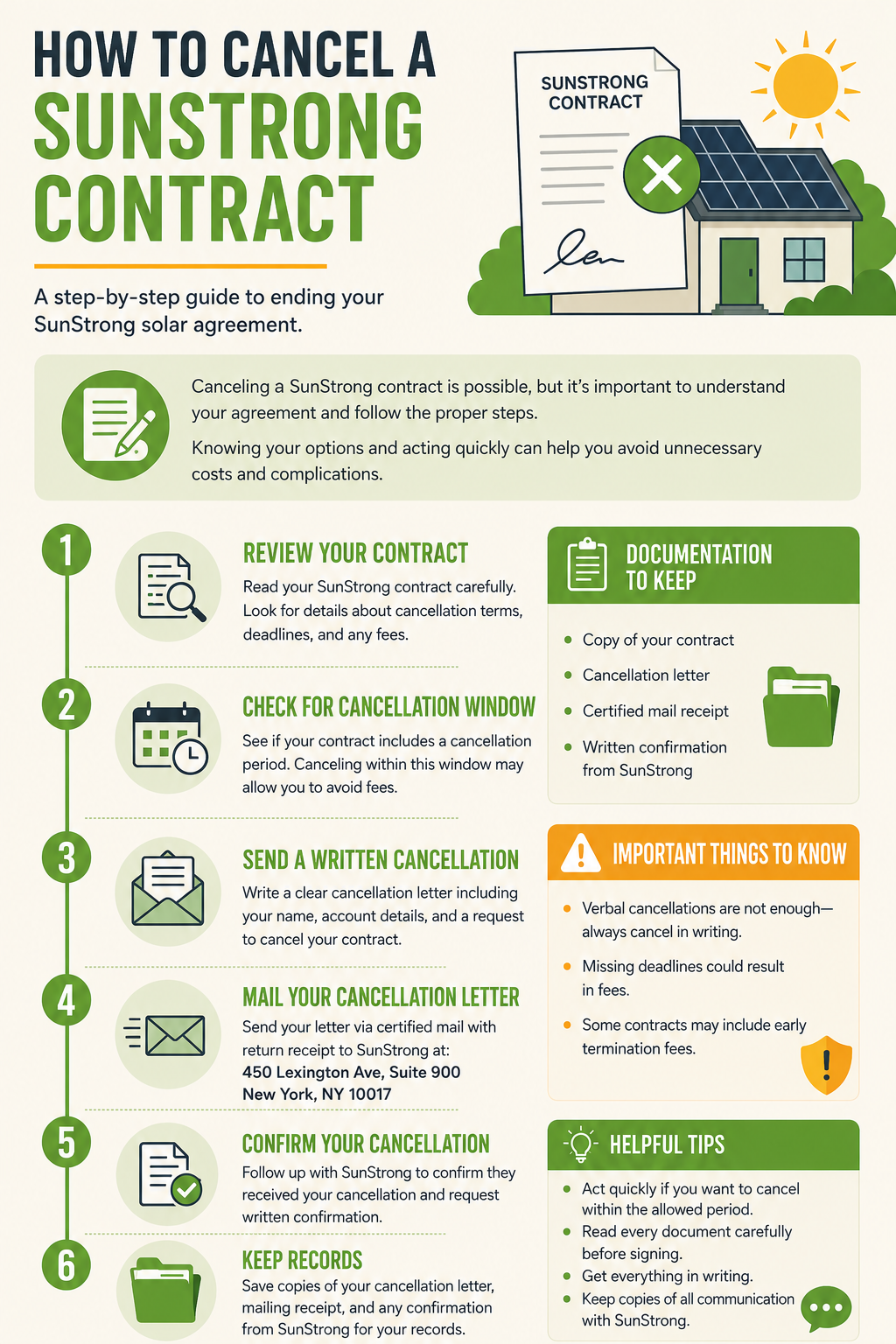
Can You Cancel a Contract Now Managed by SunStrong
Possibly. But the fact that SunStrong took over isn’t enough on its own to answer that question.
SunStrong says it manages your original customer agreement and handles servicing for the life of that contract. It also tells transitioned customers that their financing terms generally stay the same.
So your options depend first on the agreement you already had. Before you go further, check a few things:
- Who originally sold or financed your system
- Whether you have a lease, a loan, or a PPA
- What your contract says about cancellation or ending the agreement early
- Any buyout or transfer clauses
- When and how you originally signed
- Whether your problem is about the original sale, or about how SunStrong is servicing your account today
For example, a homeowner who wants out because a salesperson allegedly misled them about financing has a very different case than someone disputing a new SunStrong monitoring fee.
Who Is Responsible for Your Agreement Now
This is one of the most confusing parts of a SunStrong dispute, so it’s worth slowing down here.
SunStrong sorts customers by who originally set up their agreement. Its account system has separate paths for SunPower, Sunnova, PosiGen, and GoodLeap customers, and it tells people who aren’t sure to check their original contract or an old bill.
But more than one company can be involved in a single solar system. Here’s a simple breakdown of who typically handles what:
| Party | Why it matters to your problem |
| Original seller or originator | Connected to sales promises and the original contract |
| Installer | Usually responsible for installation problems |
| Lender or asset owner | Holds financing or ownership rights |
| SunStrong | Usually handles billing, collections, transfers, support, or covered maintenance |
| Equipment manufacturer | May still matter for certain product warranties |
Don’t assume SunStrong has become every one of these parties just because its name is now on your account. In fact, SunStrong tells customers with installation problems to go straight to their original installer. It also says it doesn’t provide maintenance for loan customers or for people who own their system outright.
Finding the right company before you file a cancellation request can save you a lot of time. You won’t end up arguing the right problem with the wrong business.
Did the SunPower or Sunnova Bankruptcy Cancel Your Agreement
No, not automatically. Neither bankruptcy filing canceled every homeowner’s agreement on its own.
What happened to your specific contract depends on its terms, and on how it (or the assets tied to it) moved through the bankruptcy and later transfers.
SunStrong’s current guidance says that once an account moves to SunStrong, the original company stops managing it, but the financing terms generally stay in place. The only changes are the ones you would have expected anyway, like a scheduled escalator or a sales tax adjustment.
In plain terms, a company going bankrupt does not mean your contract with them is canceled. The more useful questions to ask yourself are these. Was your agreement transferred? Who services it now? Who owns it? Who handles repairs and warranties? And what does your contract still say about canceling, buying out, or transferring the agreement?
Do You Actually Need Cancellation, or Something Else
A lot of people search for “cancel” when what they really need is cancellation. It helps to match your actual problem to the right fix.
| Your situation | What to look into |
| You want the whole agreement ended | Cancellation or termination rights |
| You want to own the system | Payoff or buyout terms |
| You’re selling the home | Transfer or buyout options |
| The bill looks wrong | A billing or servicing dispute |
| The system needs repair | Service, installer, or warranty responsibility |
| You think the original sale was misleading | A sales or financing dispute |
| You just want to stop paying for monitoring | Cancelling the monitoring subscription |
These paths don’t overlap as much as you’d think. Canceling a paid SunStrong monitoring subscription, for instance, does nothing to your underlying solar loan, lease, or PPA. And a homeowner selling their house may only need to transfer the agreement, not end it.
Does the FTC Three-Day Cancellation Rule Help
It might, but mainly if your original solar sale happened very recently.
The FTC’s Cooling-Off Rule gives you three business days to cancel certain sales made in your home or away from the seller’s regular place of business. It doesn’t apply to everything, though. The FTC says it doesn’t cover sales made entirely online, by phone, or by mail.
If your agreement started with SunPower or Sunnova years ago and only recently moved to SunStrong, here’s the key point: a servicing transfer does not restart the three-day clock.
If you did sign recently, check a few things. The date you signed. Where and how the sale happened. Any cancellation notice that came with your paperwork. And whether your state offers extra protections on top of the federal rule. Don’t assume the three-day rule automatically applies to your contract.
What If the Original Salesperson Misled You
A complaint about your original sale is a different issue from a complaint about how SunStrong services your account today, so it helps to keep them separate.
The Consumer Financial Protection Bureau has flagged risks in residential solar lending, including dealer fees, claims about tax credits, and promises about savings or prepayments. These are industry-wide findings. They don’t mean misconduct happened on your specific account.
If your dispute is about what you were told before signing, hold on to everything tied to that sale:
- The original sales agreement
- Financing paperwork
- Texts or emails from the salesperson
- Pricing or cost sheets
- Your payment schedule
- Any tax credit promises
- Any promised savings or production numbers
For certain credit purchases, the FTC’s Holder Rule can let you raise the same claims and defenses against a new company that you could have raised against the original seller, even after the contract changes hands. But this rule doesn’t create a brand-new claim just because your contract was moved to SunStrong. The underlying problem must already exist, and whether the rule applies depends on how your deal was financed. Don’t assume SunStrong is automatically the legal “holder” of your credit contract just because it services your account.
What If Your System Isn’t Being Repaired
Start by figuring out what kind of SunStrong customer you actually are, since the answer varies widely depending on your contract type.
SunStrong takes support requests from residential lease, loan, and PPA customers it manages. But its support page draws firm lines around who’s responsible for repairs. If your original agreement is a PPA rather than a loan or lease, SCC’s guide to getting out of a solar PPA explains how repair and performance responsibilities typically work under that structure.
If you have a lease or a PPA
Look at your original agreement to see who’s responsible for maintenance, repairs, monitoring, performance, and warranties. Then compare that to the actual problem you’re facing. If the dispute centers on your system not making the electricity it was supposed to, SCC’s solar production guarantee guide explains how those guarantees are typically enforced and what evidence supports a claim.
If you have a solar loan
SunStrong currently says it does not provide maintenance for loan customers. Installation problems should go to your original installer instead. That makes it especially important to know who installed your system and what equipment warranties apply.
If you own your system outright
SunStrong says the Company doesn’t manage customers who paid cash and don’t pay SunStrong anything and likely won’t receive help from the company. So a broken inverter or a failed installation for a cash system usually isn’t a SunStrong cancellation issue at all.
What If You’re Selling or Refinancing Your Home
If a SunStrong-managed system is holding up a home sale or refinance, check your contract’s transfer and buyout terms before you try to cancel the whole agreement.
SunStrong says handling home-sale transfers is part of its job, and it has a process built specifically for these requests, including a separate path for former SunPower customers.
Before you close on a sale, check whether your agreement allows a transfer, whether the buyer must go through an approval process, whether a buyout is available, what paperwork SunStrong requires, and whether refinancing imposes any additional requirements. Don’t assume every former SunPower, Sunnova, PosiGen, or GoodLeap agreement works the same way.
What to Check Before Asking SunStrong to Cancel
You don’t need to build a legal case before reaching out. You do need to know exactly what agreement and what problem you’re dealing with.
Find the original agreement. Check whether it came from SunPower, Sunnova, PosiGen, GoodLeap, or another company. SunStrong itself suggests checking your original contract or an old bill if you’re not sure.
Confirm the contract type. Is it a lease, a loan, or a PPA?
Get specific about the problem. Are you asking SunStrong to fix a bill, process a transfer, provide a payoff amount, resolve a service issue, or end the agreement entirely?
Keep the right records. A billing dispute needs your bills and payment history. A sales dispute needs your original sales paperwork. A repair dispute needs your service requests and warranty documents.
Use the right channel. SunStrong routes billing questions based on who originally sold you the system, and other issues go through its general support process. Whatever you send, keep a copy of it and of the response you get back.
What If SunStrong Doesn’t Resolve Your Problem
Where you go next depends on what’s still unresolved.
For a financing or servicing issue, the Consumer Financial Protection Bureau is a good place to file a complaint. If you believe you were misled during the original sale, your state Attorney General or consumer protection office may be the right contact. Installation or contractor issues often fall under your state’s contractor licensing board.
And if the real question is whether your contract can legally be canceled, that answer usually comes down to the exact wording of your agreement, your state’s laws, how the deal was financed, and the facts of your original purchase.
One more thing worth saying clearly: don’t just stop paying to “cancel.” SunStrong tells transitioned customers to continue making their existing payments unless they receive updated written instructions.
Getting Help With a SunStrong Solar Contract Problem
A SunStrong account can feel confusing, mostly because the company now manages agreements that homeowners originally signed with someone else entirely.
The clearest first step is to separate who’s responsible for what:
Your original provider handles your original agreement. Your installer handles installation problems. Your lender or asset owner holds the financing or ownership rights. SunStrong handles day-to-day servicing and account management.
Once you know where your problem actually sits, it’s much easier to figure out whether you need a cancellation, a transfer, a buyout, a billing correction, a warranty claim, or a different kind of dispute altogether.
Solar Cancellation Companies can help you review your solar agreement’s history and pinpoint exactly what kind of contract or service issue you’re facing, so you know your next practical step before you take any action.
This article shares general consumer information. It is not legal, tax, or financial advice. Your rights depend on your own agreement, your state’s laws, how your system was financed, and your specific situation.
Frequently Asked Questions
1. How do I know if SunStrong actually manages my solar account?
Check your original contract, an older bill, or communications from SunStrong. SunStrong can also confirm whether your account was transferred to its management.
2. Where do I pay my bill after my account moves to SunStrong?
Your payment portal depends on the company that originally managed your system, such as SunPower, Sunnova, PosiGen, or GoodLeap.
3. Can SunStrong help if I already paid off or own my solar system?
Usually not with maintenance. SunStrong says it does not provide maintenance for customers who own their systems outright, including paid-off systems.
4. Does moving to SunStrong change my monthly payment?
SunStrong says existing financing terms remain unchanged, except for changes already allowed by the contract, such as scheduled escalators or applicable sales-tax changes.