
Trying to cancel a Blue Raven Solar contract is more complicated than sending one notice. Blue Raven’s former owner entered bankruptcy, and the company that bought selected assets did not take responsibility for every older project. Your options now depend on when you signed, whether your system was completed by September 30, 2024, and who financed it. Start by checking your cancellation notice, project completion date, installation agreement, and lender’s name. These details show which company you need to contact first.
Who Is Responsible for Your Blue Raven Contract Now?
Blue Raven Solar was previously owned by SunPower Corporation. In August 2024, SunPower Corporation and affiliated businesses, including Blue Raven Solar LLC, entered Chapter 11 bankruptcy proceedings.
Complete Solaria then purchased selected assets connected to Blue Raven Solar, SunPower’s New Homes business, and its non-installing dealer network. The bankruptcy court approved the sale in September 2024, and the transaction closed on September 30, 2024. Complete Solaria later changed its corporate name to SunPower Inc.
This was an asset sale, not a transfer of every Blue Raven obligation. The current SunPower says it did not assume liabilities tied to Blue Raven projects completed on or before September 30, 2024. However, it agreed to bring most projects that were still unfinished on that date to completion.
That date should guide your first step:
| Your situation | Where to start | What to confirm |
| You recently signed with the current Blue Raven operation | Contact listed in your agreement | Cancellation deadline and notice method |
| Your project was unfinished on September 30, 2024 | Current Blue Raven/SunPower | Whether your project was included in the acquired business |
| Your project was completed by September 30, 2024 | Named lender, warrantor, or manufacturer | Who controls each remaining obligation |
| Your loan is active or in dispute | Current loan holder or servicer | Funding status and dispute process |
| You signed a lease or PPA | Financier or system owner | Current owner, servicer, and contract options |
Do not rely only on a Blue Raven logo printed on an old proposal. Check the legal names in the contract signature block, financing statement, warranty certificate, and any assignment notice you received.
Can You Still Use the Three-Day Cancellation Rule?
The FTC Cooling-Off Rule gives some consumers three business days to cancel qualifying sales made at their home, workplace, dormitory, or a seller’s temporary location. It can also cover a sales presentation that you invited into your home.
This rule may apply if a Blue Raven salesperson completed the sale at your home. It does not cover every solar agreement. Transactions completed entirely online, over the telephone, or at the seller’s permanent business location are generally outside this federal rule.
If you signed recently, find the Notice of Cancellation in your documents. Confirm where the sale took place, calculate the deadline, and follow the delivery instructions exactly. Under the federal rule, Saturday counts as a business day. Sundays and federal holidays do not.
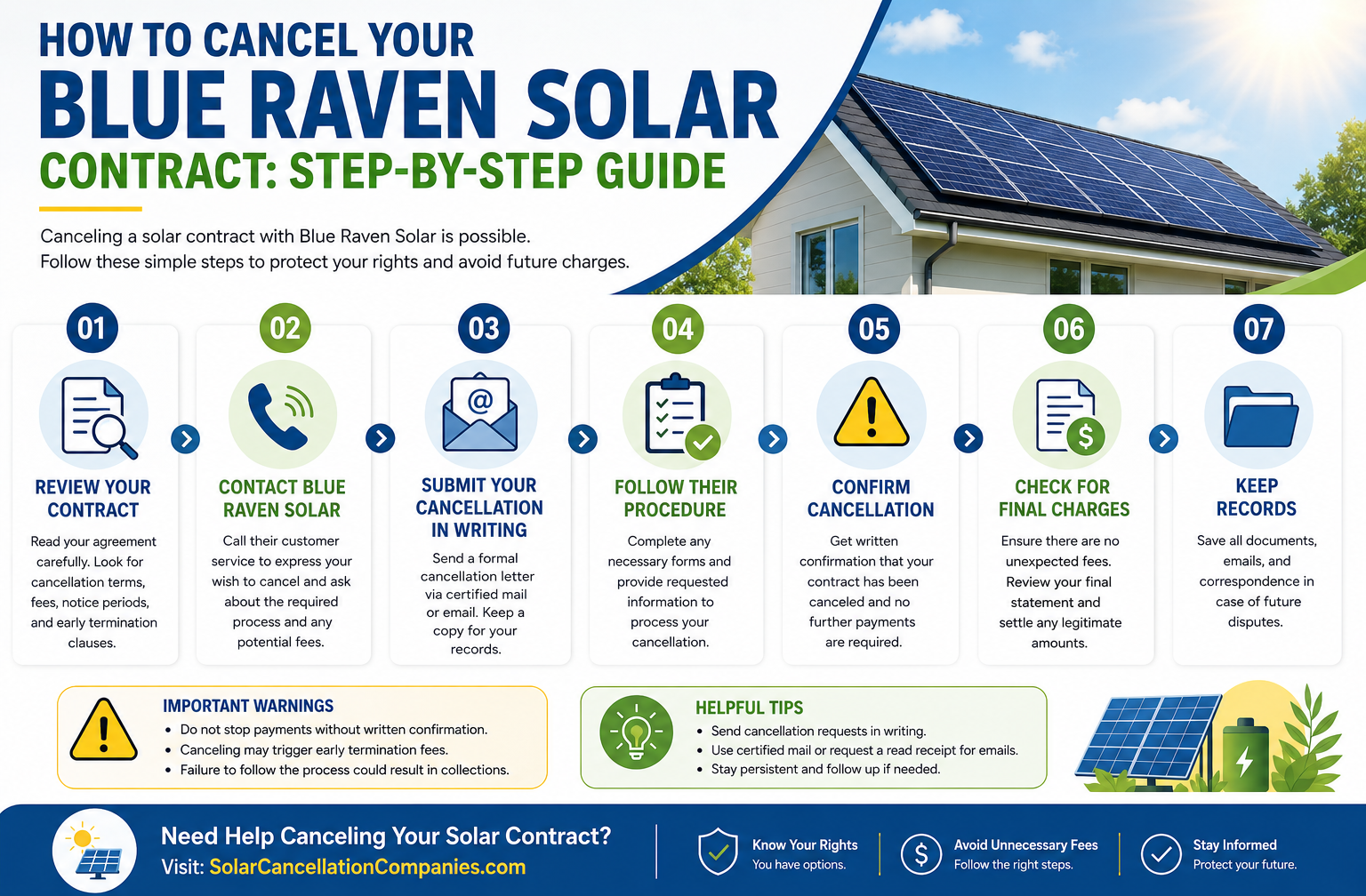
Send the notice before the deadline and keep proof of delivery. If you also signed a financing agreement, notify the lender separately and request written confirmation that no funds will be released.
State law or your Blue Raven agreement may offer additional rights. However, you should not assume every homeowner receives the same three-day period. SCC’s door-to-door solar cancellation guide explains when the federal rule may apply.
What If Blue Raven Has Not Installed the System?
If installation has not started, first determine how far the project has moved. A signed agreement with no site work is different from a project where Blue Raven has completed the design, obtained permits, or ordered equipment.
Send your cancellation request to the address listed in your agreement. Ask Blue Raven to confirm whether it accepts the cancellation and whether it claims any project costs. If the company demands payment, request an itemized statement showing the completed work and the contract clause supporting the charge.
An unfinished project from 2024 needs an extra check. The current SunPower says it intended to finish most Blue Raven projects that remained incomplete when the asset sale closed. That does not prove that your individual project was included. Ask the company to confirm your project status in writing.
You should also contact the lender. Ask whether the loan was only approved or whether funds were already sent to Blue Raven. If funds were released, ask what documents triggered payment and what must happen before the account can be closed.
Blue Raven may cancel its installation agreement without closing your financing account. Do not rely on confirmation from only one company.
What If the Panels Are Already Installed?
After installation, “cancellation” may not describe the remedy you actually need. The next step depends on whether the project is unfinished, defective, underproducing, or simply delivering less financial savings than expected.
If the panels are installed but the system never received permission to operate, check the permit, inspection, and utility interconnection records. Find out whether the installation passed inspection and whether the utility approved activation. A system that cannot legally operate may point to incomplete contractual work.
For physical defects, document the exact problem. Roof photographs, inspection reports, repair estimates, monitoring alerts, and written service requests can show what happened more clearly than a general complaint.
Then identify which protection may apply. Equipment failures usually involve the panel or inverter manufacturer. Poor installation or roof damage may fall under a workmanship or roof-penetration warranty. Low output may fall under a production guarantee, but only if the measured production falls below the standard written in that guarantee.
Archived Blue Raven material described a 25-year manufacturer warranty, a 10-year workmanship warranty, and a two-year production guarantee. Older Blue Raven documents referenced different warranty periods. Your own warranty documents therefore matter more than a general statement found online.
Is Low Production the Same as Low Savings?
No. A production problem and a savings problem require different evidence.
A production dispute asks whether the system generated the amount promised under a written guarantee. Compare the guarantee with monitoring records, utility data, outages, equipment faults, and any exclusions in the agreement.
A savings dispute asks whether the system reduced household costs as projected. Your power use, utility rates, fixed charges, and net-metering terms can affect savings even when the system works properly.
If Blue Raven promised a certain result, locate the exact written statement. A sales estimate alone may not create the same obligation as a formal production guarantee. SCC’s solar production guarantee guide explains how to compare the promised output with monitoring records and the guarantee’s claim terms.
What Happens to Older Blue Raven Warranties?
For Blue Raven projects completed on or before September 30, 2024, the current SunPower says it did not assume the related project liabilities.
Its official FAQ directs cash and loan customers with older systems to their lender. Lease and PPA customers are directed to their financier or SunStrong Management. However, this contact routing does not establish who legally owes a repair or warranty obligation. A lender may manage the financing without being responsible for faulty workmanship.
Look at each responsibility separately. Your agreement should identify the company that issued the workmanship warranty. The warranty certificate should name the panel or inverter manufacturer. A separate document may identify the company responsible for a production guarantee or ongoing service.
If the original workmanship provider will not handle the claim, request its position in writing. For equipment failures, use the model and serial numbers to contact the manufacturer directly.
Does Cancelling Blue Raven Cancel Your Solar Loan?
Not automatically.
Many homeowners have one agreement covering installation and another covering financing. Blue Raven may be responsible for the design and construction, while a separate lender controls the loan balance, payments, and credit reporting.
If Blue Raven agrees to cancel, contact your lender and ask whether the loan was funded, whether any money will be returned, and whether a balance remains. Get written confirmation that the account is closed and that future payments or credit reporting will stop.
A funded loan may require a formal dispute rather than a basic cancellation request. Do not stop making payments only because Blue Raven failed to respond. Missed payments can create credit and collection problems while the original dispute remains unresolved.
The FTC Holder Rule may allow some consumers to raise seller-related claims and defenses against the holder of a qualifying consumer credit contract. Check your financing documents for the FTC Holder Notice. The rule does not cover every loan or automatically erase the balance. Its use depends on the financing agreement and the underlying claim.
The SCC solar contract cancellation guide explains how an installer agreement and a separate financing contract can affect each other.
Were the BluePower Plus+ Costs Explained Correctly?
Blue Raven promoted financing through programs including BluePower Plus+. If your payment or total cost differs from what the salesperson presented, compare the proposal with the signed loan documents.
Focus on the cash price, amount financed, finance charge, initial monthly payment, later payment, and any payment change tied to an expected tax credit. A large difference between the cash price and financed amount deserves closer review, but it does not prove misconduct by itself.
The CFPB found that some solar lenders included substantial dealer fees or markups in financed amounts. It also identified misleading statements across the solar-financing market about monthly payments, tax credits, and expected savings. These findings do not prove that your Blue Raven transaction was improper. They show which figures homeowners should verify. A homeowner who finds a large gap between the cash price and loan principal can use SCC’s solar dealer fee guide to review how that difference appears in the financing documents.
A federal solar tax credit was not an automatic government payment. Eligibility depended on the tax rules for the year the property was placed in service, qualifying expenses, and the taxpayer’s circumstances. Eligible taxpayers calculated the credit using IRS Form 5695, and the IRS recommends keeping purchase and installation records.
If a salesperson promised a specific refund, compare that statement with your contract’s tax disclaimer, tax return, Form 5695, and loan payment schedule. A tax professional should determine personal eligibility.
What Should You Ask For?
Your request should match the documented problem.
A homeowner inside an applicable cancellation period can request written cancellation. Someone with an unfinished project may need a completion plan or negotiated termination. A defective system may require warranty performance, while a loan opened for a cancelled or incomplete project may require a lender funding review.
If the issue involves older Blue Raven obligations, identify the responsible party before demanding a remedy. Asking the current Blue Raven operation to cancel a loan held by another company will not resolve the financing account.
State the property address, agreement number, project status, and exact result you want. Attach supporting documents and request a written response.
Where Can You Escalate an Unresolved Blue Raven Problem?
Send the complaint to the agency that oversees the part of the transaction causing the problem.
The Consumer Financial Protection Bureau accepts complaints involving consumer loans and servicing. Suspected deceptive sales conduct can be reported to the Federal Trade Commission and the homeowner’s state attorney general. Installation and contractor-licensing concerns usually belong with the state contractor regulator. Utility interconnection issues may require contact with the utility or state utility regulator.
The CFPB can route eligible complaints to financial companies for review and response. Government complaints may also create a useful record. However, filing a complaint does not automatically cancel a contract, pause loan payments, or award compensation.
Get the Right Blue Raven Contract Help
Before seeking help, gather your installation agreement, financing documents, cancellation notice, BluePower Plus+ proposal, project completion date, permit and inspection records, warranties, monitoring data, and written communications.
Solar Cancellation Companies helps homeowners compare reviewed companies that handle solar contract, financing, installer, and warranty disputes. A document-based review can show whether your next step should involve Blue Raven, the current SunPower operation, a lender, a manufacturer, or another responsible party.
This article provides general information and is not legal, financial, or tax advice. Contract rights and available remedies depend on the homeowner’s documents, transaction, state law, and individual circumstances.
Frequently Asked Questions
Can I Cancel Blue Raven Solar Over Misleading Sales Promises?
Possibly, depending on the evidence and contract terms. Save any emails, texts, proposals, or written claims that conflict with your signed agreement.
What if Blue Raven Cancelled My Project but the Loan Is Still Active?
Contact the lender directly. Ask whether funds were released, returned, or still remain due. Installer cancellation does not automatically close a separate loan.
Can I Sell My Home With a Blue Raven Solar Loan?
Usually, the loan terms determine what happens. Check for payoff, transfer, or sale requirements before listing the property.
Who Handles My Blue Raven Warranty Now?
Check your original warranty documents. The workmanship provider, equipment manufacturer, lender, and current SunPower operation may each handle different obligations.