

If you signed a contract with Vivint Solar years ago, there is no single rule that tells you how to get out of it. Sunrun bought Vivint Solar back in 2020, but older contracts, whether they were leases, power purchase agreements, or purchase plans, can each work differently. Before you agree to any payoff or try to cancel anything, you need to know what type of agreement you have, when you signed it, who services it now, and which clause actually applies to you.
Who Actually Handles My Old Vivint Solar Contract Now
Sunrun finished buying Vivint Solar on October 8, 2020. Since then, Vivint Solar has operated as a fully owned part of Sunrun, and it still shows up that way in Sunrun’s most recent public filings.
That’s why your paperwork might say “Vivint Solar” at the top, while your bills, service messages, or home sale paperwork now come from Sunrun.
This buyout doesn’t mean you can ignore the contract you originally signed. That document is still the first place to look for your rights.
Before you ask anyone for a cancellation or a payoff number, figure out four things:
- Who you originally signed with, meaning the Vivint entity named on your contract.
- Who services the account today, the company currently handling your payments and service requests.
- Who owns the system, which matters most if you have a lease or a power purchase agreement.
- Whether a separate lender is involved, which applies if you financed a system purchase through another company.
If your main issue is really about how Sunrun is handling things day to day, rather than the old Vivint paperwork itself, our guide on cancelling a Sunrun contract covers that separately.
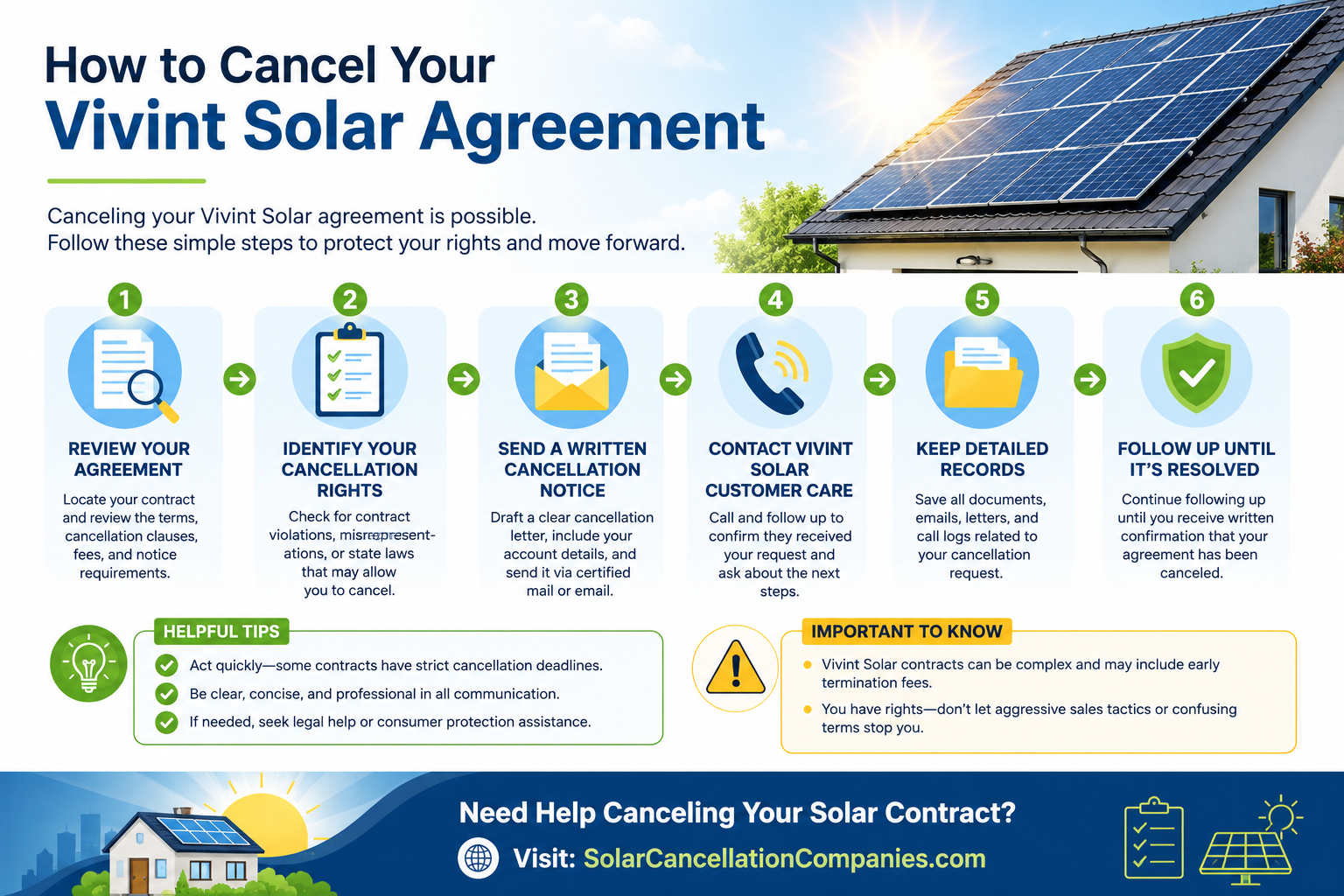
Figuring Out Which Type of Vivint Contract You Signed
Vivint Solar didn’t use one standard contract for every customer. Filings the company made with securities regulators describe several different agreement types, including 20- and 25-year power purchase agreements, 20- and 25-year leases, straight purchase agreements, and separate maintenance contracts.
| Agreement type | What to check first | Terms worth reading closely |
| Power purchase agreement | Contract date and version number | Transfer, prepayment, purchase, default |
| Solar lease | Lease length and who owns the system | Assignment, home sale terms, end of term |
| System purchase agreement | Whether you paid outright or financed it | Purchase terms, warranty, financing |
| Purchase with a separate loan | Which lender services the loan | Payoff amount, default terms, disputes |
Don’t assume your neighbour’s Vivint contract works the same way yours does, even if you signed around the same time.
Vivint’s own filings show it used different contract versions over the years. One filing from 2013 mentions “Version 2.6” agreements used in several states, and later court cases looked at both older and newer versions still in use after that.
So read through your own contract for language about transfers, home sales, prepayment, buying the system, default, and how disputes get resolved. That’s the language that actually governs your situation.
What Kind of Exit Might Your Contract Actually Offer
When someone says they want to “cancel” a Vivint contract, what they often need is one of several different remedies built into the agreement. Confusing these can cost you real money.
Transfer, prepayment, buying the system, and ending the contract through default are four different outcomes. They are not interchangeable, even though a salesperson or call centre rep might use the words loosely.
A federal case called Dekker v. Vivint Solar is useful here, not because it applies to every customer, but because it shows how much these contracts changed over time. The case dealt with older and newer generations of Vivint’s power purchase agreements, and the terms in each generation weren’t identical.
That case proves Vivint’s contract language shifted across the years. It does not mean the specific terms from that lawsuit apply to your contract.
Before you pay anyone a cent to exit your agreement, ask for three things in writing: the exact clause that allows the charge, how the amount was calculated, and what changes about your obligations once you pay it.
Specifically, find out whether the payment:
- only prepays your remaining service,
- actually transfers ownership of the equipment to you, or
- fully ends your obligations under the contract.
A word like “buyout,” said over the phone, doesn’t guarantee all three of those things happen. Get it in writing before you pay.
Did the Dekker Lawsuit Change My Contract
Only a specific, limited group of older Vivint customers were affected by the Dekker settlement. It covered customers with early-version power purchase agreements signed around 2012 and 2013, and the number of people covered was relatively small compared to Vivint’s full customer base.
For that specific group, the settlement changed how much it would cost them to buy their system if they defaulted, lowering it from the original pricing formula in their contract. The court that approved the deal was clear that this only applied to that one group of customers with that one contract version.
This does not mean every Vivint customer, or even every customer with an older contract, can use that same pricing to buy their system.
It also doesn’t mean a court ruled that Vivint’s termination fees are illegal across the board. The court’s approval order specifically said it wasn’t making a finding on whether those default charges were unlawful.
If your agreement dates back to 2012 or 2013, check your paperwork to see if it’s labelled as an early version before assuming this settlement has anything to do with you. If you think it might, ask the settlement administrator or a lawyer for the exact terms rather than relying on numbers you’ve seen repeated online, since the precise formula and eligibility details are specific to that case.
The 2026 California Settlement Is Worth Checking Too
If you live in California, there’s a newer development that older cancellation guides won’t mention.
On February 19, 2026, district attorneys from Riverside, San Diego, Alameda, Fresno, and San Francisco counties announced a $4.3 million settlement with Vivint Solar. It covers residential power purchase agreements signed between August 3, 2016 and October 8, 2020. Vivint agreed to the judgment without admitting wrongdoing, and Sunrun was not named as a party.
The settlement sets aside $3 million specifically to pay back eligible California customers. Vivint is required to notify people who may qualify and to post information about the claims process on both the Vivint and Sunrun websites.
What the Settlement Actually Claims
Prosecutors alleged that Vivint misrepresented its relationship with local utility companies, overstated the savings or costs customers could expect, and misled people about their ability to cancel. The judgment also puts limits on how Vivint can use consumer credit reports, requires contract translations in some cases, and restricts unlawful liquidated damages provisions going forward.
What a California Homeowner Should Do
Start by checking the date on your contract. If you signed a Vivint power purchase agreement between August 2016 and October 2020, you may be eligible for restitution under this settlement.
Don’t assume you qualify just because you have a Vivint system. And keep this settlement separate in your head from the older Dekker case. They involve different time periods, different customers, and different legal claims.
Selling a Home With a Vivint Solar System Attached
Selling a house with an old Vivint agreement is exactly where people mix up transfer, prepayment, and purchase, so it’s worth slowing down here.
Sunrun currently runs a transfer process where the seller and buyer both provide information, sign paperwork, and the buyer goes through a soft credit check. This is the operational process today, separate from whatever your original 2013 or 2018 Vivint contract actually says.
Sunrun’s own filings state that, generally speaking, a seller can either transfer the agreement to the buyer (if the buyer qualifies) or buy out the system themselves. Sunrun also says sellers sometimes have the option to prepay the remaining balance instead.
If your buyer doesn’t want to take on the solar agreement, prepaying might let the sale go through with the system staying on the roof and running on the remaining contract term. But prepaying isn’t the same as owning it outright, so don’t assume the equipment becomes yours just because you’ve paid ahead.
Before you close on the sale, get clear on exactly what any quoted number covers: is it an assignment, a prepayment, a full purchase, or something else specific to your contract? Don’t let a salesperson or closing agent use these words interchangeably, because they lead to very different outcomes for you.
Is a UCC Filing Holding Up Your Sale or Refinance
Don’t assume every solar-related filing on your property title is a mortgage lien, because it usually isn’t.
Sunrun says it doesn’t place a lien on your home under its standard contracts, but some properties do have a UCC filing or a similar notice connected to the solar equipment. Sunrun says these can often be temporarily removed as part of a transfer.
For an old Vivint system, the smart move is to get the actual document from your title company or lender rather than relying on what someone calls it over the phone. Compare that document against your original Vivint contract and your current Sunrun account.
Titles get held up more often by confusion over labels than by the filings themselves, so pull the paperwork first.
Is This Really About Cancellation, or a Dispute Over What You Were Told
Sometimes what feels like wanting to cancel is really about the contract not matching what you were promised when you signed it.
Sometimes what feels like wanting to cancel is really about the contract not matching what you were promised when you signed it.
The FTC recommends reviewing your solar contract for the costs, payment terms, any performance guarantees, tax credit assumptions, maintenance responsibilities, early termination fees, and what happens if you sell your home. It’s also worth comparing what’s written down against what the salesperson told you at the time.
If you’re dealing with an older Vivint dispute along these lines, hold onto your signed contract, any sales materials, and texts or emails that back up what you were told. The 2026 California settlement makes this extra relevant if your contract falls in that August 2016 to October 2020 window, since the allegations there covered exactly this kind of mismatch between promises and paperwork. If the sales pitch and paperwork do not match, SCC’s solar contract misrepresentation guide explains how to organise that evidence. Keep in mind that disagreeing with how you were sold something doesn’t automatically cancel your contract on its own. What you can actually do depends on your specific facts, your agreement, and the evidence you have.
What If the System Just Isn’t Performing Well
Poor solar output doesn’t automatically give you a way out of the contract either.
The FTC suggests checking whether your agreement guarantees a minimum amount of energy production, who’s responsible for repairs, and what happens if the system underperforms. Read the maintenance and remedy language in your actual contract rather than assuming low output alone cancels anything.
What Happens If You Just Stop Paying
Stopping payments doesn’t cancel your contract. It usually just triggers whatever default terms are written into it.
The Dekker case came about partly because of disagreements over Vivint’s default terms, and those terms weren’t the same across every contract version Vivint used. So before you consider withholding payment, find out exactly what your contract says happens next, including whether you get a notice period or a chance to catch up before anything more serious kicks in.
If what you actually owe is a separate solar loan rather than a lease or power purchase agreement with Vivint itself, the rules are different again. Our guide on what happens if you stop paying a solar loan or lease covers that separately.
Arizona Has Its Own Settlement Process
If you’re in Arizona, there’s a separate route worth knowing about.
The Arizona Attorney General reached a consent agreement with Sunrun and Vivint Solar that the court approved on May 22, 2025. It gives eligible customers options like restitution, repairs, or changes to their service contract. Sunrun and Vivint didn’t admit to the state’s allegations as part of the deal.
The agreement spells out its own definition of an eligible complaint and its own process for filing one. It’s not a blanket cancellation right, and filing a complaint doesn’t guarantee your agreement gets cancelled.
If you’re in Arizona and think you have a qualifying issue, go through the official process listed on the Attorney General’s website rather than relying only on regular customer service. And keep in mind this settlement is separate from both the Dekker case and California’s 2026 restitution fund.
What to Get in Writing Before You Choose an Exit
Before accepting any transfer, purchase, prepayment, or termination number from Vivint or Sunrun, work through this list.
- Get your complete signed agreement, including any amendments or later paperwork.
- Identify the contract type and version, noting the signing date and which Vivint entity you signed with.
- Confirm who services your account today by comparing your original paperwork with your current Sunrun statements.
- Get clear on what you actually need, since a home sale, a system purchase, a sales dispute, and a performance issue all call for different solutions.
- Ask which clause authorises any quoted charge before you agree to pay it.
- Ask for the calculation in writing, rather than trusting a number someone else with a different contract received.
- Confirm what happens after you pay, including whether the contract ends, ownership transfers, or any filing on your title gets removed.
- If you’re in California or Arizona, check whether one of the current state settlements applies to you before assuming the standard contract process is your only path forward.
Frequently Asked Questions
Can Sunrun cancel my old Vivint Solar contract?
Not automatically. Buying Vivint Solar didn’t give Sunrun a blanket right to cancel legacy agreements. What you can do depends on your original contract and any settlement that applies to you specifically.
Is a Vivint Solar prepayment the same as buying the system?
No. Prepaying covers your future service payments, but it doesn’t necessarily transfer ownership of the equipment. Always ask directly whether a quoted amount buys the system or just pays ahead on service.
Can I transfer my Vivint Solar agreement when I sell my house?
Often, yes, though the exact right depends on your contract. Sunrun runs a current transfer process involving the buyer, seller, and a credit check, but it’s worth comparing that against what your original agreement says about home sales.
Does the 2026 California settlement cancel my PPA automatically?
No. It sets up a $3 million restitution fund for eligible customers who signed qualifying contracts between August 2016 and October 2020. It doesn’t cancel contracts on its own, and eligibility depends on the specific claims process.
Need Help Making Sense of Your Vivint or Sunrun Contract
Between the original Vivint paperwork, Sunrun’s current processes, home sale requirements, financing, and now several separate settlements, it’s easy to lose track of what actually applies to you.
Solar Cancellation Companies helps homeowners work through exactly this kind of tangle. We can help you identify which agreement you actually signed, organise your records, compare any transfer or payoff offer against your contract’s own language, and figure out whether your issue involves Vivint or Sunrun servicing, a separate lender, a state settlement, or something else entirely.
The goal isn’t to promise a cancellation your contract doesn’t actually allow. It’s to help you understand exactly what you owe, who’s responsible for it, and what you need before you take your next step.
This article is general information, not legal, financial, or tax advice. Your specific rights and options depend on your contract, your facts, and the law where you live.