
You signed a solar contract. You trusted the salesperson. You thought your bills would go down. Now something has gone wrong.
Maybe your savings never came. Maybe the installer won’t pick up the phone. Maybe the system barely works. When you asked about your options, someone brought up an arbitration clause. That clause changes everything.
In 2026, most U.S. solar contracts include a mandatory arbitration clause. Most homeowners never notice it. It is buried deep inside long legal papers. Salespeople rarely explain it. But when a problem starts, that clause becomes the most important thing you ever signed.
This article explains what these clauses do, what rights you may lose, and what options may still be open to you.
What Is a Solar Mandatory Arbitration Clause?
A solar arbitration clauses is a contract term. It forces you to settle any dispute through a private process, not through the courts. You cannot skip it or opt out later. You agreed to it when you signed the contract.
How Arbitration Differs From Going to Court
In court, a judge or jury hears your case. The process is open to the public. You can ask for documents and records from the other side. You can appeal the decision.
In arbitration, a private person decides the case. The process is closed. You get very little access to evidence. There is almost no way to appeal. And the solar company has usually done this many times before.
Where Arbitration Clauses Show Up in Solar Agreements
You might find one in more than one place. Understanding what type of solar agreement you signed is the first step, because arbitration terms can appear differently across loans, leases, and PPAs:
- The main installation contract
- The solar loan or finance agreement
- The lease or power purchase agreement (PPA)
- A separate document attached at signing
Your installer contract and your lender agreement may each have their own mandatory arbitration solar contract clause. That means two separate arbitration rules in one deal.
Common Terms Hidden Inside These Clauses
Look for these when you read your contract:
- Binding arbitration: The decision is final. You cannot fight it in court
- Jury trial waiver: You give up your right to a jury
- Class action waiver: You cannot join other homeowners in one lawsuit
- Venue rules: The arbitration may happen in another state
- Cost-sharing: You may have to pay fees even if you win
Why Solar Arbitration Clauses Matter More Than Most Homeowners Realize
Rights You May Be Giving Up
When you agree to a solar arbitration clause rights waiver, you may lose the ability to:
- Sue in state or federal court
- Ask for a jury trial
- Join a class action lawsuit
- Have a public hearing
- Get full access to company records and evidence
- Appeal a decision that went against you
These are the main tools people use to hold big companies responsible. Giving them up is a big deal.
How Arbitration Can Change the Outcome
Studies show that companies win arbitration cases against consumers at a higher rate than in court.
Arbitrators often depend on repeat business from corporations. That creates a tilt. The solar arbitration agreement risks are real. Most homeowners only find out after a problem has already started.
The Link Between Arbitration and Class Action Waivers
If a solar company misled thousands of people with the same sales pitch, a class action can be a powerful tool.
Arbitration clauses usually kill that option. Every homeowner has to fight alone. That is exactly what these companies want.
The Real Problems That Lead to Solar Arbitration Disputes
Promised Savings That Never Came
Sales reps often said solar would cut or wipe out your electric bill. For many homeowners, that never happened.
Bills stayed high. Loan payments added on top. Many ended up paying more each month than before they got solar.
The CFPB found that some solar loans inflate costs by 30 percent or more compared to what homeowners were told at signing.
Misleading Sales Claims
Federal agencies have reported a 746 percent rise in solar complaints since 2018. Thousands of homeowners say they were misled.
The FTC has warned about offers like “free solar panels” and “zero electric bill” claims that were never based in reality.
Delayed or Incomplete Installs
Some homeowners are still paying loan bills on systems that were never fully put in or approved by local inspectors.
Once the solar contract dispute process kicks off, the arbitration clause takes over. From that point, you are in a private process with limited options. Homeowners dealing with companies like Sunnova, Sunrun, and Freedom Forever have faced exactly this situation.
Equipment That Does Not Work as Promised
Panels that fall short of their output targets. Inverters that fail in the first year. Monitors that go dark.
When gear does not meet the specs you were sold, a solar contract legal review may show you have options. But acting on those options may mean going through arbitration.
Loans That Became Too Expensive
Many solar loans have rate increases built in over time. Monthly costs grow. Some homeowners were never clearly told this would happen. If your loan is through GreenSky, GoodLeap, or Mosaic, each of those lenders has specific terms worth reviewing.
Trouble Selling Your Home
A home with an active solar loan or PPA can be hard to sell. Some buyers do not want to take on payments they did not choose. If a dispute comes up during the sale, arbitration may control how it is handled.
Can You Still Cancel a Solar Contract That Has an Arbitration Clause?
What Arbitration Does and Does Not Block
An arbitration clause does not automatically stop you from canceling your solar contract. It controls how disputes are settled. It does not remove your right to exit. These are two separate things, even though people often mix them up.
Contract Cancellation vs Arbitration
If you want to cancel a solar contract and the company says no, the fight over whether you can cancel may then go to arbitration.
Your right to cancel depends on your contract terms, your state laws, and the facts of your case. Our solar exit guides cover cancellation paths for many of the most common solar companies and contract types.
State Laws That May Still Protect You
Some states have solar contract cancellation options written into law. A private contract cannot take those away.
Texas is one example. The state has a Deceptive Trade Practices Act. New Texas rules go into effect on September 1, 2026. They require new disclosures for all residential solar sales. Other states may have rules worth checking too. Our solar state laws page covers current homeowner protections across all states, including what your state allows that overrides private contract terms.
Common Myths About Cancellation
Many homeowners believe that once they sign, they are stuck. That is not always true. False promises, fraud, incomplete work, or state law may give you a path to cancel or void the deal. It depends on the facts.
When an Arbitration Clause May Not Hold Up
Fraud and False Promises
If the contract was based on lies or false claims, a court may refuse to enforce the arbitration clause at all. A deal built on deception may not bind you to any of its terms.
Hidden or Unclear Terms
In the California case Cabatit v. Sunnova Energy Corp. (2021), a court ruled the arbitration clause was not valid. The homeowners were never told it was there. They never got a copy of the contract.
The court said the clause was unfair on more than one count. This case still matters today.
One-Sided Contract Language
In that same case, the clause made the homeowners go to arbitration for their claims. But it let Sunnova sue in court for its own claims. The court found no good reason for that gap. Clauses that work only one way can be challenged.
Improper Signing
Were you rushed into signing? Was the contract in a language you do not speak well? Did you never get a copy? These facts can matter when a court decides if the clause is valid.
State Law Exceptions
Some states limit how arbitration clauses can work in consumer deals. US solar contract arbitration laws are not the same in every state. A solar arbitration lawyer near you can help you find out what rules apply in your state.
What Happens During Solar Arbitration?
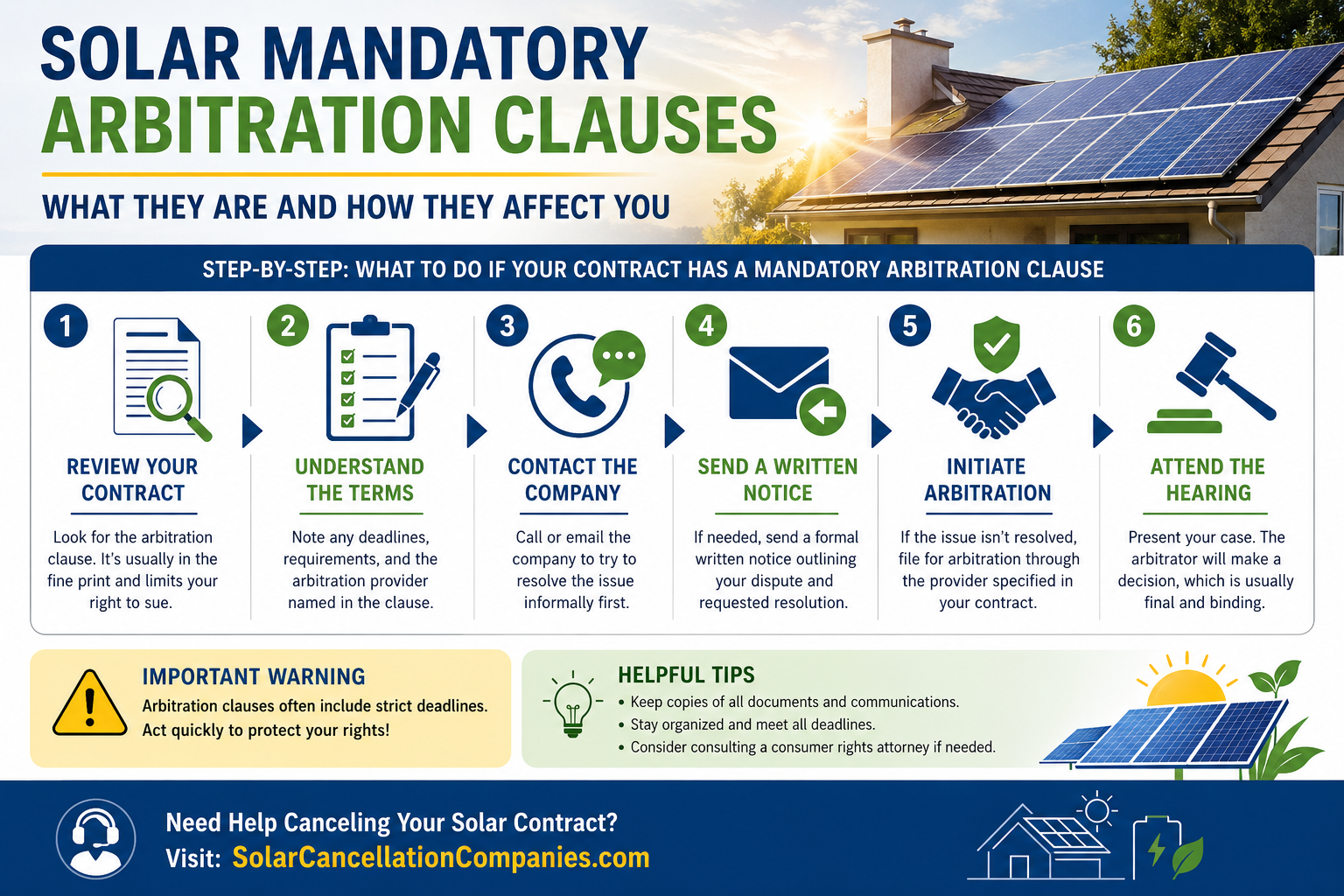
Here is the basic solar dispute resolution timeline once arbitration begins:
- Both sides check the rules and pick a forum, often AAA or JAMS
- You file a demand and pay any required fee
- Both sides rank and remove names until a neutral arbitrator is chosen
- Each side shares records, though access is limited compared to court
- The hearing is held in person or by video
- The arbitrator issues a final decision, usually 30 to 60 days after the hearing
Delays are common. If the other side does not pay their arbitration invoice on time, your case can stall for three to five months or more.
How Much Does Solar Arbitration Cost?
The solar contract arbitration cost is often higher than people expect. Here is a real look at what you might face:
| Cost Type | Typical Range |
| Filing fee (AAA consumer) | $200 to $300 |
| Filing fee (AAA construction) | $1,250 or more |
| Admin fees | $1,000 to $3,500 |
| Arbitrator fees | $3,000 per day or more |
| Attorney fees | $5,000 to $30,000+ |
| Expert witness costs | $1,500 to $10,000+ |
| Total (simple case) | $2,000 to $6,000+ |
| Total (complex case) | $15,000 to $50,000+ |
Some contracts make you split the fees with the company. Always check who pays what before you file. A few solar companies do cover the filing fee. But not all of them do. The costs of the solar arbitration process can end up being more than the dispute is worth. That is part of why these clauses favor companies.
How Long Does Solar Arbitration Take?
The timeline shifts depending on how complex your case is and whether both sides cooperate.
| Stage | Typical Time |
| Notice of intent and 30-day talk window | 30 days |
| Filing and picking an arbitrator | 4 to 8 weeks |
| Evidence exchange and motions | 2 to 4 months |
| The hearing itself | 1 to 3 days |
| Decision after the hearing | 30 to 60 days |
| Total for a simple case | 6 to 12 months |
| Total for a complex or delayed case | 12 to 24 months or more |
Many cases settle before the hearing ever happens. How fast that occurs depends on your records, the company, and whether you have legal help.
Arbitration vs Lawsuit: Which Gives You More Power?
| Factor | Arbitration | Lawsuit in Court |
| Cost | High; company covers less | Lower fees; attorney costs vary |
| Speed | 6 to 18 months | 1 to 3+ years |
| Evidence rights | Very limited | Full access |
| Class action | Usually blocked by contract | Available |
| Appeal rights | Almost none | Full appeal process |
| Public record | No, it is private | Yes |
| Win rate for consumers | Lower | Higher |
The arbitration vs lawsuit solar choice is not just about money or time. It is about fairness. Courts have rules that protect you. Arbitration has far fewer of them.
Documents to Gather Before Any Solar Dispute
Good records are your best tool. This is true no matter how your case is handled.
Use this solar contract arbitration checklist as your starting point:
- Signed installation contract, all pages included
- Loan or finance agreement, with all riders
- Lease or PPA if you have one
- Written quotes, proposals, and sales materials
- Emails and texts with the sales rep and installer
- Monthly electric bills before and after the install
- Production reports and screenshots from your monitoring app
- Photos of the system and any damage
- Warranty papers and service agreements
- All written contact with your lender
- UCC lien records from your county
Better solar contract dispute documentation means a stronger position in any review or hearing.
Frequently Asked Questions
Can I sue a solar company if my contract has an arbitration clause?
Maybe. An arbitration clause often limits your ability to file a lawsuit in court. However, courts may refuse to enforce the clause if there was fraud, misrepresentation, hidden contract terms, or other legal issues. Each case depends on the facts and state laws involved.
Can I opt out of a solar arbitration clause?
Some solar contracts include an opt-out period, usually within 30 days of signing. If you miss that deadline, the arbitration requirement may become binding. Check your contract carefully to see if an opt-out option exists and what steps are required.
Is arbitration better than going to court for a solar dispute?
It depends on the situation. Arbitration is often faster than a lawsuit, but it usually offers fewer legal protections. Homeowners may have limited access to evidence, fewer appeal rights, and no opportunity to join a class action lawsuit.
How do I know if my solar contract contains an arbitration clause?
Review the sections titled “Dispute Resolution,” “Arbitration,” “Legal Remedies,” or “Terms and Conditions.” Arbitration clauses are commonly included in installation agreements, solar loans, leases, and power purchase agreements (PPAs).
Can I cancel my solar contract even if there is an arbitration clause?
Yes. An arbitration clause does not automatically prevent contract cancellation. It only affects how disputes are resolved. Your cancellation rights may still be protected under state laws, contract provisions, fraud claims, or consumer protection statutes.
Conclusion: Know What You Signed Before a Dispute Starts
Mandatory arbitration clauses are not just small print. They are real contract terms. They can change your options completely when something goes wrong with your solar system.
You may be giving up the right to sue. The right to a jury. The right to join a class action. These are not minor things.
Arbitration can be costly. It can drag on for a year or more. And in 2026, with dozens of solar companies in bankruptcy or already shut down, the stakes are real.
If you have questions about your contract, your arbitration clause, or your cancellation options, Solar Cancellation Companies is a good place to start. Contact Us Today.